How to Write a Resume That Beats the ATS
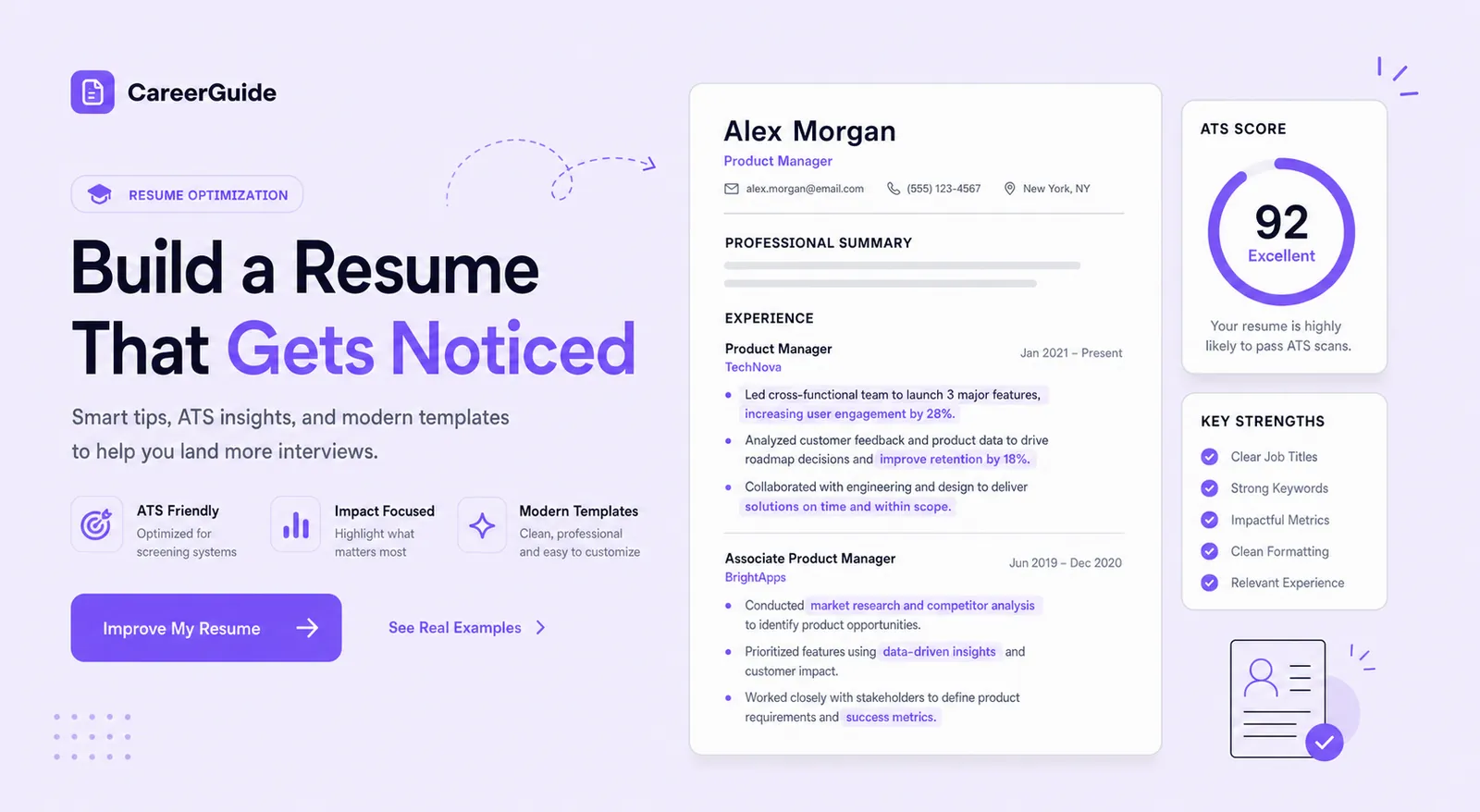
We've read resumes that were gorgeous — custom fonts, a sidebar, a skills gauge chart — and watched them get rejected by an ATS before a person ever saw them. And we've read plain, boring-looking resumes that sailed through and landed interviews. Learning how to write a resume that actually works means learning to design for two readers at once: a piece of parsing software with zero taste, and a recruiter with about seven seconds of patience.
This guide covers what a recruiter actually reads in those first seven seconds, the resume format that survives ATS parsing without looking like a plain-text file, a formula for writing bullet points that show impact instead of just listing duties, how to tailor a resume per role without rewriting it from scratch every time, and an honest look at free tools versus paid resume writers.
One thing to let go of early: a resume's job is not to tell your life story. It's to get you an interview. Every choice below optimizes for that, nothing else.
Get your first tailored resume free
Jobedly rewrites your resume to match a specific job posting's language and requirements in seconds — your first tailored resume is free.
Build a winning resume freeWhat a recruiter reads in 7 seconds
Recruiters skim before they read. In the first pass, they're scanning for job title match, years of experience, and one or two standout signals — not absorbing your full career history. That first-pass skim decides whether your resume gets a real read at all, and it happens fast enough that formatting choices matter as much as content choices.
Put the most important information where the eye lands first: name and target title at the top, a two-to-three-line summary that states your level and specialty in plain language, and your most relevant, most impressive bullet point within the first third of the page. If a recruiter has to hunt for evidence you're qualified, most won't hunt — they'll move to the next resume.
White space matters more than people give it credit for. A page crammed edge to edge with 9-point font signals "I couldn't decide what to cut" before a recruiter reads a single line. Cutting your weakest third of content usually makes the strongest two-thirds land harder, not weaker — density is not the same thing as substance, and a cluttered page actively works against the seven-second scan you're trying to win.
Resume summary examples
A strong summary states role, years of relevant experience, and one or two standout outcomes — no adjectives doing the work that numbers should do. "Marketing coordinator with 4 years running paid social campaigns; grew one client's lead volume 38% in six months" beats "Dynamic, results-driven marketing professional passionate about growth" every time, because the first version is checkable and specific.
If you're unsure how your target title is typically described, the BLS Occupational Outlook Handbook lists standard duties and terminology by occupation, which is a solid gut check before you commit to a specific title and framing in your summary line.
Do I need a resume objective
Almost never, for anyone with any work history. Objectives ('Seeking a challenging role where I can grow...') take up prime real estate saying nothing checkable. A summary that states what you've actually done replaces the objective and works far harder in the same space. The one exception is a true career-change or first-job resume with genuinely no relevant experience to summarize — even then, a short framing statement beats a generic objective.
If you are making a career change and considering an objective for that reason specifically, our guide to changing careers covers how to reframe a resume around transferable skills instead — it's almost always the stronger move over an objective statement, even in a pivot.
Resume format that survives the ATS
Applicant tracking systems parse resumes into structured data — name, dates, titles, skills — before a human ever opens the file. Complex layouts confuse that parsing, sometimes badly enough that your work history shows up scrambled or missing entirely on the recruiter's end, even though it looks fine on your screen.
| Element | ATS-safe choice | Risky choice |
|---|---|---|
| Layout | Single column, top to bottom | Multi-column, sidebars |
| Headings | Standard labels (Experience, Education, Skills) | Creative labels (My Journey, The Toolkit) |
| Contact info | Plain text in the body, not a header/footer | Embedded in a header/footer graphic |
| Fonts | Standard, widely supported (Calibri, Arial, Georgia) | Decorative or script fonts |
| Graphics | None, or minimal and non-essential | Skill gauges, icons standing in for text |
| File type | PDF (text-based, not scanned image) | Image-based PDF or unusual file formats |
This exact topic — what an ATS does, what breaks parsing, and how to test your resume against a real posting — gets a full walkthrough in our companion guide, how to beat applicant tracking systems. If ATS parsing specifically is where you suspect you're losing ground, that's the deeper read.
Bullet points that show impact (formula)
The formula that holds up across almost every field: action verb, plus what you did, plus the measurable result. Duties describe what you were supposed to do. Impact describes what actually happened because of you. Recruiters and hiring managers are scanning for the second one.
- Weak (duty-only): "Responsible for managing social media accounts."
- Strong (impact): "Grew Instagram following from 2,100 to 9,800 in eight months by shifting to short-form video content."
- Weak: "Handled customer service inquiries."
- Strong: "Resolved an average of 60 customer inquiries daily with a 96% satisfaction rating, ranking top 3 on the team."
- Weak: "Worked on the finance team's budgeting process."
- Strong: "Rebuilt the department's quarterly budgeting process, cutting close time from 9 days to 4."
Not every bullet will have a clean number, and that's fine — don't invent one. Where a real metric exists, use it. Where it doesn't, describe the concrete outcome instead of the task ("Trained 4 new hires who were all fully ramped within their first month" still works without a percentage attached).
A trick that helps when you're stuck rewriting a duty-only bullet: ask "so what?" after you write it. "Managed the team's shared inbox" — so what? "...cutting average response time from two days to four hours." That second half is the part a recruiter actually cares about. If you can't answer "so what" for a bullet after a few tries, it's usually a sign the bullet describes a task too minor to include at all, and cutting it is the right call.
Order matters within each role, too. Lead each job's bullet list with your single strongest, most quantifiable accomplishment — not necessarily your most recent task, not necessarily the one you're proudest of personally, but the one a stranger skimming for six seconds would find most convincing. The rest of the bullets can follow a looser logic, but that first line under every job title is doing outsized work and deserves the most editing attention.
How to list skills on a resume
Group skills by category (technical, tools, languages) rather than dumping them in one long undifferentiated line, and lead with the skills the specific posting mentions by name. A skills section that mirrors the posting's own language does double duty — it reads clearly to a recruiter and it helps a keyword-matching ATS recognize the overlap.
Pay and skill benchmarks from BLS Occupational Employment and Wage Statistics can also help you gauge whether a skill you're listing is genuinely a differentiator for your target role or just table stakes everyone lists — worth knowing before you spend prime resume space on it.
Resist the urge to list every tool you've ever touched once. A skills section with forty entries reads as padding, not depth, and buries the handful of skills that actually matter for this posting under a pile of filler. A tighter list of 10–15 genuinely relevant skills, ordered by relevance to the specific role, outperforms an exhaustive inventory almost every time.
A quick gut check for whether a skill belongs on the list: could you talk about it comfortably for two minutes in an interview if asked directly? If the honest answer is no, it either doesn't belong on the resume at all, or it belongs framed more modestly — "familiar with" rather than listed flatly alongside skills you've used daily for years. Overstating a skill to pass a keyword screen only moves the problem downstream to the interview, where it's harder to recover from.
Once your resume is in good shape and skills are listed honestly, the next step in most people's process is prepping for the conversation those skills will trigger — our guide to preparing for a job interview picks up right where the resume leaves off. LinkedIn's own talent research, via LinkedIn Talent Solutions, is also a useful supplementary read on how recruiters actually search and filter skill keywords at scale.
Tailoring per role without starting over
Full rewrites for every application don't scale, and they're not necessary. Build one strong base resume, then adjust three things per posting: the summary line (swap in the target title and the most relevant achievement), the skills section order (lead with what this posting cares about most), and the bullet point selection within each role (surface the 3–4 most relevant accomplishments for this specific job, even if you have six good ones on file).
- Read the posting and note its top 5 stated requirements.
- Check your base resume for existing bullets that speak to each one — reorder or lightly reword to mirror the posting's language.
- Update the summary to name the target title and one matching outcome.
- Skim once for ATS-breaking formatting before you submit.
Done well, this takes five to ten minutes per application, not an hour. That's the entire point of automating the tailoring step — the judgment about what matters doesn't change, but the manual reformatting work disappears.
It's worth keeping a running "bullet bank" outside your actual resume — every strong accomplishment you've ever written up, even the ones that don't fit your current base version. When a posting emphasizes something your default resume undersells, you pull from the bank instead of trying to invent a new bullet from memory under time pressure. Over a few months of searching, that bank becomes the single most useful document in your job search folder.
See which roles your resume already fits
Jobedly scores open roles against your resume automatically, so you know where to spend your tailoring time before you start rewriting anything.
See jobs ranked for youHow to write a resume with no experience
Structure around projects, coursework, and transferable skills instead of a blank Experience section. A "Relevant Projects" section with 2–3 entries, each written with the same action-plus-result bullet formula as work experience, carries real weight — recruiters read it as evidence of ability, not just as a placeholder for missing history.
How long should a resume be
One page for most early-to-mid career candidates. Two pages becomes reasonable once you have 10+ years of relevant experience or genuinely can't compress without losing important, differentiating detail. Three pages is almost never justified — at that length, the resume has usually stopped being a screening document and started being an autobiography.
Free tools vs. paid resume writers
Paid resume writers can be worth it for senior or executive candidates navigating a genuinely complex career story, or for anyone who's stuck and needs a structured outside eye. But the price tag (often several hundred dollars) buys mostly formatting and phrasing polish — the underlying strategy (which achievements to highlight, how to frame a gap or a pivot) is something you can work through yourself with the right framework, and most paid services don't tailor per application anyway, which is where a lot of the real win lives.
| Option | Cost | Tailors per application? | Best for |
|---|---|---|---|
| DIY from a template | Free | Manual, time-consuming | Comfortable writers with time to spare |
| Generic resume builder | Free–$20/mo | No — one static resume | A clean starting format |
| Paid human resume writer | $150–$800+ | Rarely, without extra fees | Complex career stories, senior roles |
| AI-tailored resume (e.g. Jobedly) | First one free | Yes — per posting, automatically | Anyone applying to multiple roles who wants fit-matched resumes fast |
Whatever route you choose, the underlying content strategy — impact bullets, ATS-safe format, tailored summary — stays the same. Tools change how fast you can execute it, not what "good" looks like.
The honest recommendation, having watched all four paths play out: most candidates get more value from spending an hour genuinely learning the impact-bullet formula and the ATS-safe format than from spending several hundred dollars on a writer who won't tailor the result per application anyway. Save the paid option for situations where your career story is genuinely complex — multiple pivots, a long gap, an unusual path into a field — where an outside structuring eye earns its cost.
Whichever path gets you to a strong base resume, the next real lever is making sure it actually survives the systems standing between you and a human reader. That's a big enough topic on its own that it gets its own full breakdown in our guide to beating applicant tracking systems.
Getting your first tailored resume free
Everything above is learnable by hand. It's also exactly the kind of repetitive judgment work AI is good at automating once you know what "good" looks like.
Let the AI team do the grinding
Jobedly scores every role 0–100 the moment it posts, rewrites your resume to win in seconds, and drafts a matched cover letter automatically. Your first tailored resume is free.
Get your free tailored resumeFrequently asked questions
How do I write a resume with no experience?
How long should my resume be?
Do I need a resume objective?
How do I list skills on a resume?
What resume format is safest for the ATS?
Should I use a paid resume writer?
How do I show impact instead of just listing duties?
How do I tailor my resume for each job without rewriting it every time?
Glossary
- ATS
- Applicant Tracking System — software that parses, stores, and often ranks resumes before a recruiter sees them.
- Keyword match
- The overlap between the specific terms in a job posting and the language used on a resume, often used by ATS screens.
- Reverse-chronological
- A resume format listing work history from most recent to oldest — the standard, most ATS-friendly structure.
- Applicant tracking
- The broader process employers use to collect, sort, and manage incoming job applications, usually via ATS software.
- Impact bullet
- A resume bullet point written to show a measurable or concrete result, not just a listed responsibility.
- Resume summary
- A short block at the top of a resume stating role, experience level, and a standout achievement, replacing the older 'objective' format.