How to Find a Job: The Complete Modern Job Search
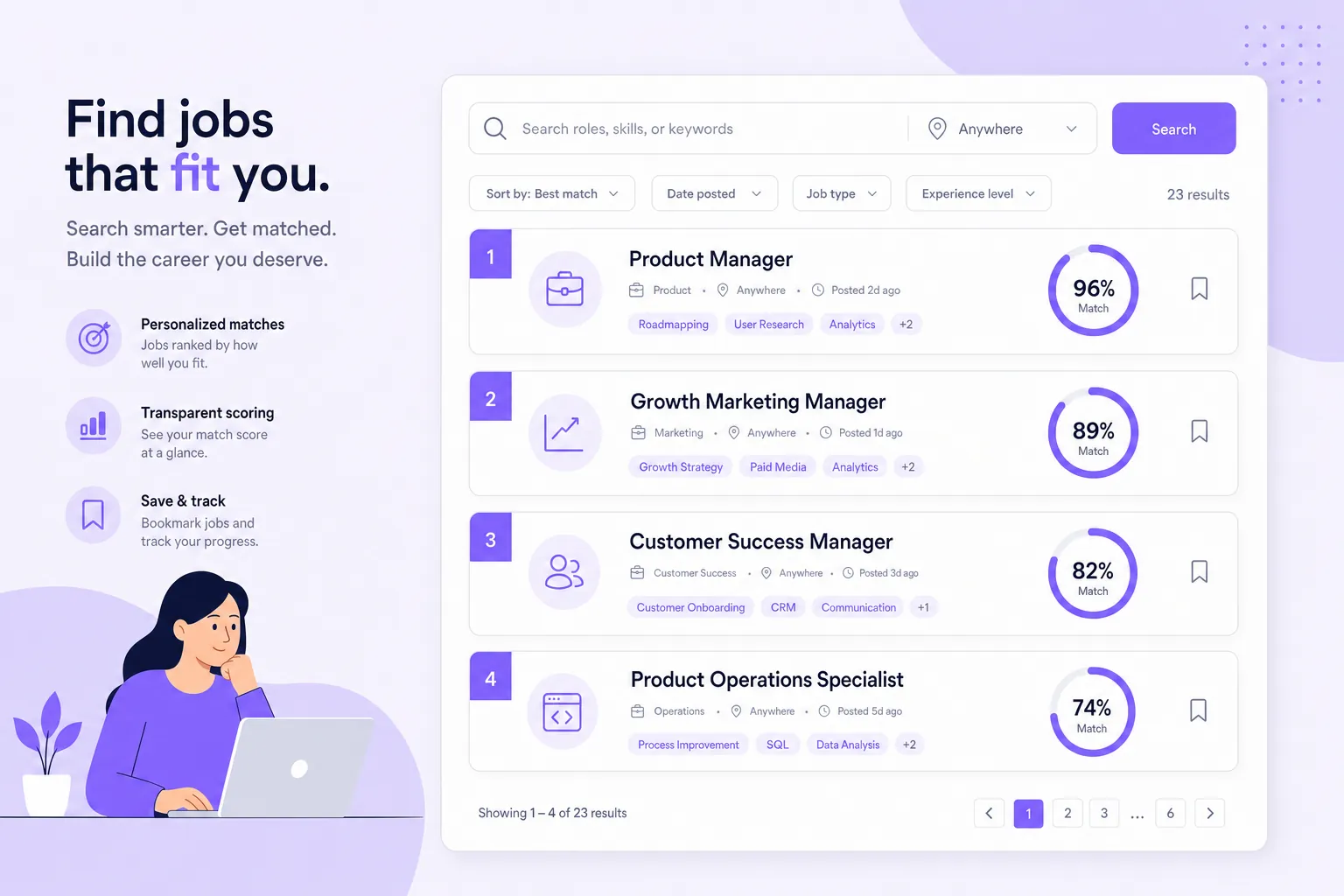
We've watched a few thousand job searches up close, and the pattern is almost boring at this point: the people who figure out how to find a job quickly aren't the ones applying to the most postings. They're the ones running something closer to a system — a short list of channels, a way to triage postings fast, and a way to know if they're wasting time before week six. Everyone else is refreshing job boards at midnight, applying to anything with a pulse, and wondering why nothing sticks.
This guide is the whole thing, start to finish: where jobs actually get filled, how to build a search system instead of a spray-and-pray habit, how to read a posting the way a recruiter reads a resume, how to track applications without losing your mind, and when it's actually worth letting AI do the ranking for you. We'll also get real about how long this takes, because the timeline anxiety is half the problem.
One note before we start: most of what's broken about a slow job search isn't effort. It's aim. Fix the aim and the hours you're already putting in go a lot further.
Skip the guesswork on fit
Jobedly's AI scores every open role 0–100 against your background the moment it posts, so you spend your energy on jobs you can actually win.
Get your free tailored resumeBuild a search system, not a spray-and-pray
A job search without a system feels like effort but produces noise. Here's the minimum system that actually holds up over 4–12 weeks: a target list of roles and companies, a weekly quota you can sustain (not a heroic one), a way to tailor materials fast, and a review point every Friday where you look at what's working and cut what isn't.
- Define your target: 2–3 job titles, a realistic salary band, and a short list of company types you'd say yes to.
- Set a weekly volume you can hold for 8 weeks straight — 10–15 tailored applications beats 60 generic ones almost every time.
- Build a resume base you can adapt in minutes, not hours, per posting.
- Track everything in one place so you know what's actually moving.
- Review weekly: which channel produced replies? Which titles got traction? Adjust, don't restart.
The instinct when a search feels slow is to apply to more things. The better move is usually to apply to fewer things with a tighter match. That's the entire thesis behind AI ranking tools — matching effort to roles where you already clear the bar, instead of hoping quantity averages out.
A system also protects you from the emotional whiplash of a long search. Without one, every rejection feels like a referendum on your worth. With one, a rejection is just a data point — this channel, this title, this company, didn't work this time, and the weekly review tells you whether that's a pattern or a coincidence. That distinction matters more than it sounds; it's the difference between a search that gets sharper over time and one that just gets more exhausting.
There's also a resourcing question people skip: how much of your week should this actually take? Treating a full-time search like a full-time job (structured hours, daily targets) works for some people and burns out others. What holds up better across the searches we've watched is a fixed, modest daily block — 90 minutes to two hours of focused, high-quality work — done consistently, rather than sporadic 10-hour binges followed by three days of avoidance.
| Channel | Volume of roles | Competition per role | Best for |
|---|---|---|---|
| Big job boards | Very high | Very high | Casting a wide net, entry to mid-level roles |
| Company career pages | Medium | High | Targeted searches at specific employers |
| Referrals / network | Lower, but often unlisted | Low | Any level — highest reply rate per hour spent |
| AI-matched platforms (e.g. Jobedly) | High, pre-filtered | Lower (matched to you) | Cutting through volume without cutting quality |
Reading a job post like a recruiter
Most job postings are written fast, recycled from an old template, and padded with wish-list requirements nobody actually enforces. Learning to read past the padding is a skill, and it saves you from wasting tailoring time on the wrong roles — or worse, self-selecting out of the right ones.
It helps to remember who wrote the posting and why. Most job descriptions are drafted by a hiring manager under time pressure, sometimes with input from HR, sometimes copy-pasted from a template three roles old. That context explains a lot of what looks confusing on the page: contradictory requirements, an outdated tech stack listed alongside a modern one, or a seniority level that doesn't match the stated years of experience. None of that is a signal you're reading it wrong. It's a signal the posting itself is imperfect, which is normal, not disqualifying.
Separate the posting into three buckets: must-haves (usually the first 3–5 bullet points, often tied to the job title itself), nice-to-haves (the longer tail of the list, frequently aspirational), and culture signals (language about pace, autonomy, team size). If you clear the must-haves and most of the nice-to-haves, apply. Don't disqualify yourself over a nice-to-have you're missing — hiring managers rarely get a candidate who checks every box, and they know it.
- Job title inflation is common — read the actual responsibilities, not just the title, before deciding it's out of reach or beneath you.
- "3–5 years experience" on a listing marked entry-level is usually a copy-paste error or a wish list, not a hard line.
- Salary ranges (where posted) tell you more about seriousness of the listing than almost anything else in the post.
- A posting live for 60+ days is often either low-priority for the employer or quietly hard to fill — worth noting, not necessarily worth skipping.
Tracking applications without losing your mind
By week three of a real search, memory stops working as a tracking system. You will not remember which version of your resume you sent to which company, or when you're due for a follow-up. A simple tracker — spreadsheet, notes app, whatever you'll actually update — needs five columns at minimum: company, role, date applied, status, and next action date.
The point of tracking isn't organization for its own sake. It's so your weekly review (see the system section above) is based on real numbers instead of vibes. "I've applied to a lot of jobs" feels true and tells you nothing. "I applied to 22 jobs, got 3 replies, and all 3 came from referrals" tells you exactly where to spend more time next week.
Keep the tracker lightweight enough that updating it doesn't become its own chore. A spreadsheet with five columns takes ten seconds to update after each application. A twenty-column masterpiece with color coding and dropdown menus looks impressive and gets abandoned by week two. Pick the boring version you'll actually maintain over the elaborate one you'll quietly stop using.
Let ranking replace some of the tracking
Jobedly scores every open role against your profile the moment it posts, so you're not manually triaging hundreds of postings just to find the ones worth tracking.
See jobs ranked for youWhen to use AI to rank fit
AI matching tools aren't a replacement for the system above — they're a way to make the first bucket, application volume, cheaper. Instead of reading 200 postings to find the 20 worth your time, a fit-scoring tool reads them for you and hands you a ranked shortlist. That's the entire value proposition, and it's a big one when postings post continuously and job seekers don't have continuous time to read them all.
The failure mode to avoid is treating a high match score as a guarantee. It isn't. It's a filter that gets you to the right 20 postings faster, not a promise of an offer. Use it to prioritize your tailoring time — spend real effort on your top-ranked matches, not evenly across everything.
How long a job search really takes
There's no honest single number here — it moves with role level, location, industry demand, and how narrow your target is. What we can say with confidence: the labor market's overall openings give you a sense of scale. The U.S. had roughly 7.594 million job openings as of the most recent reading, according to the Bureau of Labor Statistics' Job Openings and Labor Turnover Survey — a market with real demand, but one where competition still concentrates hard around popular titles and locations.
Set expectations by role level, not by anecdotes from one friend who got hired in a week. Entry-level and high-volume roles can move in days to a few weeks if your materials are tight. Specialized mid-career roles often run 6–12 weeks. Senior and executive searches routinely run 3–6 months, partly because there are fewer open seats and partly because the process itself has more steps.
How to find a job you love
"Love" is doing a lot of work in that phrase, and chasing it directly tends to backfire — it turns the search into a philosophical project instead of a series of concrete decisions. A more workable version: define the two or three things that made your worst job bad (bad manager, no autonomy, brutal commute, misaligned pay) and filter hard against those. Removing what you hate gets you further than searching for what you love, especially on search number one. If pay itself is one of those factors, our guide to negotiating salary is worth reading before you accept anything, not after.
Wage and role-level benchmarks from the BLS Occupational Employment and Wage Statistics program are a useful sanity check here too — comparing a target role's typical pay against your expectations early saves you from filtering your whole search around a number that isn't realistic for the title.
Best sites to find a job 2026
No single board covers everything, and the biggest ones are also the most crowded. A workable stack: one large general board for volume, one or two niche boards for your specific field, direct company career pages for your top-choice employers, and an AI-matched platform like Jobedly to cut through the noise on the general boards by surfacing what's actually a fit. Rotate through the stack weekly rather than living on one site.
How many jobs should I apply to per day
Fewer than most people think, done well. Two to four tailored applications a day, five days a week, sustained for 6–8 weeks, will outperform a frantic 20-a-day binge that burns out by week two. Consistency beats intensity in a process this long.
Once you've narrowed a stack of boards and started submitting, the mechanics of the application itself start to matter as much as the targeting — our guide to applying for jobs online covers the submission-side details that trip people up after they've found the right posting.
Where Jobedly fits into all of this
Everything above works without any tool at all — it's a system built on habits, not software. But the mechanical parts of it (reading hundreds of postings, ranking them by fit, tailoring a resume for each one) are exactly the parts worth automating, because they're the parts that eat hours without requiring judgment.
Let the AI team do the grinding
Jobedly scores every role 0–100 the moment it posts, rewrites your resume to win in seconds, and drafts a matched cover letter automatically. Your first tailored resume is free.
Get your free tailored resumeFrequently asked questions
What's the fastest way to find a job?
How do I find a job with no experience?
How many jobs should I apply to before I hear back?
Is the hidden job market real?
Should I apply even if I don't meet every requirement?
How long should a job search take?
What's the difference between a job board and an AI-matched platform?
Do I need to track my applications?
Glossary
- Hidden job market
- Roles filled through referrals, internal moves, or direct outreach before or without a wide public posting.
- Referral
- A recommendation from someone inside or connected to a company, typically producing much higher reply rates than cold applications.
- ATS
- Applicant Tracking System — software employers use to collect, parse, and rank incoming applications.
- Match score
- A numeric estimate (e.g. 0–100) of how well a candidate's background fits a specific job posting, generated by AI matching tools.
- Tailored application
- A resume and application customized to a specific posting's requirements and language, as opposed to a generic one sent everywhere.
- Nice-to-have
- A qualification listed on a posting that's preferred but not strictly required — often aspirational rather than enforced.