How to Apply for Jobs Online (and Actually Hear Back)
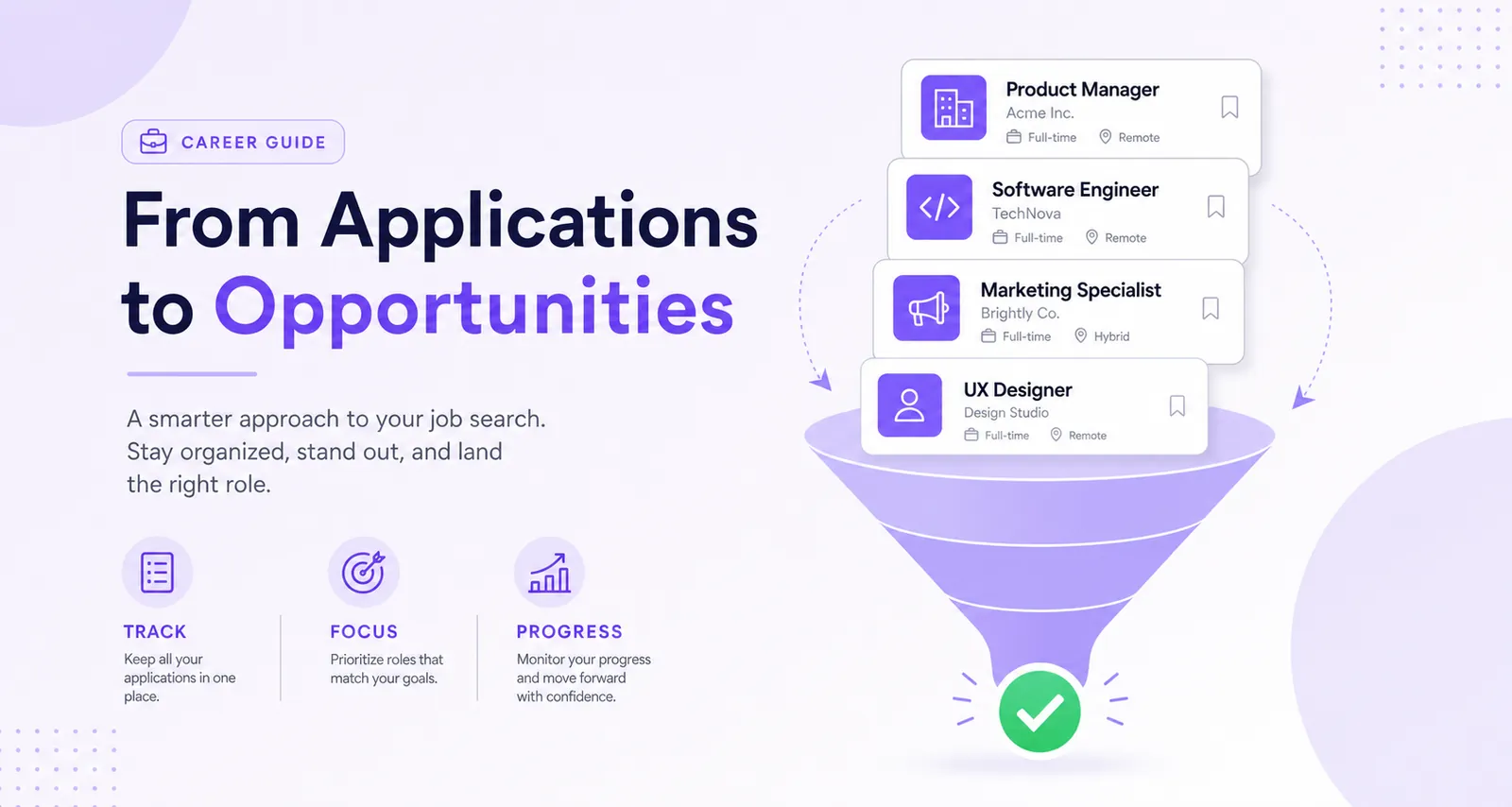
Here's the thing nobody tells you before you send application number thirty: how to apply for jobs online isn't really about the apply button. It's about what happens in the ninety seconds before a human — or an algorithm standing in for one — decides whether your application is worth a second look. Most people obsess over finding jobs and barely think about the application step itself, and that's exactly where a lot of good candidates quietly vanish.
This guide covers the whole application funnel: where people actually drop out of it, when quick-apply beats a tailored application (and when it backfires), what to attach versus what to leave out, how to follow up without being the person recruiters dread hearing from, and the specific things that trigger an auto-reject before a person ever sees your resume.
The short version, if you read nothing else: applying is a funnel with real drop-off at every stage, and most of that drop-off is preventable. Let's walk through where.
Stop guessing which applications are worth your time
Jobedly ranks every open role against your background before you apply, so your effort goes toward postings you're actually positioned to win.
Get your free tailored resumeThe application funnel and where people vanish
Think of every application as passing through four gates: it has to get past the ATS parser, past a keyword or requirements screen (automated or human), past a recruiter's quick read, and finally to a hiring manager. Most applications don't fail because the candidate was unqualified — they fail at gate one or two, often over something fixable like formatting or missing keywords, before a person with judgment ever gets involved.
We've heard the number "71% of jobs you'd never hear back from" thrown around, and directionally it tracks what we've watched happen: the overwhelming majority of applications to any single popular posting get no individual response, simply because so many people apply and only one gets the job. That's not a reason to give up — it's a reason to make sure your application clears the early, avoidable gates instead of getting filtered out by something you could have fixed in five minutes.
Context helps here: demand in the broader labor market is real. The U.S. reported roughly 7.594 million job openings in the most recent BLS Job Openings and Labor Turnover Survey reading — plenty of roles exist. The bottleneck isn't a lack of openings; it's that popular postings concentrate applicant volume far beyond what any single recruiter can individually respond to.
The funnel shape also explains a pattern that confuses a lot of job seekers: getting an interview at a small, low-visibility company while getting total silence from a big-name employer with a similar role, despite feeling more qualified for the second one. Visibility drives volume, and volume overwhelms even well-run recruiting teams. A less visible posting with fewer applicants gives your resume more attention per submission almost by default — worth remembering before writing off smaller, less flashy employers.
| Stage | What kills applications here | How to survive it |
|---|---|---|
| ATS parsing | Complex formatting, tables, columns, images | Use a clean, single-column, ATS-friendly format |
| Keyword/requirements screen | Missing role-specific keywords and skills language | Mirror the posting's exact terms where true |
| Recruiter's first read (6–10 seconds) | Cluttered layout, no clear impact statements | Lead with outcomes, not just duties |
| Hiring manager review | Generic resume that could apply to any role | Tailor top third of resume to this specific posting |
It's worth naming the emotional cost of this funnel too, because it's real and it's not a personal failing. Applying online at volume, with silence as the most common outcome, is genuinely demoralizing in a way that in-person networking or a warm referral usually isn't — there's no feedback, no closure, just a status that quietly never updates. Knowing that going in doesn't make the silence less annoying, but it does help separate "this process is built to feel this way for almost everyone" from "something is specifically wrong with me," which is a distinction that keeps people from quitting a search too early.
Quick-apply vs. tailored — when each wins
Quick-apply (one-click applications using a stored profile) isn't inherently bad — it's a tool, and like any tool it's misused constantly. It wins when you're applying to a high-volume, lower-competition role where speed matters more than a hyper-tailored pitch, or when you're testing the waters on a role you're not fully sure about. It loses badly when it's your only method for competitive, well-matched roles you actually want.
Is easy apply worth it
Worth it as a volume play, not as your whole strategy. Use quick-apply to cover ground on roles that are decent-but-not-dream fits, and reserve your tailoring time for the postings that matter most — the ones where you're a strong match and genuinely want the outcome. Splitting effort this way beats going all-in on either extreme.
The tailoring itself doesn't need to be a rewrite from scratch every time. A strong base resume, adjusted at the top third — summary, top skills, most relevant bullet framing — to match each posting's language, gets you 90% of the benefit of a full rewrite in a fraction of the time. That's the whole premise behind resume tools that auto-match language to a posting instead of asking you to redo it manually each time.
A practical split that's held up across the searches we've watched: reserve tailored, full-effort applications for roles scoring as strong matches, and let quick-apply cover the mid-tier postings where you're a reasonable but not outstanding fit. Skip applying entirely to postings so far outside your experience that even a perfect tailoring pass wouldn't close the gap — that effort is better spent elsewhere.
What to attach and what to skip
Default to attaching: a tailored resume, a cover letter when the application allows one (see our guide to writing a cover letter for when it actually moves the needle), and a portfolio or work samples link if your field uses them. Skip: unrequested reference lists, cover letters stuffed into fields that clearly weren't designed for them, and file formats the ATS is likely to mangle. If an application asks about background checks or references upfront, the FTC's guidance on employer background checks is a useful reference for what employers are and aren't allowed to ask at this stage.
- Save your resume as a standard PDF unless the posting explicitly requests Word — PDFs preserve formatting more reliably across ATS platforms.
- Name the file something a human can read at a glance: FirstLast-Resume.pdf beats resume_final_v3.pdf.
- If a cover letter field is optional and you have nothing specific to say, a short, genuine paragraph beats a padded one.
- Only attach a portfolio if it's current and relevant — a stale link is worse than no link.
How to apply for a job with no experience
Lean on the cover letter or summary field to connect dots the resume alone can't. Explicitly name the transferable skill and tie it to the posting's actual requirement — don't assume the reader will make that leap for you. For a full framework on this, our entry-level job search guide covers building experience signals from scratch. New graduates specifically should also check NACE's new-grad hiring research for a realistic read on entry-level timelines.
One more attachment question that comes up constantly: LinkedIn profile links. Include one if it's current, complete, and consistent with your resume — mismatched job titles or dates between the two are a small but avoidable red flag. If your profile is thin or outdated, either update it before you start applying in earnest or leave it off the application rather than sending a reviewer to a page that undercuts the resume you just submitted.
Application follow-up that isn't annoying
There's a version of follow-up that helps and a version that actively hurts your chances. Helpful follow-up is brief, spaced out, and adds something (a relevant update, genuine enthusiasm, a quick clarifying note) rather than just asking "any update?" Annoying follow-up is frequent, generic, and treats the recruiter's inbox like a countdown timer you're allowed to reset.
- Wait 7–10 business days after applying before your first follow-up, unless the posting states a timeline.
- Send one polite, short note — restate interest, add one genuine detail, ask if there's an update.
- If there's no response after that, follow up once more at the two-to-three-week mark, then let it go.
- Never follow up more than twice unless invited to by the recruiter directly.
Why am I not hearing back from job applications
Usually one of four things: the resume isn't parsing cleanly through the ATS, the resume doesn't mirror the posting's language closely enough to clear a keyword screen, the role had far more applicants than openings (common on high-visibility postings), or the application arrived after the employer had already moved deep into interviews with other candidates. Rarely is it because you're fundamentally unqualified — it's almost always something in the mechanics.
If you're seeing this pattern across many applications, not just one or two, it's worth an honest audit rather than assuming bad luck. Pull five recent applications where you heard nothing, and check each one against the funnel table above — formatting, keyword overlap, resume clarity, fit. A pattern usually jumps out fast once you're looking for it directly instead of just feeling generally discouraged.
And a reframe worth sitting with: silence isn't always a signal about you specifically. Some roles get pulled internally after a posting goes live, some get filled through a referral that came in on day two, and some postings were never a serious search to begin with — a compliance requirement to post externally even when an internal candidate already had the job. None of that is visible to an applicant on the outside, and no amount of resume polishing changes an outcome that was decided before your application arrived.
Apply to roles ranked in your favor
Jobedly surfaces roles where your background already scores well, so your applications land in front of employers more likely to respond.
See jobs ranked for youCommon auto-reject triggers
Some rejections happen before a human ever opens your resume. These are the mechanical triggers worth eliminating, because they cost you interviews you were otherwise qualified for.
- Formatting the ATS can't parse: text boxes, tables, columns, headers/footers containing key info, and images with embedded text.
- Missing hard requirements the posting lists as mandatory (specific certification, location, work authorization) with no explanation offered.
- A resume with zero overlap in language to the posting's core skills, even if the underlying experience genuinely matches.
- Contact information errors — a typo'd email or missing phone number kills a response even after everything else went right.
- Applying to a role and location combination clearly outside what's stated, with no note explaining relocation or remote intent.
This is exactly the territory our guide to beating applicant tracking systems goes deep on, if formatting and parsing are where you suspect you're losing ground.
Best time to apply for jobs
Early in a posting's life beats late, generally — the first days after a posting goes live tend to get closer attention before the applicant pile grows unmanageable. Within the week, weekday mornings when recruiting teams are actively working through their queue tend to outperform weekend or late-night submissions, though this matters far less than tailoring quality.
There's a broader pattern worth internalizing across every trigger on this list: almost all of them are fixable in minutes once you know to look for them, and almost none of them are fixable after the fact. That's the real argument for a pre-submission checklist — a formatting scan, a keyword comparison against the posting, a contact-info double-check — run every single time, even on your fiftieth application when the process feels rote. The cost of the checklist is two minutes. The cost of skipping it is an application that silently never had a chance.
Building the checklist once and reusing it beats reinventing it under the pressure of "I just want this submitted." Keep it short enough that you'll actually run it every time — five checks, not twenty — and treat any application that fails a check as worth five more minutes before you hit submit, not a reason to submit anyway and hope.
None of this replaces the earlier steps in the process — finding the right roles, as covered in our guide to the complete modern job search, still has to happen before an application is worth submitting at all. Applying well is the finishing move, not a substitute for aiming at the right target in the first place.
Applying smarter, not just more
Every gate in this funnel gets easier when you're only applying to roles you're genuinely positioned to win, which is the entire point of ranking fit before you spend time tailoring anything.
Let the AI team do the grinding
Jobedly scores every role 0–100 the moment it posts, rewrites your resume to win in seconds, and drafts a matched cover letter automatically. Your first tailored resume is free.
Get your free tailored resumeFrequently asked questions
How many jobs should I apply to online per week?
Why am I not hearing back from any job applications?
Is Easy Apply worth using?
Should I always send a cover letter?
How do I apply for a job online with no experience?
How soon should I follow up after applying?
What file format should I use for my resume?
What's the best time of day to apply for jobs?
Glossary
- Quick apply / Easy Apply
- A one-click application method using a stored profile, common on major job boards and platforms.
- Application funnel
- The sequence of screening stages — parsing, keyword screen, recruiter review, hiring manager review — an application passes through.
- Auto-reject
- A rejection triggered by automated screening (parsing failure, missing required qualification) before a human reviews the application.
- Keyword screen
- A stage where an ATS or recruiter checks a resume for specific terms tied to the posting's core requirements.
- Tailored application
- An application customized to a specific posting's language and requirements, as opposed to a single generic version sent everywhere.