How to Write a Cover Letter (That Actually Gets Read)
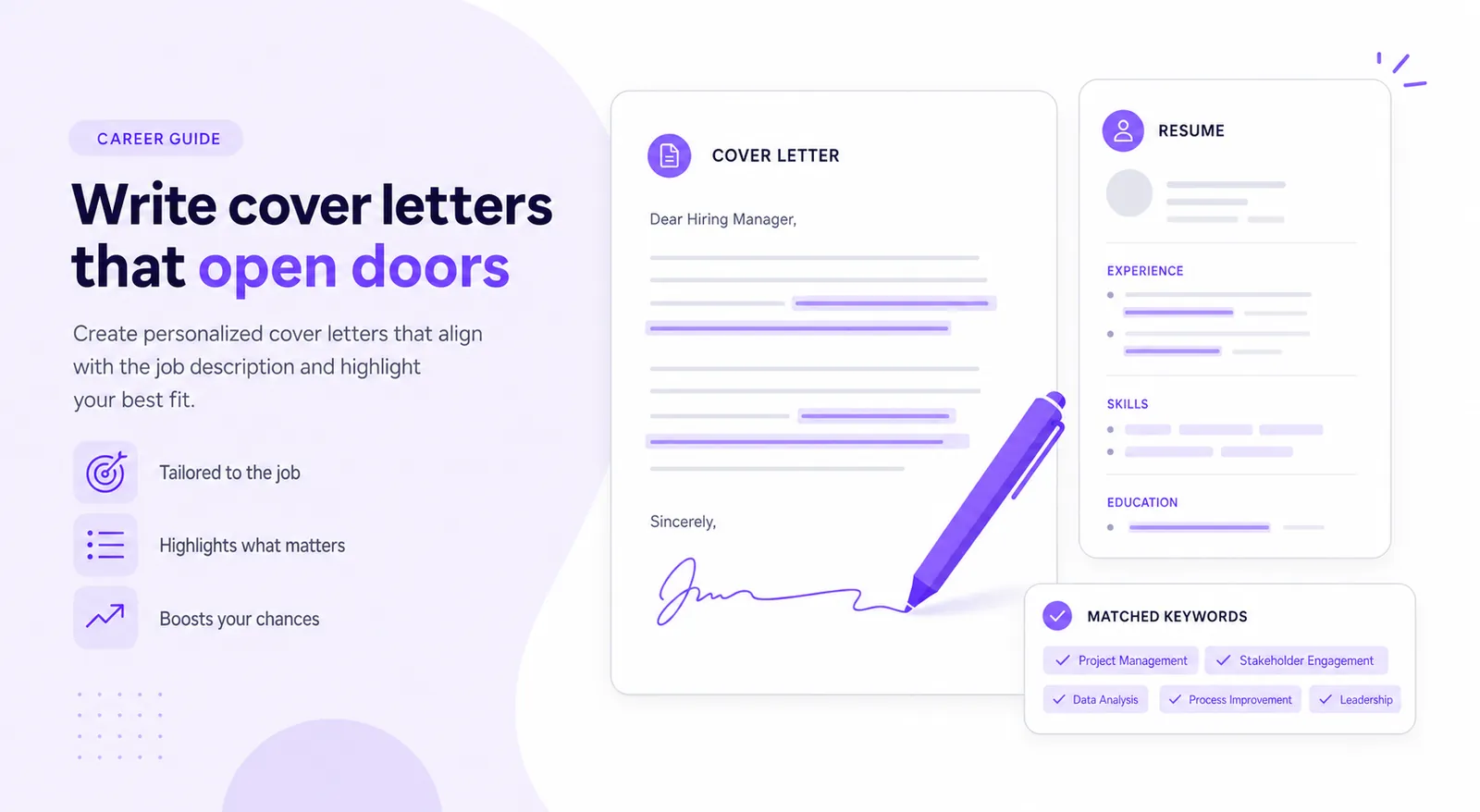
We've read enough cover letters to lose count, and most of them say nothing. Somewhere around letter two hundred, the pattern gets obvious: people either treat how to write a cover letter like a formality they can phone in, or they overthink it into a five-paragraph résumé rehash nobody asked for. Neither works. A cover letter that gets read does one job — it answers the question the recruiter is actually asking, which is never "tell me your history," it's "why you, why this, why now."
This guide walks through the structure that consistently gets a second look, the openers that don't make a hiring manager's eyes glaze over, and the honest answer to whether you even need one for the job you're applying to. We'll also cover formatting, length, and what to do when you've got zero relevant experience to point to.
One more thing before we start: a cover letter is not a solo project you have to get perfect from a blank page every time. Jobedly's agents draft a matched cover letter automatically once your resume is tailored to a role, so you're editing a strong first pass instead of staring at a cursor.
Skip the blank page
Get a matched cover letter drafted for you the moment your resume is tailored to a role — free to start.
Get your free tailored resumeDo cover letters still matter? (honest answer)
Sometimes. That's the honest answer, and anyone who tells you it's always yes or always no hasn't been on both sides of enough hiring processes. At high-volume employers running everything through an applicant tracking system, the cover letter field is often optional and frequently unread — the recruiter is triaging hundreds of resumes and doesn't have time to open an extra document for each one. At smaller companies, in creative and communications-heavy roles, and for any job where writing is part of the work, the letter gets read closely, sometimes before the resume.
Here's the pattern we kept seeing: when a cover letter field is marked optional, most candidates skip it — which means the ones who send a sharp, specific letter stand out by default. You're not competing against everyone who applied. You're competing against everyone who applied and wrote something worth reading, which is a much smaller group.
Do recruiters read cover letters?
Recruiters skim resumes first, always. If the resume clears the bar, a fair number will open the cover letter next — especially for roles above entry level, roles involving client communication, or roles where culture fit is a stated concern. If the resume doesn't clear the bar, the cover letter rarely saves you. So the letter isn't a replacement for a strong, tailored resume — think of it as the thing that turns a maybe into a yes once the resume has already done its job. If your resume needs work first, that's worth fixing before you spend an hour on the perfect letter.
The volume recruiters are working through is a big part of why this pattern holds. With millions of open roles nationally at any given time, a busy hiring manager's incentive is to move fast, not to read every attachment — which is exactly why a letter that earns a read has to work harder than it used to.
The 4-paragraph structure that works
Forget the five-paragraph essay format you learned in school. A cover letter that gets read is four tight paragraphs, no filler, no restating your resume line by line. Here's the structure we've seen work over and over, across industries and seniority levels.
- The hook (2–3 sentences). Name the role, name the company, and give one specific reason you're writing that isn't "I saw this posting and I'm a good fit." Reference something real about the team, the product, or the problem they're solving.
- The proof (3–4 sentences). One concrete example — a result, a project, a number if you have one — that maps directly to what the posting says they need. Not a list. One story, told well, beats three bullet points restated as prose.
- The fit (2–3 sentences). Connect your proof to their specific situation. Why does this experience matter to them, right now, given what you know about the role or the company stage?
- The close (1–2 sentences). A direct, confident sign-off. Not "I look forward to hearing from you" — say what you want next, plainly.
That's it. Four paragraphs, roughly 250 to 350 words total. If you're going longer than that, you're probably repeating your resume, which is the single most common mistake we see.
How long should a cover letter be?
One page, no more, and honestly the best ones run shorter than a full page — around 250 to 350 words is the sweet spot. Recruiters are reading on a screen, often on a phone, often between other tasks. A letter that requires scrolling past the fold is a letter that gets skimmed for keywords and closed, or not opened at all.
| Length | What happens |
|---|---|
| Under 150 words | Reads as low-effort unless the role is casual or the letter is meant to be a quick note |
| 250–350 words | The range that consistently gets read in full |
| 400–500 words | Often skimmed only for the first and last lines |
| Over 500 words / multiple pages | Rarely finished; treated as a resume duplicate |
Openers that aren't "I am writing to apply"
"I am writing to apply for the position of X" is the most common opening line in existence, and it tells the reader absolutely nothing they don't already know from the subject line. If you take one thing from this section, take this: your first sentence should be doing work, not just occupying space.
How to start a cover letter
- Name a specific detail about the company. "Your engineering blog post on the migration to event-driven architecture is the reason I'm applying" beats any generic opener.
- Lead with a relevant result. "I cut onboarding time by a third at my last company, and I want to do the same for your customer success team" gives the reader a reason to keep going.
- Reference a mutual connection or referral, if real. "Maria on your data team suggested I reach out" is a strong, honest opener — never fabricate this.
- State a point of view on the problem the role solves. Especially strong for strategy, product, and senior roles: show you already understand what they're up against.
What all of these have in common: they're specific to this company and this role. A letter that could be sent to ten different companies with a find-and-replace on the company name is a letter that reads like it, no matter how well-written the sentences are.
This isn't unique to job applications, either — it's basic persuasive writing. Harvard Business Review has covered this exact pattern in the context of business writing generally: specific, concrete openings outperform abstract, generic ones because they give the reader something to actually picture. A cover letter is no exception to that rule.
Matching the letter to the posting
The resume gets you past the filter. The cover letter is where you make the case in your own words — so it should mirror the language of the posting without copying it verbatim. If the job description says "cross-functional collaboration" three times, that's a signal, not a coincidence. Use it, but back it with your own example rather than parroting the phrase back empty.
We generally recommend picking the two or three requirements in the posting that you're strongest on and building the "proof" paragraph around those — not trying to address everything in the listing. A letter that tries to cover eight qualifications ends up covering none of them convincingly.
This is also where a tailored resume and letter pair matters more than either alone — if your resume is written to beat the ATS but your letter doesn't reference the same priorities, the two documents feel disconnected. Jobedly's agents pull the same signal from the job posting into both the resume rewrite and the auto-generated letter so they read as one coherent pitch rather than two separate drafts.
When to skip it
Skip the cover letter, or keep it to two sentences, when: the application system explicitly marks it optional and the role is high-volume entry-level; the posting says not to include one (rare, but it happens, and you should respect it); or you have genuinely nothing specific to say because you're applying broadly and speed matters more than polish for that particular application. Sending a weak, generic letter is often worse than sending none — it signals low effort more clearly than silence does.
Cover letter with no experience
If you're early in your career, don't apologize for it and don't pad the letter with filler about how excited you are. Lead with transferable proof instead — a school project, a volunteer role, a part-time job where you solved a real problem. Employers hiring for entry-level roles know you don't have five years of experience; what they're checking for is whether you can think clearly about a problem and communicate it. One well-told example from outside a traditional job does that better than a vague paragraph about your enthusiasm.
Cover letter vs resume
They're not doing the same job. The resume is a scan document — built for speed, built to survive an ATS, built to prove you meet the baseline qualifications in the first six seconds of a read. The letter is a persuasion document — built to be read slowly, built to make a case, built to sound like an actual person wrote it. Confusing the two is how you end up with a resume full of prose paragraphs (which ATS software handles poorly) and a cover letter that's just a bulleted list (which reads like a second resume nobody asked for).
This split isn't just our opinion — it shows up in how hiring teams themselves describe the two documents. SHRM, which sets a lot of the norms HR teams train on, consistently frames the cover letter as the narrative complement to a resume's factual record, not a duplicate of it. That distinction is worth internalizing before you write a word.
Formatting your letter and a working example
Format-wise, keep it simple: your name and contact info at the top (matching your resume header), the date, the hiring manager's name if you can find it ("Dear Hiring Team" is fine if you can't), then the four paragraphs, then a plain sign-off. No decorative fonts, no colored borders competing with your resume design, no letterhead. Save it as a PDF with a filename that includes your name, and if the application allows a combined document, some ATS platforms parse a merged resume-plus-letter PDF more cleanly than two separate uploads — check the posting's instructions either way.
Here's a short annotated example for a marketing coordinator role, showing the four beats in action:
"Your team's recent rebrand cut load time in half without losing the brand's personality — that kind of practical creative work is exactly why I'm applying for the Marketing Coordinator role. At my current job, I rebuilt our email nurture sequence and raised open rates by restructuring subject lines around a single clear benefit per send, not a list of features. I'd bring that same instinct — say less, say it clearer — to your content calendar. I'd welcome the chance to talk about where the team needs the most help right now."
Notice what's missing: no "I am writing to apply," no restated job title in the opening line, no list of unrelated skills. Every sentence is either proof or connection. That's the template — adapt the specifics, keep the shape.
See roles ranked to your background
Jobedly scores every open role 0–100 the moment it's posted, so you can put your best letter toward the jobs actually worth the effort.
See jobs ranked for youIf you're applying at scale, writing a fresh letter from scratch for every role isn't realistic — and it's also not necessary. Build one strong base letter with your best proof story, then adjust the hook and fit paragraphs per posting. That's roughly ten minutes of editing instead of an hour of writing, and it's the same approach behind how Jobedly auto-generates a matched letter once your resume is tailored to a specific job. For a deeper look at getting the surrounding application right, see our guide on how to apply for jobs online and, before any of this matters, our guide on how to find a job in the first place.
Let the AI team do the grinding
Jobedly scores every role 0–100 the moment it posts, rewrites your resume to win in seconds, and drafts a matched cover letter automatically. Your first tailored resume is free.
Get your free tailored resumeFrequently asked questions
Is a cover letter necessary in 2026?
How do I address a cover letter with no hiring manager name listed?
Should a cover letter repeat my resume?
Can I reuse the same cover letter for multiple jobs?
What's the biggest mistake people make writing a cover letter?
Do cover letters matter more for career changers?
Should I mention salary expectations in a cover letter?
What file format should I use for a cover letter?
Glossary
- Cover letter
- A short, one-page letter submitted alongside a resume that makes a persuasive case for why you're a fit for a specific role and company.
- ATS (Applicant Tracking System)
- Software employers use to collect, sort, and filter applications before a human reviews them.
- Hook
- The opening lines of a cover letter, meant to give the reader a specific reason to keep reading rather than skim.
- Tailored letter
- A cover letter customized to reference the specific company, role, and language of a job posting, rather than a generic template.
- Sign-off
- The closing lines of a cover letter that state what you want next, e.g. an interview or a conversation.