The Entry-Level Job Search Guide (For No-Experience Candidates)
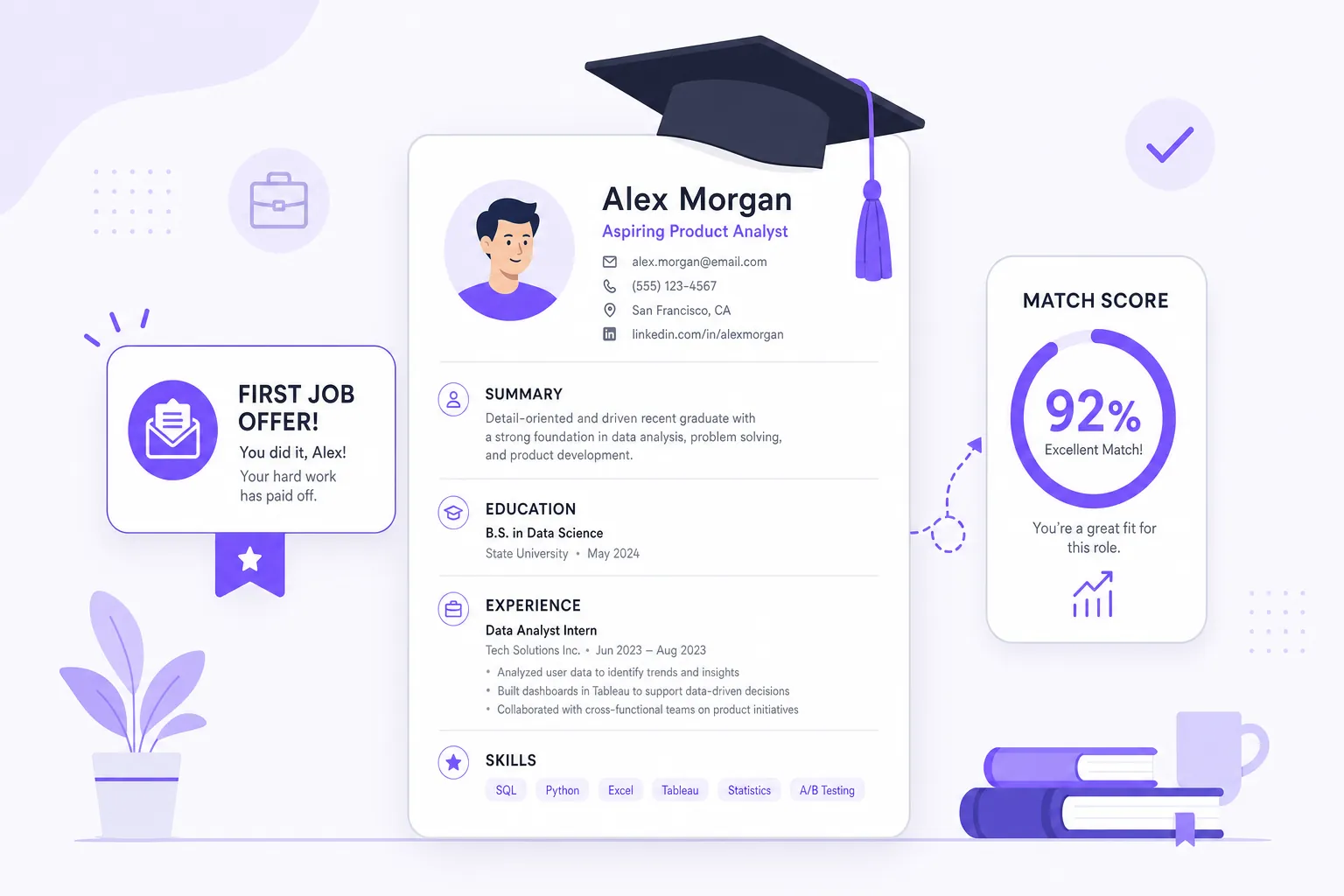
"Entry level, three years of experience required" is the joke everyone makes and the wall almost every new grad actually hits. If you're starting an entry level job search right now, you already know the frustration: postings that call themselves entry level while listing requirements that don't sound entry level at all. That gap is real, but it's also more navigable than it looks once you understand why it exists and what actually gets you through it.
This guide covers why that mismatched language happens, how to build real experience signals when you don't have a job history to point to, how to use your campus network and early professional contacts before you've built a "real" one, how to structure a resume with no work history, and what a realistic search actually looks like in terms of volume and timeline.
You don't have to figure out the resume formatting and the search strategy alone at the same time — Jobedly's agents build a tailored resume for your first real search in seconds, free, so you can focus your energy on the search itself.
Start with a resume that actually gets read
Get your first tailored resume free — built to highlight the experience you do have, the way entry-level recruiters actually screen for it.
Get your free tailored resumeWhy "entry level, 3 years experience" happens
This mismatch is real, and it's not a conspiracy against new grads — it's mostly a byproduct of how job postings get written. A hiring manager drafts a wishlist of everything a perfect candidate would have, HR labels the role "entry level" based on pay band and reporting structure, and nobody reconciles the two before it's posted. The result: a posting that reads as contradictory but is, in most cases, more flexible in practice than the text suggests.
The practical takeaway: don't self-select out of a posting just because it lists "1–3 years preferred" if the role is genuinely titled entry level and the core requirements otherwise match your background. Recruiters filling entry-level roles routinely see applicants with zero direct experience and expect to train on the job — the requirement line is often aspirational, not a hard gate.
This is also backed by how new-grad hiring actually tracks over time. NACE's job outlook surveys show employers consistently planning to hire new graduates in meaningful volume even in tighter labor markets, which lines up with what we see in postings: the demand for entry-level talent doesn't disappear just because the wording sounds demanding.
There's a second, quieter reason this happens too: some postings genuinely are written for a slightly more experienced hire, and get relabeled entry level later when the search stalls and the hiring manager widens the net. You can't always tell which situation you're looking at from the outside, which is exactly why the smarter move is applying and letting the process sort it out, rather than trying to guess your way out of good opportunities before you've even submitted anything.
Building experience signals with no experience
"No experience" almost never means zero relevant signal — it usually means no job title that says so. Recruiters screening entry-level candidates are looking for proof of three things: can you follow through on something, can you produce a real result, and can you communicate clearly about both. None of those require a paycheck to demonstrate.
How to get a job with no experience
- Class projects with a real deliverable. A capstone project, a group case study with a measurable outcome, a research paper that solved an actual problem — these count as proof when framed with a result, not just a course title.
- Volunteer or club leadership. Running a student org's budget, coordinating an event, managing a social account for a nonprofit — all of these map to real transferable skills employers screen for.
- Freelance or gig work, even small. Built a website for a local business, tutored, ran social media for a friend's shop — small, real, and provable beats big and vague.
- Personal projects. A side project, a portfolio piece, a small app or analysis you built independently — these show initiative that a transcript alone can't.
The framing matters as much as the activity itself. "Member of student marketing club" is weak. "Grew a student org's Instagram following by managing a monthly content calendar and running two campus events" is strong — same underlying experience, very different signal.
If you're still enrolled or recently finished, it's also worth doing this exercise before you graduate rather than after: pick one gap you already know you'll face and close a small piece of it now, while you still have easy access to a class, a club, or a professor's project to attach it to. A short internship, a research assistantship, or even a well-scoped independent project completed in your final semester tends to carry more weight than the same thing done scrambling after graduation with no institutional structure around it.
Leveraging campus + early network
Your network at this stage is smaller than someone ten years into a career, but it's not nothing, and it's underused far more often than it's overused. Career services offices, professors with industry ties, alumni databases, and even classmates who landed roles a semester ahead of you are all legitimate, normal parts of an early-career search — using them isn't cutting a corner, it's how the process is designed to work.
A short, specific outreach message to an alum in a role or company you're interested in — asking for fifteen minutes, not a job — consistently outperforms a cold application into a black-box ATS. Most people are more willing to help a student or recent grad than they are a stranger further along in their career, so this is genuinely one of the highest-leverage moves available to you right now, more than it will be again for a while.
That said, network conversations don't replace a real application strategy — they supplement it. Pair outreach with a systematic application process; our guide on how to apply for jobs online covers how to track and manage volume without losing quality per application.
Don't overlook the informal side of this either — group chats, class Slack or Discord servers, and even parents' or family friends' professional networks are all fair game at this stage. Nobody expects a 22-year-old's first job to come purely from cold applications, and mentioning that a family friend works at a company you're interested in, then asking them for a quick introduction, is a completely normal and expected move, not something to feel awkward about.
Entry-level resume without work history
A resume with no traditional work history needs a different structure than a standard chronological resume — leading with a thin or empty work section undersells you before the reader gets to your actual strengths. Lead with education and a skills-forward summary, then a "Projects" or "Leadership" section that does the heavy lifting a work history section normally would.
Entry level resume examples
A strong structure for a no-experience resume: contact info and summary at top, education (with relevant coursework or honors if space allows), then a Projects/Leadership section with two to four entries written like job bullets — action, task, result — followed by a skills section. Keep it to one page. Padding a one-page resume into two pages to compensate for a short work history reads worse than a clean, well-organized single page.
| Section | Experienced candidate | No-experience candidate |
|---|---|---|
| 1st section | Summary | Summary |
| 2nd section | Work experience | Education |
| 3rd section | Education | Projects / leadership |
| 4th section | Skills | Skills |
| 5th section | Certifications (optional) | Relevant coursework (optional) |
For the mechanics of formatting so this survives an applicant tracking system intact, see our guide on how to beat applicant tracking systems — the same ATS rules apply whether you have ten years of experience or none.
A quick word on part-time and service jobs, since a lot of new grads have one and aren't sure whether it belongs on a resume aimed at a career-track role: include it, briefly, especially if you held it for a meaningful stretch or took on any responsibility beyond the basic task list. A part-time retail job where you trained new hires or handled a cash reconciliation process says something real about reliability and ownership, even if the industry has nothing to do with your target field. Leaving it off entirely can read as a gap rather than a strength.
One more thing worth knowing before you list past employers as references: if a background check is part of the process, you have rights around how that information is used. The FTC's guidance on background checks lays out what employers can and can't do with that data, which is useful context heading into your first professional background check.
Realistic expectations for the first role
New-grad hiring moves on its own calendar, and the volume math is different than for experienced hires — expect to apply to more roles, and expect the process to take longer than it feels like it should when everyone around you seems to be posting about a new job.
How many jobs to apply for new grad
There's no single magic number, but a search that stays purely reactive — applying to a handful of postings a week and waiting — tends to move too slowly for the entry-level market's volume and response rates. A more effective approach pairs a steady volume of tailored applications with active outreach, rather than relying on either alone. Quality per application still matters more than raw volume; a rushed, generic application to fifty postings a week typically converts worse than a smaller number of tailored ones paired with outreach.
For grounded, current context on the new-grad hiring landscape rather than guesswork, NACE (the National Association of Colleges and Employers) tracks new-grad hiring trends and outcomes directly and is one of the few sources built specifically around this stage of the job market, rather than the labor market broadly.
It's also worth pacing yourself deliberately rather than front-loading every application in the first two weeks after graduation and burning out by month two. A sustainable weekly rhythm — a set number of tailored applications, one or two outreach messages, and time blocked for interview prep when something lands — tends to outlast a frantic short burst, and the entry-level search is, realistically, a marathon more often than a sprint.
Best entry level jobs
The "best" entry-level job is less about a single ideal title and more about which roles in your target field hire the most new grads with structured onboarding — customer success, sales development, coordinator and analyst roles, and rotational programs tend to be more open to no-experience candidates than highly specialized individual-contributor roles. Casting a slightly wider net across adjacent titles in your field, rather than fixating on one exact job title, usually surfaces more real opportunities.
How to find a job after college
Combine three channels rather than relying on one: your school's career center and alumni network, a steady cadence of tailored applications through general job boards, and direct outreach to companies you're specifically interested in even without a live posting. Our how to find a job guide covers the broader mechanics of this multi-channel approach in more depth, and it applies just as much at this stage as any other.
See roles actually open to no-experience candidates
Jobedly's agents score every open role 0–100 against your background — including projects and coursework, not just job titles.
See jobs ranked for youLast thing: the first job is not the only job, and it doesn't have to be perfect. It has to be a real step that teaches you something and gives your next resume its first genuine work history line. Most people look back at their first role as a stepping stone, not a defining choice — treat the search with that pressure removed, and it usually goes better, not worse.
Let the AI team do the grinding
Jobedly scores every role 0–100 the moment it posts, rewrites your resume to win in seconds, and drafts a matched cover letter automatically. Your first tailored resume is free.
Get your free tailored resumeFrequently asked questions
Should I apply to jobs that say '1-3 years experience preferred' with no experience?
How do I list a class project on my resume like real experience?
Is it worth applying to jobs outside my major?
How long does a new grad job search typically take?
Should my resume include my GPA?
What if I don't have any internships?
Should I use a career center if I've already graduated?
How do I handle a resume gap between graduation and my first job?
Glossary
- New grad
- A candidate who has recently completed a degree program and is searching for their first full-time role in their field.
- Rotational program
- A structured entry-level hiring program where new hires rotate through multiple teams or functions over a set period.
- Career services
- A university office providing job-search support, resume review, and employer connections to current students and often recent alumni.
- Projects section
- A resume section used in place of, or alongside, work experience to showcase relevant class, volunteer, or personal projects.
- Informational interview
- A brief, informal conversation with someone in a target role or company, used to learn about the work rather than apply for a job.