How to Prepare for a Job Interview (Without Sounding Rehearsed)
We've sat in on debriefs after interviews that went sideways for the same reason almost every time: not a lack of qualification, a lack of preparation. Knowing how to prepare for a job interview isn't about memorizing answers word for word — it's about building a small set of real stories and research points you can pull from no matter which direction the conversation goes. The candidates who sound most natural in the room are usually the ones who prepared the most, not the least.
This guide covers the prep system we'd actually recommend using, how to use the STAR method without sounding like you're reading from a script, which questions to ask when it's your turn, and how the prep changes for phone, video, and panel formats. We'll also cover what to do with the questions you genuinely don't have a good answer for — because everyone gets at least one.
If you're not sure you're even interviewing for the right roles yet, Jobedly's agents score every open job 0–100 against your background the moment it posts, so your prep time goes toward interviews worth having.
Make sure you're prepping for the right roles
See every open job ranked against your background before you spend hours prepping for the wrong one.
See jobs ranked for youThe prep system (company, role, stories)
Good interview prep breaks into three buckets, and skipping any one of them shows. We'd budget roughly an hour total for most interviews, more for a final-round or executive conversation.
- Company research (15–20 minutes). Read the About page, the most recent press release or blog post, and if it's public, skim the last earnings call summary or a recent news story. You're not trying to become an expert — you're trying to have two or three specific things to reference that prove you did the work.
- Role research (10–15 minutes). Reread the job posting slowly. Identify the two or three requirements that show up first or repeat — those are almost always the priorities. Then think about who might be interviewing you and what they'd care about most given their likely role.
- Story bank (20–30 minutes). Prepare four to six stories from your own experience that can flex across multiple question types — a time you solved a hard problem, a time you disagreed with someone and how it resolved, a time you led without formal authority, a time you failed and what changed after.
The story bank is the part people skip, and it's the part that matters most. If you walk in with six flexible stories, you can answer almost any behavioral question by picking the closest match and shaping it to the question — instead of trying to invent a brand-new answer on the spot, which is where most of the rambling and "ums" come from.
It also helps to know the shape of the market you're walking into. With the national unemployment rate sitting at 4.2% as of June 2026, competition for strong roles is real but not brutal — which is exactly the environment where solid, specific prep separates you from candidates coasting on a decent resume alone.
STAR without sounding robotic
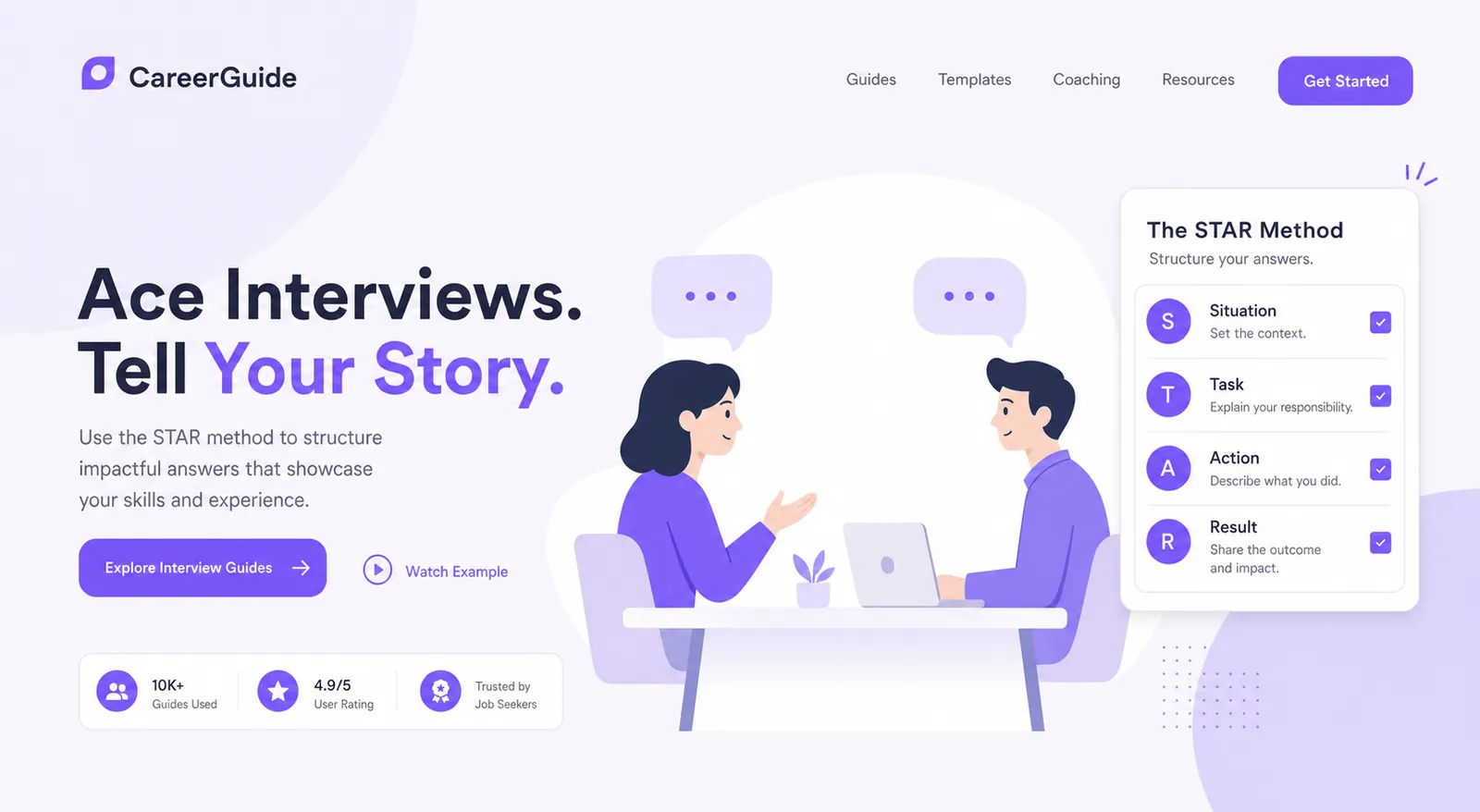
STAR — Situation, Task, Action, Result — is the standard framework for behavioral answers, and it works. The problem is that most people who've read about it deliver answers that sound like they're checking off the four letters out loud: "The situation was... the task was..." That's the version that sounds rehearsed and stiff.
The fix is to use STAR as a mental outline, not a script. Set up the context in one or two sentences, spend most of your time on what you actually did and why you made the choices you made, and close with a specific result — ideally one with a number, even an approximate one. You should be able to tell the whole story in 60 to 90 seconds. Longer than that and you're probably including detail that doesn't serve the point.
| Question | Weak answer | Strong answer |
|---|---|---|
| Tell me about a time you missed a deadline | "I had a project, it was late, I finished it eventually, it turned out okay." | "I underestimated a dependency on another team. Once I saw the risk two days in, I flagged it immediately, renegotiated scope with my manager, and delivered the core piece on time with a follow-up two days later. Now I build in a buffer for cross-team work up front." |
| Tell me about a conflict with a coworker | "We disagreed about something but we worked it out." | "We disagreed on which metric to prioritize. Instead of pushing my view harder, I asked what evidence would change their mind, and we ran a small test to settle it. It changed how I approach disagreements now — lead with a test, not an opinion." |
How to answer tell me about yourself
This isn't an invitation to recite your resume top to bottom. Give a present-to-past-to-future arc in under ninety seconds: what you do now, the one or two experiences that led there, and why this specific role is the logical next step. Anchor it to the job you're interviewing for — the same story told to two different roles should end with two different "and that's why this role" lines.
What are your weaknesses answer
Skip the fake weakness ("I'm a perfectionist") — interviewers have heard it a thousand times and it signals you're not being straight with them. Name something real but not disqualifying for the role, and spend more time on what you're actively doing about it than on the weakness itself. "I used to avoid giving direct feedback; I've been forcing myself to do it within 24 hours instead of stewing on it" is honest and shows growth.
Why should we hire you
Answer with the specific intersection of what they need and what you've already proven you can do — not a general list of strengths. "You need someone who can own the migration end to end without heavy oversight; I did exactly that at my last company, here's the result" beats "I'm a hard worker and a fast learner" every time.
Questions you should ask them
The "do you have any questions for us" moment is not a formality — it's still being evaluated, and it's your best chance to evaluate them back. "No, I think you covered everything" is a wasted opportunity every single time.
Questions to ask the interviewer
- "What does success look like in this role at the 90-day mark?" — shows you're thinking about impact, not just getting the offer.
- "What's the biggest challenge the team is facing right now?" — often gets you the most honest, useful answer in the whole interview.
- "How would you describe the team's working style?" — helps you actually assess fit instead of just performing for it.
- "What made you decide to join, and what's kept you here?" — a good gauge of genuine enthusiasm vs. rehearsed talking points.
- Save comp-process questions ("what's the timeline, what's the range") for later rounds unless they raise it first — see our guide on how to negotiate salary for when that conversation should happen.
Two or three thoughtful questions beat five generic ones. Pick based on what you actually want to know, not what you think sounds impressive.
Timing matters too. Don't hold every question until the very end — if something comes up naturally mid-conversation, ask it then. Interviews that feel like a real back-and-forth instead of a rigid Q&A session tend to leave a stronger impression on both sides, and interviewers remember candidates who engaged with the conversation rather than just answering on cue and waiting for their turn.
One more thing worth naming: it's fine to ask a question you're slightly nervous about, like team turnover or why the role is open. Phrased plainly and without an accusatory tone, those questions usually get honest answers, and the answer tells you more about whether you'd actually want the job than almost anything else in the process.
Virtual/phone/panel differences
How to prepare for a phone interview
Phone interviews strip out body language, which means your tone and pacing carry more weight than usual. Stand up if it helps your energy, keep notes in front of you (nobody can see them), and over-articulate slightly — pauses feel longer on the phone than they actually are, so don't panic and fill them with filler words.
For video interviews, test your camera and audio beforehand, every time, even on a platform you've used before. Frame yourself centered with good light in front of you, not behind you, and look at the camera lens when answering, not the little thumbnail of yourself — it reads as more direct eye contact on the other end.
Video-first hiring isn't a fluke of any one company's process — it tracks with how much of the workforce operates remotely now. Pew Research's ongoing work on remote work trends shows this shift is durable, not temporary, which is exactly why video-interview fluency is now a baseline skill rather than a niche one.
Panel interviews are their own animal: multiple people, sometimes with different priorities, sometimes tag-teaming questions. Address the person who asked the question directly, but glance at the others when making a key point — it reads as including the room rather than tunnel-visioning on one person. Afterward, if you can, send a brief thank-you to each panelist rather than one generic group note.
One practical detail that trips people up on video calls: internet issues happen, and how you handle them matters more than the glitch itself. If your connection drops or freezes, don't disappear silently and hope nobody notices — send a quick message the moment you're back, apologize briefly, and move on without dwelling on it. Interviewers have seen this a hundred times and rarely hold a technical hiccup against a candidate who handles it calmly.
It's also worth rehearsing your setup once, out loud, the day before rather than the hour before. Say your two-minute introduction into the actual camera and microphone you'll be using, at the volume and distance you'll actually sit at. Small adjustments — moving the laptop six inches, turning a lamp toward your face instead of behind you — make a bigger difference to how you come across than most people expect, and they're much easier to fix the day before than mid-interview.
Handling the ones you can't answer
Everyone eventually gets a question they don't have a great answer for — a technical gap, an experience they don't have, a scenario they've genuinely never faced. The instinct is to panic or bluff. Both read worse than the alternative: a brief pause, an honest "I haven't dealt with that exact situation, but here's how I'd approach it," and then reasoning through it out loud.
Interviewers are frequently testing how you think under uncertainty more than whether you already know the answer. Walking through your logic — even landing on an imperfect conclusion — usually scores better than a confident wrong answer or a frozen silence.
It's also worth knowing your rights here: some questions you might get asked aren't just hard, they're not legal to ask in the first place — questions about age, marital status, disability, or family planning, for instance. The U.S. EEOC's guidance on prohibited employment practices lays out exactly what's off-limits, and it's worth a skim before high-stakes interviews so you recognize it if it happens and know you can redirect.
Walk in with the right resume behind you
A resume tailored to the role gives you built-in talking points for almost every interview question — build yours free.
Build a winning resume freeOnce the interview's done, follow up within 24 hours with a short, specific thank-you note referencing something from the actual conversation — not a generic template. And if this is one of several interviews you're juggling, it's worth revisiting your resume and cover letter for the next round so every stage of the process is telling the same consistent story about you.
A last, honest note on nerves: even well-prepared people get nervous, and that's not a sign of failure. What tends to actually help isn't trying to eliminate the nerves entirely — it's having so much prepared material in your back pocket that the nerves have less room to derail you. The story bank, the two or three researched company details, the questions you plan to ask — all of it exists to give a nervous brain somewhere concrete to land instead of freezing on a blank page in real time.
Let the AI team do the grinding
Jobedly scores every role 0–100 the moment it posts, rewrites your resume to win in seconds, and drafts a matched cover letter automatically. Your first tailored resume is free.
Get your free tailored resumeFrequently asked questions
How many stories should I prepare for a behavioral interview?
How far in advance should I start preparing for an interview?
What should I wear to a virtual interview?
Is it okay to take notes into an interview?
What if I completely blank on a question?
Should I bring up salary expectations if they don't ask?
How do I prepare for a panel interview specifically?
Glossary
- STAR method
- A framework for structuring behavioral interview answers: Situation, Task, Action, Result.
- Behavioral interview
- An interview style that asks candidates to describe past experiences to predict future behavior, e.g. "tell me about a time..."
- Panel interview
- An interview conducted by multiple interviewers at once, often representing different functions or levels.
- Story bank
- A prepared set of flexible personal examples that can be adapted to answer a range of interview questions.
- Final round
- The last stage of an interview process, often involving senior leadership or a decision-maker.