How to Write a Job Description People Actually Read to the End
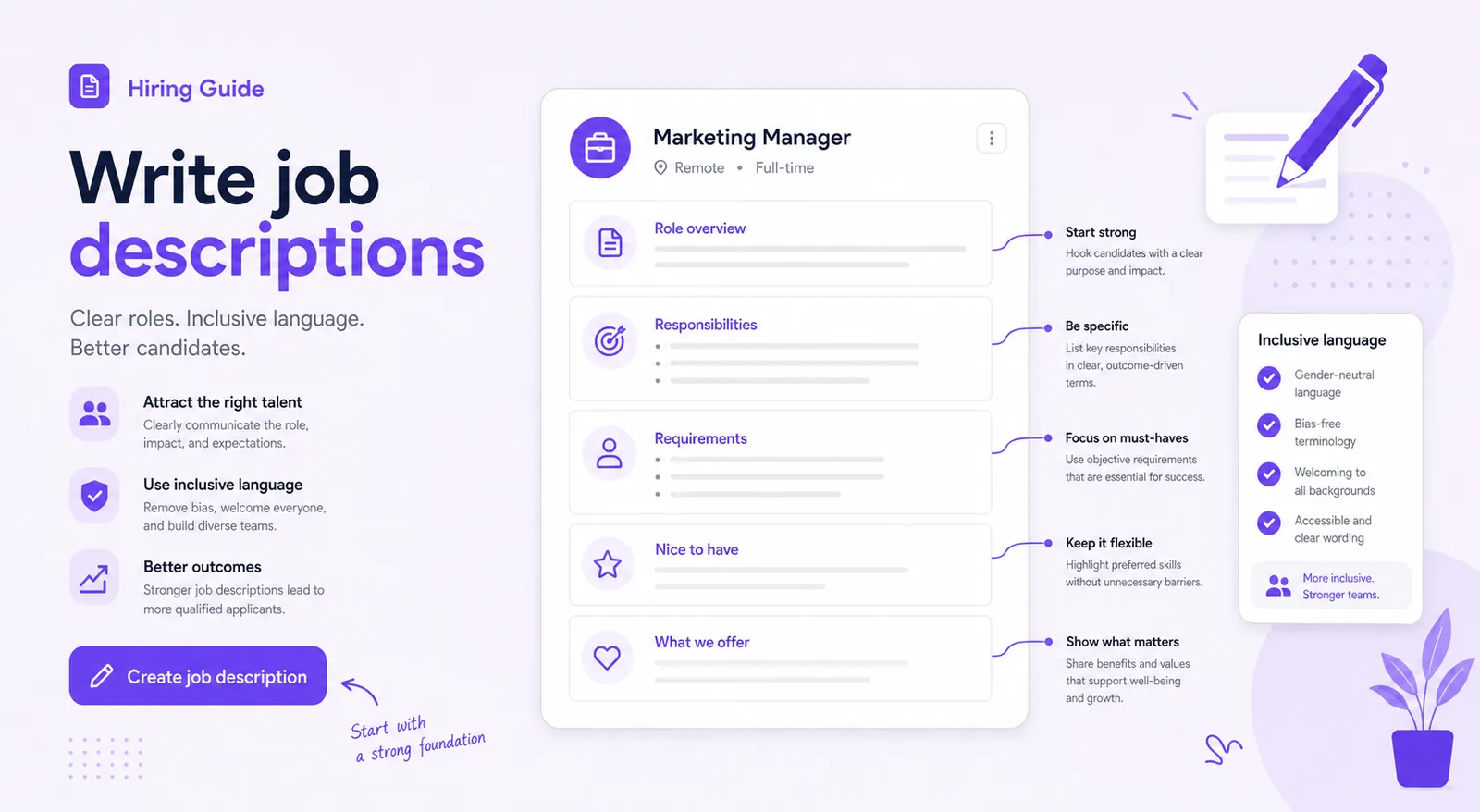
We once counted the requirements bullet points on a job description a client insisted on posting as-is: nineteen. Nineteen "required" qualifications for a mid-level coordinator role. It got four applicants in two weeks. We cut it to six. Applications tripled within days on the exact same listing everywhere else. How to write a job description that works is mostly a subtraction exercise, not an addition one.
There's an odd asymmetry in who spends time on a job description versus who reads it. Internally, the description gets reviewed by a manager, sometimes HR, occasionally legal, and each pass adds language written for an internal audience — department names, tool acronyms, compliance boilerplate. None of that internal audience is who the finished post is actually for.
Candidates don't read job descriptions the way hiring managers write them. Hiring managers write comprehensively, trying to cover every possible responsibility and qualification. Candidates skim, looking for a fast answer to one question: is this worth fifteen minutes of my time to apply? Every extra paragraph, every inflated requirement, is a chance for them to answer "no" before they've even gotten to the parts that would've excited them.
This guide covers what candidates actually read versus skip, the structure that consistently converts better, how to separate true requirements from nice-to-haves, writing in inclusive language that doesn't quietly filter out strong candidates, and the basic SEO habits that get your post found in the first place.
Write it once, post it free
Once your job description is tight, post it free on Jobedly and let AI agents rank who applies — no separate paid boost required.
Post a job freeWhat candidates actually read (and skip)
Eye-tracking and click behavior on job postings consistently show the same pattern: title and first two lines get read closely, the responsibilities section gets skimmed, the requirements list gets scanned for obvious dealbreakers, and the "about the company" boilerplate mostly gets skipped entirely unless something in it stands out.
- Read closely: job title, pay range, location/remote status, first line of the description.
- Skimmed: core responsibilities — candidates are checking "does this match what I actually want to do."
- Scanned for red flags: requirements list — an inflated list here is the single biggest applicant-killer.
- Usually skipped: company mission statements longer than two sentences, generic "we're a fast-paced, dynamic team" filler.
There's a reading-behavior detail that trips up a lot of well-intentioned writers: candidates scan in an F-shaped pattern, meaning they read the first line of a section fully and then increasingly skim down the left edge of the rest. That's exactly why the first sentence under each heading carries more weight than anything after it. If the most important detail in your responsibilities section is buried in bullet four, most readers will never see it. Put the thing you most want them to know first, every time, in every section.
The structure that converts
There's a reliable order that matches how candidates actually consume the page, rather than how a hiring manager might naturally draft it.
- Job title (searchable, not internal jargon) + location/remote status + pay range.
- One or two sentences on what the role actually is — plain language, no mission statement.
- Core responsibilities — 4–6 bullets, specific, not generic.
- Requirements — true must-haves only, kept short.
- Nice-to-haves — clearly separated and labeled as optional.
- Compensation and benefits detail, if not already covered by the pay range.
- A short, genuine line about the team or company — one paragraph, not five.
- Clear, low-friction call to apply.
How long should a job description be
Long enough to be specific, short enough to be read in full. In practice that's usually 300–500 words for most roles — enough room for real responsibilities and requirements without padding. If yours is pushing past 700 words, something in it is probably redundant or belongs in an internal document instead of the public posting.
Job description template free
A usable free template is just the eight-step structure above, filled in plainly: title, pay, one-line role summary, 4–6 responsibility bullets, 3–5 true requirements, 2–4 nice-to-haves labeled as such, a short team blurb, and an apply link. You don't need a paid template generator — the structure is the product, and it's the same structure regardless of role or industry.
One structural choice that quietly matters: bullet points beat paragraphs for responsibilities and requirements, almost without exception. A paragraph forces the reader to parse sentence structure to extract the actual list of duties; a bulleted list hands it to them pre-parsed. We've rewritten dense paragraph-style descriptions into bullets with literally no other change and watched time-on-page and application-completion both improve. It's a small edit with an outsized return, because it removes friction at exactly the point where a skimming reader is deciding whether to keep going.
Requirements vs. nice-to-haves (stop over-asking)
Requirements bloat happens for an understandable reason: every stakeholder who touches the job description adds one more thing they'd love to see, and nobody wants to be the person who removes someone else's addition. The result is a wish list disguised as a requirements list, and it filters out qualified people who'd have been fine without the fifteenth bullet point.
| Bloated version | Trimmed version | Why it works |
|---|---|---|
| "5+ years experience in [narrow tool]" | "Experience with similar tools; willingness to learn ours" | Tool-specific experience is trainable; broader aptitude isn't |
| "Bachelor's degree required" | Removed unless legally or technically necessary | Filters out capable candidates for no functional reason in most roles |
| "Must be an expert in Excel, PowerPoint, and three internal systems" | "Comfortable with spreadsheets and standard office software" | Internal system fluency is a training-week problem, not a hiring filter |
| Twelve bullet points of "required" skills | 4–5 true must-haves, rest moved to nice-to-haves | Every extra required line disqualifies someone in their own head before applying |
How to write job requirements
For each candidate line item, ask: would we actually reject someone great who was missing only this? If the honest answer is no, it's a nice-to-have, not a requirement — move it down and label it accordingly. This single filter, applied line by line, is what turned that nineteen-bullet list into six.
It helps to run this exercise with someone other than the person who wrote the original list, because the author of a requirement is the person least able to see it objectively — they remember the specific situation that made them add it, and that memory makes it feel essential even when it isn't. A second set of eyes, asking the reject-someone-great question line by line, catches padding the original writer will defend out of habit rather than necessity.
Research on this pattern, often cited by outlets like SHRM, points to the same underlying mechanism repeatedly: candidates — women in particular, across multiple studies — tend to apply only when they meet nearly all listed requirements, while a smaller share of candidates will apply having met only a fraction of them. That means an inflated list doesn't just shrink your applicant pool. It skews who's left in it, in a direction that has nothing to do with actual ability to do the job.
Inclusive, bias-free language
Language in a job posting can quietly discourage qualified people without ever mentioning a protected characteristic. Gendered phrasing, age-coded terms, and unnecessarily aggressive tone ('ninja,' 'rockstar,' 'must thrive under extreme pressure') all measurably shift who applies, even when no one intended that effect.
Inclusive job description language
| Avoid | Use instead | Why |
|---|---|---|
| "Recent grad" / "digital native" | "Early-career" / specific skill needed | Age-coded phrasing can discourage older, qualified applicants |
| "Rockstar," "ninja," "guru" | The actual job title | Gendered/masculine-coded language reduces applications from women, per multiple hiring studies |
| "Must be able to work long hours without complaint" | State actual schedule expectations plainly | Vague endurance language reads as a red flag rather than a filter |
| "He/she will manage..." | "You will manage..." or "the person in this role will..." | Avoids assuming gender and speaks directly to the reader |
This isn't about softening standards — a role with hard requirements should say so plainly. It's about making sure the words around those requirements don't add filtering you never intended and wouldn't defend if asked about directly.
Tone matters as much as specific word choice. A posting that reads as demanding and combative in every line — heavy on words like "must," "required," "non-negotiable" stacked one after another — sets an adversarial expectation before the person has even applied. The same requirements, stated plainly without the escalating tone, read as a normal job posting rather than a warning label. Say what's required. You don't have to say it like a threat.
SEO for your job post so it gets found
A perfectly written job description that no one finds doesn't help you hire anyone. Basic SEO for job posts is less about tricks and more about matching how people actually search.
Job title best practices
- Use the title candidates actually search, not an internal or invented one — "Customer Success Manager," not "Client Happiness Champion."
- Avoid pure internal levels ("Level II Associate") without a plain-language equivalent alongside it.
- Include the core function in the title even if there's a branded twist — "Senior Software Engineer — Platform Team," not just "Platform Team Member."
- Location and remote status belong near the title, since many searches filter on this immediately.
Beyond the title, posting on boards that support structured job-posting data (so search engines like Google for Jobs can index the role correctly) does more for discoverability than any amount of keyword stuffing in the body text. Our guide to posting a job for free covers which free platforms handle this well.
For roles that require specific certifications, licenses, or fall into occupation categories with standard pay bands, the BLS Occupational Outlook Handbook and BLS Occupational Employment and Wage Statistics are useful references for making sure your title and pay range match how the role is actually classified and compensated in the market, not just how your company happens to label it internally.
Keyword stuffing specifically — repeating the job title or skill terms unnaturally throughout the body just to game search — tends to backfire twice over. It reads poorly to an actual human candidate, and modern search ranking (on both general search engines and job boards themselves) is generally built to discount exactly that pattern rather than reward it. Write the description once, in plain language, using the terms a candidate would naturally search for because they're the accurate terms for the role — not because you inserted them an extra three times.
Get the description right, then let ranking do the rest
Post your finished job description free on Jobedly — AI agents score and rank every applicant automatically once they start coming in.
Find candidates with AIOnce your description is written and posted, the next bottleneck is usually reviewing what comes in — see how to screen job applicants for triage, and how to find qualified candidates if applications are still thin after a solid rewrite.
Treat the first version of any job description as a draft, not a final artifact. The most reliable signal you'll ever get on whether a description works is what actually happens after you post it — if applications are thin, if the applicants who do come in are consistently missing the same thing, that's real feedback on the post itself, not just on the market. Revising a description after a slow week of applications is not admitting failure. It's the fastest lever you have, faster than switching boards or waiting longer.
Post the description you just wrote
A tight, well-structured job description is wasted if it sits unposted. Get it live free and let ranking handle the response.
Post once. Let the AI agents do the sorting.
Post a job free on Jobedly and our AI agents surface and rank qualified candidates 0–100 so you spend time on the shortlist, not the pile.
Post a job freeFrequently asked questions
What's the ideal length for a job description?
Should I include salary in a job description?
How many requirements should a job description have?
What's the difference between requirements and qualifications in a job posting?
Do job titles affect how many applicants I get?
How do I make a job description sound less corporate without losing professionalism?
Should requirements differ for remote vs. in-office roles?
Glossary
- Requirements bloat
- The tendency for a job description's requirements list to grow beyond what's truly necessary as multiple stakeholders each add their own must-have.
- Nice-to-have
- A qualification that's helpful but not disqualifying if a candidate lacks it — should be listed separately from true requirements.
- Job posting SEO
- Practices (accurate titles, structured data, plain-language phrasing) that help a job listing get found in searches and aggregators like Google for Jobs.
- Inclusive language
- Wording in a job post that avoids unintentionally discouraging qualified candidates through gendered, age-coded, or overly aggressive phrasing.
- Structured data (JobPosting schema)
- Machine-readable markup that helps search engines correctly index a job listing's title, pay, and location.
- Job description format
- The ordering and structure of a job post's sections — title, summary, responsibilities, requirements, nice-to-haves, apply call to action.