How to Hire Remote Employees the Right Way
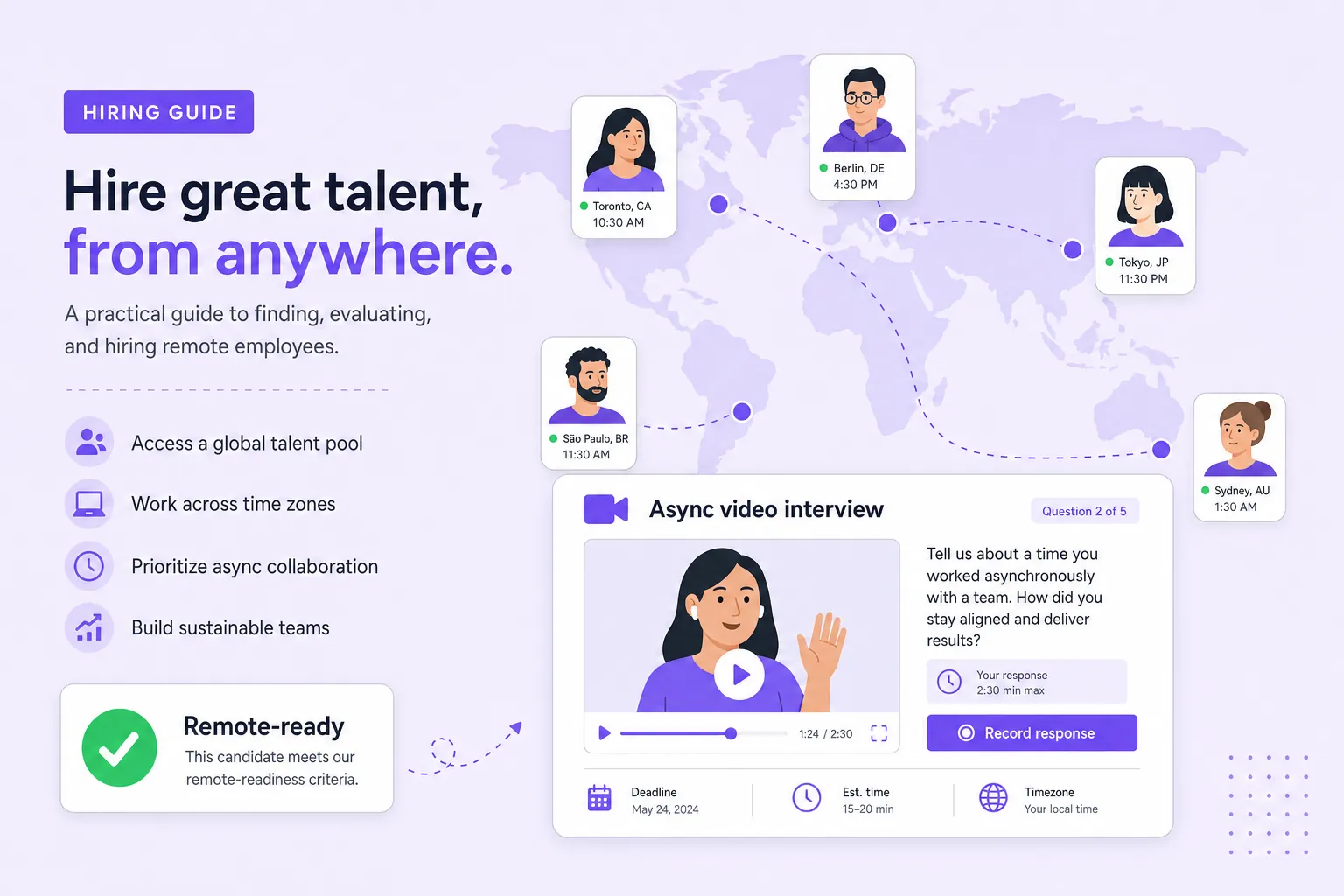
How to hire remote employees is a different question than "how to hire," and treating it the same way is where most remote hires quietly go wrong. The skills you're testing barely change. Everything around the skills changes — how someone communicates without a shared room, how they manage their own time without a manager glancing over, and whether they can actually get things done without someone physically checking in.
We've reviewed remote hiring processes that were just in-office processes copy-pasted onto a video call, and they consistently missed the same thing: they tested competence but never tested remote-readiness, which turned out to be the actual predictor of who succeeded six months in. Someone can be excellent at the job and still struggle badly working remotely, and the reverse is just as true.
This guide covers what actually needs to change in your process — the posting, the assessment, the interview format, and the compliance basics across states — plus where AI-ranked applicants help you filter a remote posting's typically larger, more geographically spread applicant pool down to the people worth a real conversation.
Consider this the checklist version of a lesson most teams learn the expensive way — by hiring someone great on paper who never quite adjusted to working without a room full of people around them. Every section below exists because we've seen the specific gap it closes cost someone a hire that looked perfect in the interview.
Filter a bigger remote applicant pool faster
Remote postings pull more applicants from more places. Jobedly's AI agents rank them against your role automatically, so volume doesn't turn into review paralysis.
Find candidates with AIWhat Changes When the Role Is Remote
Three things change immediately once a role goes remote: your applicant pool gets much bigger and more geographically spread, your ability to casually observe someone's work style disappears, and communication has to be made explicit instead of ambient. None of that is bad — a bigger pool usually means better candidates are reachable — but each one requires a deliberate adjustment to how you evaluate and manage people, not just where they sit.
The biggest mistake we see is treating remote as a logistics change instead of a role-design change. If a job genuinely requires spontaneous in-person collaboration to function well, forcing it remote and hoping communication habits fix the gap usually doesn't work. If the work is fundamentally about deliverables and clear handoffs, remote often works better than in-office, because it forces the clarity that in-office teams get away with skipping.
The applicant pool shift deserves its own mention because it changes your sourcing math, not just your evaluation criteria. A local in-office posting might reasonably draw from a metro area of a few hundred thousand working adults. A fully remote posting can draw from the entire country, or beyond — which is a real advantage for finding rare skill combinations, but it also means "post and hope" produces a much bigger, noisier pile than a local posting ever would, and manual review simply doesn't scale to it.
Managers feel this shift too, and it's worth naming before you get deep into hiring. Managing remote well means managing outputs and check-ins deliberately, instead of managing by proximity — noticing who looks busy, who's at their desk late. If your management style has always leaned on ambient presence to gauge how things are going, hiring remote will expose that gap fast, and no candidate assessment technique fixes a management style that isn't ready for it.
Writing a Remote Job Post That Filters Well
A vague "remote" tag on a posting invites a flood of applicants who assume remote means unstructured, low-oversight, and loosely accountable. A specific remote posting filters that out before it starts. State the actual working hours or overlap requirements, whether the role is fully remote or hybrid, what tools and communication cadence the team already uses, and whether there are location or time-zone restrictions.
- Specify time-zone overlap requirements explicitly — "must overlap 4+ hours with Eastern time" filters far better than "remote-friendly."
- Name the actual collaboration tools and cadence (daily standup, weekly sync, async-only) so candidates self-select based on fit, not guesswork.
- Say whether the role is remote-first, hybrid, or remote-eligible for specific states/countries only — vague eligibility wastes both sides' time.
- Mention what independence looks like day to day, since that's what separates candidates who thrive remote from those who need in-person structure.
The core structure from how to write a job description still applies — a remote posting just needs an added layer of specificity about how work actually happens, not just what work it is.
Expect a bigger, more varied applicant pool the moment "remote" appears in a posting — that's the upside of removing geography as a constraint. It's also why the specificity matters more here than almost anywhere else in this hiring series: a vague remote posting doesn't just attract more people, it attracts more people who were never going to be a fit, which turns your screening step into the bottleneck if you're not filtering earlier in the funnel.
Assessing Remote-Readiness (Not Just Skills)
Skill assessment for a remote role looks almost identical to an in-office one. Remote-readiness assessment is the part most processes skip entirely, and it's the part that predicts whether someone actually succeeds once they start.
How to assess remote candidates
| Signal | What to ask | Watch for |
|---|---|---|
| Self-direction | Describe a project you owned with minimal oversight — what did that look like day to day? | Vague answers, or a story that's really about a highly structured team, not independent work |
| Written communication | Share a written update or doc you produced for a distributed team | Rambling, unclear, or missing key decisions/next steps |
| Async collaboration history | How did your last team handle time-zone gaps or delayed responses? | No real answer, or a pattern of everything requiring live sync |
| Home setup / environment | Do you have a reliable, distraction-appropriate space to work consistently? | Answered defensively — the question itself should be asked neutrally, not as a gotcha |
| Prior remote track record | What's actually different about how you manage your day working remote vs. in-office? | No self-awareness of the difference at all |
None of these questions are meant to be a pass/fail gate the way a skills test might be — remote-readiness exists on a spectrum, and plenty of people grow into it with the right onboarding and management support. What you're really listening for is self-awareness: does the candidate have any real reflection on how they work independently, or is the question met with a blank look because it's genuinely never come up before. The second answer isn't disqualifying, but it does tell you how much extra structure you'll need to provide in month one.
Async-Friendly Interview Process
Remote interviewing has one structural advantage most teams don't use: you can evaluate real communication skills through the process itself, not just ask about them. How a candidate handles scheduling emails, how clearly they write follow-up questions, whether they show up prepared for a video call — all of that is a live sample of exactly the skill you're trying to assess.
Remote interview best practices
- Test video-call basics on purpose — start with something low-stakes to see how comfortable and prepared the candidate is with remote-native tools, since that's literally the job environment.
- Include at least one written component (a short async response to a real scenario) to evaluate written communication directly rather than inferring it from a verbal interview.
- Keep the process itself async-friendly where reasonable — offer scheduling flexibility across time zones instead of forcing every candidate into your local business hours.
- Use the same structured interview approach as any other role — remote doesn't change what makes a structured interview effective, it just changes the delivery format.
Get to the right remote candidates faster
A remote posting draws a bigger, more scattered pool. Jobedly's AI agents rank every applicant against your role automatically, so you spend interview time on real contenders.
Find candidates with AICompliance Across States and Countries (High Level)
Hiring remote employees in another state (or country) is not the same legal exercise as hiring locally, and this is the part most small and mid-size employers underestimate. Different states have different tax withholding, unemployment insurance, and employment-law requirements, and hiring someone who works from a state you have no other presence in can trigger new registration and tax obligations for your business.
This guide can't responsibly cover every state's specific rules — they change and vary too much for a general page to be your compliance source. What we can say reliably: check requirements for the employee's actual work location, not your company's headquarters, before finalizing an offer for someone in a new state, and get a payroll provider or professional who explicitly handles multi-state compliance if you're hiring outside your existing footprint for the first time. The U.S. Department of Labor is a starting point for federal-level obligations, but state-specific rules require state-specific guidance.
International remote hiring adds another full layer — worker classification, local labor law, and tax treaty questions that are genuinely jurisdiction-specific. Most companies hiring internationally for the first time use an employer-of-record service rather than attempting direct local employment, precisely because the compliance risk of getting it wrong is high and the setup cost of doing it right alone is significant.
A practical habit worth adopting before you post a remote role at all: decide up front which states (or countries) you're actually willing and able to hire in, and say so in the posting. "Remote — must currently reside in one of the following states" is a completely normal constraint, and it saves you from the awkward, morale-damaging conversation of telling a great finalist late in the process that you actually can't hire them because of where they live.
Remote Onboarding That Actually Works
Remote onboarding fails in a specific, predictable way: the new hire's first week is technically fine — laptop arrives, accounts get created — but socially empty, because nobody built in the equivalent of the in-office hallway conversations that normally teach a new person how things really work. Structure has to replace what used to happen by accident.
Build a first-week plan that includes actual scheduled conversations with teammates, not just system access and a document to read. Assign a specific point of contact for questions rather than a general "ask anyone" policy that, remotely, often means asking no one. And be explicit about response-time norms early — a remote new hire has no ambient sense of whether a two-hour delay on a message is normal or alarming until someone tells them.
With remote work now a durable feature of the labor market, per BLS telework data (March 2026), and a large share of workers actively preferring it where their role allows, per Pew Research Center — remote work, remote hiring competence isn't a niche skill anymore — it's a core part of running a hiring process that reaches the full breadth of qualified candidates rather than only the ones near an office.
The teams that get the most out of remote hiring treat it as its own discipline rather than a variant of their existing process with a video call swapped in. That means a posting written for remote from the start, a real remote-readiness assessment alongside the skills evaluation, an interview process that tests communication directly instead of assuming it, and a compliance check before an offer goes out rather than after. Get those four right and remote hiring stops being the riskier option — it becomes the one that reaches candidates your local competitors never see at all.
Post once. Let the AI agents do the sorting.
Post a job free on Jobedly and our AI agents surface and rank qualified candidates 0–100 so you spend time on the shortlist, not the pile.
Post a job freeFrequently asked questions
How do I hire remote employees for the first time?
What should a remote job posting include that an in-office one doesn't?
How do I assess remote candidates beyond their technical skills?
What are remote interview best practices?
Can I hire a remote employee who lives in a different state?
Do I need an employer of record to hire internationally?
How is remote onboarding different from in-office onboarding?
Is remote work still growing or has it plateaued?
Glossary
- Remote-readiness
- A candidate's demonstrated capacity for self-direction, async communication, and independent work quality, distinct from their raw job-skill competence.
- Async communication
- Communication that doesn't require both parties to be present at the same time, such as written updates or recorded messages, as opposed to live/synchronous meetings.
- Employer of record (EOR)
- A third-party organization that legally employs workers on a company's behalf in a jurisdiction where the company itself isn't set up to employ directly, commonly used for international hiring.
- Multi-state compliance
- The set of tax, payroll, and labor-law obligations that vary by state and can be triggered by employing someone who works from a state different from a company's home base.
- Time-zone overlap
- The portion of the working day during which a remote employee's schedule aligns with their team's core hours, used to set collaboration expectations for distributed teams.
- Hybrid role
- A role that combines both remote and in-person work, typically with defined in-office days or a required geographic proximity.