How to Find Qualified Candidates When the Good Ones Aren't Applying
We once had a role open for six weeks with forty applicants and not one of them qualified. The temptation in that moment is to conclude the talent doesn't exist. It almost never doesn't exist — it's just not applying to your post, which is a different problem with a different fix. How to find qualified candidates is really a sourcing question disguised as a hiring question.
Most job openings only ever reach people who are actively browsing boards that day. That's a small, self-selected slice of the total talent pool. The rest — the people doing good work somewhere else right now, not looking, but not unmovable either — never see your post at all unless you go find them.
This guide covers why qualified people so often skip past open roles, the difference between sourcing actively and sourcing passively, how to write postings that speak to the candidate instead of your org chart, where AI matching actually earns its keep, and how to turn all of it into a pipeline you can reuse instead of rebuilding every time you hire.
Stop waiting on the applicant pile to improve
Jobedly's AI agents actively surface and rank qualified candidates for your open roles — post free and let the matching do the searching.
Find candidates with AIWhy good candidates aren't applying
There are a handful of repeat reasons, and almost none of them are "there's no one out there." The job description buries the actual role under jargon. The requirements list reads like a wish list, not a bar. The pay isn't listed, so strong candidates — who have options — skip past it rather than gamble their time on a mismatch. Or the role simply never reaches people who aren't already scrolling a job board that week.
Unemployment sitting at a historically moderate 4.2% as of June 2026 means a large share of the people you'd want are currently employed somewhere else. They are not refreshing job boards. Reaching them takes a different motion than posting and waiting.
There's a second, quieter reason good candidates skip past open roles: the application itself is a tax on their time, and they price that tax before deciding whether to pay it. A posting with a vague title, no pay range, and an unclear "apply here, we'll get back to you" close reads as low-probability, high-effort. A candidate weighing five open tabs will close that one first, not because they're unqualified, but because the posting gave them no reason to believe the effort would be worth it. That's a writing and structure problem, not a talent-supply problem, and it's fixable in the time it takes to rewrite the post.
Research from LinkedIn Talent Solutions has repeatedly found that the large majority of the global workforce identifies as at least somewhat open to a new opportunity even while not actively job-hunting — which is exactly the population a post-and-wait strategy never reaches.
How to find employees for small business
Small employers often assume sourcing tools are built for enterprise recruiting teams with dedicated headcount. They're not, anymore. A free posting distributed across a couple of boards plus AI matching (Jobedly's model) gives a five-person company access to the same surfacing logic a much bigger recruiting team would use — without hiring a recruiter to run it.
There's also a scale mismatch worth naming directly. A national retailer hiring two hundred people a quarter can absorb a mediocre applicant-to-hire ratio because volume covers for inefficiency. A five-person shop hiring one person can't. Every wrong applicant you have to read is a bigger percentage of your total available hiring time than it would be for a large team. That asymmetry is exactly why small employers feel sourcing pain more acutely, and exactly why fixing the sourcing motion — not just tolerating a bad one — matters more for a small business than the size of the company would suggest.
We've also noticed small employers underuse a resource they already have: their existing customers, vendors, and local network. A well-worded post on your own channels, shared by people who already trust the business, often produces a smaller but meaningfully higher-quality applicant pool than a cold post on a general board. It costs nothing and takes ten minutes, and it's the single most skipped step in small-business sourcing.
Active vs. passive sourcing
Active sourcing means reaching people who are already looking — posting where job seekers browse, and making sure your listing is easy to find and worth clicking. Passive sourcing means reaching people who aren't looking yet, through outreach, referrals, talent pools, or AI matching that surfaces fit based on background rather than search behavior.
| Channel | Reaches active seekers? | Reaches passive talent? | Effort required |
|---|---|---|---|
| Job board posting (free/paid) | Yes | Rarely | Low |
| AI candidate matching (Jobedly) | Yes | Yes — ranks fit, not just recency | Low |
| Employee referrals | Sometimes | Yes, often highly qualified | Low, but relationship-dependent |
| Direct outreach / LinkedIn messaging | No | Yes | High |
| Talent pool / past applicants | No | Yes, if maintained | Medium (upkeep needed) |
| Employer branding / careers page | Yes | Yes, slow-building | Medium, compounding over time |
How to source passive candidates
Direct outreach works but doesn't scale for a small team — you can message a dozen people a week, tops, before it eats your whole schedule. That's the gap AI matching is built to close: it evaluates every applicant and, on richer platforms, surfaces fit signals beyond keyword search, so passive-leaning candidates who do apply don't get lost under a pile of active-seeker noise.
Referrals deserve a more deliberate place in this mix than most employers give them. The instinct is to treat referrals as something that happens to you — an employee happens to mention an opening to a friend — rather than something you actively run. The employers who get the most out of referrals ask specifically, repeatedly, and make it easy: a clear, current opening list shared internally, a simple way to submit a name, and a fast response when someone does. None of that requires software. It requires someone remembering to ask more than once.
It's also worth being honest about the limits of passive sourcing for a small team. Cold outreach to someone who isn't looking has a low response rate no matter how well-crafted the message is — that's just the nature of interrupting someone who wasn't thinking about a job change. The return on that effort goes up considerably when the outreach is targeted at people who look like genuinely strong fits, rather than a wide, generic net. This is precisely where matching technology changes the math: instead of guessing who might be a fit and reaching out cold, you can let applicants self-select in and then have the ranking tell you which of them deserve the most attention.
Writing for the candidate, not the org chart
A shocking number of job posts read like internal memos — full of department names, internal tool acronyms, and a requirements list assembled by five different stakeholders who each added their own must-have. None of that speaks to the person deciding whether to spend fifteen minutes applying.
How to attract qualified applicants
- Lead with what the person will actually do, not the company's five-year mission.
- Cut the requirements list to what's truly non-negotiable — every extra line filters out someone who could've done the job.
- Include pay. It is consistently one of the strongest levers for attracting qualified applicants who'd otherwise skip an unlisted range.
- Say what's genuinely different about the role or team, specifically — vague claims like "fast-paced" and "great culture" have been drained of meaning by overuse.
- For the full breakdown of structure and language, see how to write a job description.
Using AI matching to surface fit
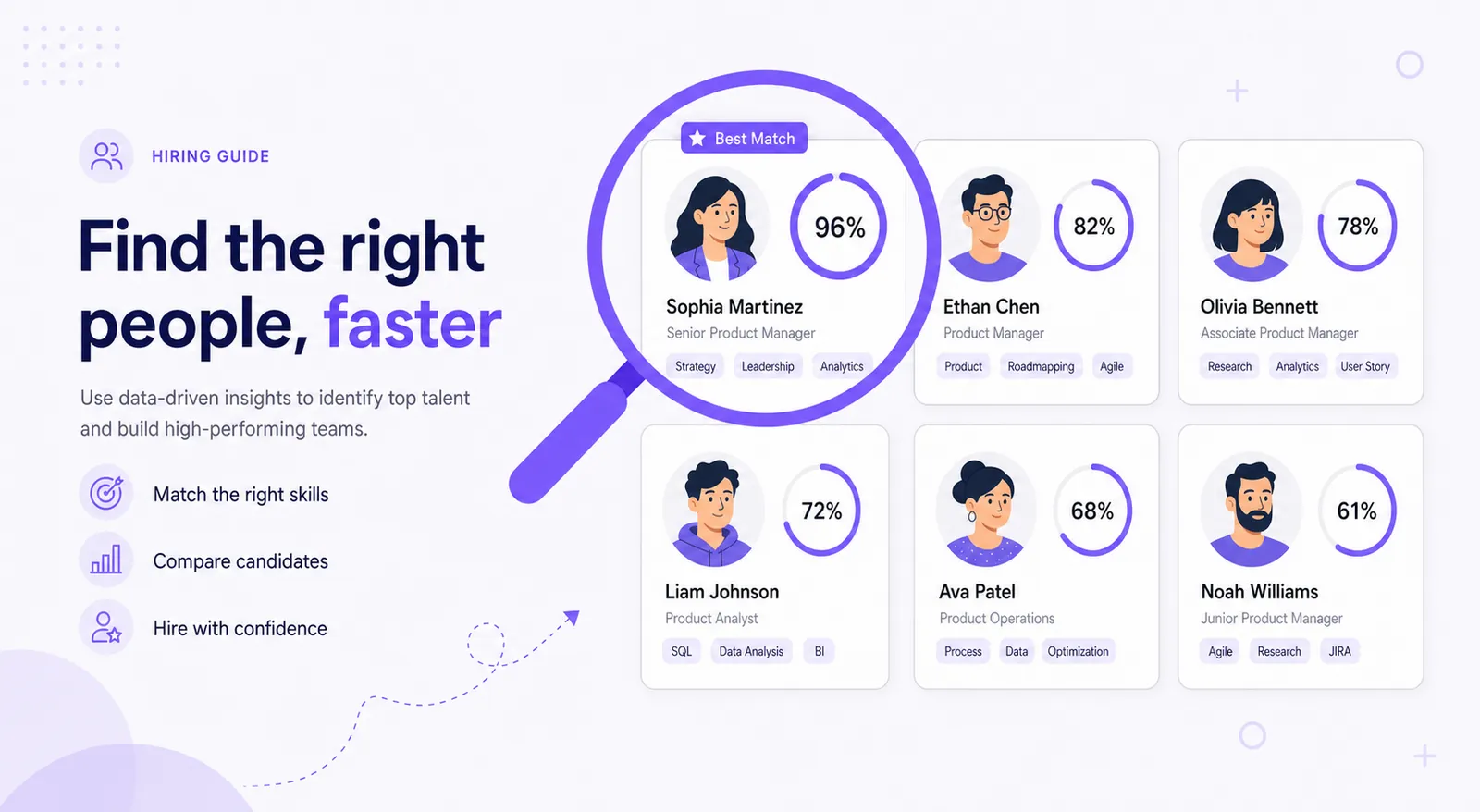
The traditional model — post, wait, sort manually — treats every applicant as unknown until a human reads them. AI matching flips that: every applicant gets scored against the role the moment they apply, so review starts with a ranked shortlist instead of a flat queue sorted by nothing more meaningful than timestamp.
That number matters for sourcing specifically: if your role can be remote or hybrid at all, restricting your search to local candidates is a self-imposed limit, not a market reality. Widening the geography and letting AI ranking handle the resulting volume is usually a better trade than staying narrow to keep the applicant count manageable.
Let AI agents do the finding, not just the sorting
Post your role free on Jobedly and our AI agents actively surface and rank qualified candidates 0–100 — including people you'd never have found by keyword search alone.
Find candidates with AIFor roles that are fully remote, our remote hiring guide covers what changes in sourcing and assessment once location stops being a filter.
One thing worth watching for: AI matching is only as good as what it's matching against. If your job description is vague, generic, or overloaded with unnecessary requirements, ranking software will do exactly what you asked it to — rank against the wrong bar. Fixing the posting itself, before you lean on matching to fill it, is not optional groundwork. It's the actual input the whole system depends on.
Building a repeatable pipeline
The employers who stop struggling to find candidates are usually the ones who stopped starting from zero every time a role opens. A pipeline means: past strong applicants stay on file, referral sources stay warm, and your sourcing channels are already set up rather than rebuilt per req.
If your sourcing plan leans on referrals or direct outreach, the U.S. Department of Labor publishes general guidance on fair hiring practices worth keeping in view as your sourcing channels diversify beyond a standard job posting.
Best places to find candidates
- AI-matched free posting (Jobedly) — ongoing, low-effort, ranks fit automatically.
- Employee referrals — ask explicitly, don't wait for it to happen organically.
- A maintained "good but not right now" list from past hiring rounds.
- Your own careers page and social presence — see employer branding for how to make this actually convert.
- Niche communities or boards specific to the role's field.
How to find candidates without recruiters
Recruiters are effectively paid sourcing labor — they search, reach out, and pre-qualify on your behalf. You can replace a meaningful share of that labor with a combination of AI matching and a small, consistent referral ask. It won't fully replicate an experienced recruiter's network overnight, but for most single-role hiring at a small or mid-size company, it closes most of the gap at a fraction of the cost.
There's also a maintenance cost to a pipeline that's worth naming honestly, because pretending it's free is how these lists rot. Contact information goes stale. People who were open six months ago have since taken other jobs. A pipeline that isn't periodically refreshed becomes a graveyard of dead leads that feels productive to maintain and isn't. The realistic version of this practice is a short quarterly check-in — a five-minute pass through the list, removing names that are clearly no longer relevant and flagging the two or three still worth a message — rather than an ever-growing spreadsheet nobody revisits.
The pipeline mindset also changes how you treat a hiring round that doesn't work out. If a role closes without a hire, or the hire doesn't stick, the instinct is to feel like the sourcing effort was wasted. It usually wasn't — the near-miss candidates from that round are exactly the raw material for your "good but not now" list, and revisiting them for the next opening is dramatically faster than sourcing from zero again. We've filled roles in under a week purely by going back to a strong runner-up from a search two months earlier. That only works if someone actually kept the list.
Once candidates start flowing in through a real pipeline, the next problem is triage — our guide on how to screen job applicants picks up exactly there, and candidate sourcing strategies goes deeper on channel-specific tactics if you want to specialize further.
Turn sourcing into a system, not a scramble
A pipeline you maintain will always outperform a search you start from zero. Posting free and letting AI ranking run continuously is the lowest-effort way to keep that pipeline moving.
Post once. Let the AI agents do the sorting.
Post a job free on Jobedly and our AI agents surface and rank qualified candidates 0–100 so you spend time on the shortlist, not the pile.
Post a job freeFrequently asked questions
Why am I not finding qualified candidates even after posting on multiple boards?
What's the difference between sourcing and recruiting?
How do I reach candidates who aren't actively job searching?
Is it worth widening my search to remote candidates?
How many qualified applicants should I expect from a free job posting?
Do employee referrals actually produce better candidates?
Can AI candidate matching replace manual sourcing entirely?
Glossary
- Active candidate
- A job seeker currently and visibly searching for a new role — applying to postings, updating profiles, browsing boards.
- Passive candidate
- A person not actively job-hunting who could still be a strong fit if reached directly with the right opportunity.
- Talent pool
- A maintained list of past applicants or contacts who were strong but not selected, kept warm for future openings.
- Candidate sourcing
- The process of identifying and reaching potential candidates, as distinct from screening or interviewing them once found.
- AI candidate ranking
- Automated scoring that orders applicants by fit to a role's requirements rather than by application timestamp.
- Boolean search
- A structured search technique using AND/OR/NOT operators to find candidate profiles matching specific criteria, often used on LinkedIn.