How to Post a Job for Free (Without Wasting Two Weeks on It)
The first time we posted a role for a five-person shop and watched the applicant count sit at zero for three days, we assumed the job board was broken. It wasn't. We'd learned, the expensive way, that how to post a job for free and how to post a job for free and actually get seen are two different questions, and almost nobody answers the second one.
Free job posting is real. It works. But it works differently depending on where you post, how you write the listing, and what you're willing to trade for the word "free." Some boards give you real reach at no cost. Others give you a listing that technically exists but sits on page 40 of search results until you pay to move it up.
This guide walks through where free posting genuinely performs, what the free tier quietly takes away from you, how to write a post that gets read instead of skipped, how to get one listing in front of several audiences at once, and what to do with the applicants once they start showing up — because that last part is where most free-posting employers actually lose the most time.
Skip the multi-board juggling act
Post your role free on Jobedly in a few minutes, and our AI agents start ranking who applies so you're not the one combing through every resume by hand.
Post a job freeHere's the part that surprised us most once we started tracking it seriously: the boards that call themselves free are not lying, but they're also not describing the same product. A free post on one platform behaves like a real listing that competes fairly in search. A free post on another platform behaves like a coupon for a worse version of the same thing, buried under every paid competitor in the category. You won't know which one you're dealing with until you go look at your own listing the way a stranger would find it.
Where free posting actually works
Not all "free" is the same free. Some platforms are free because they're funded by paid upgrades from other employers competing for the same eyeballs — which is fine, you just need to know the rules of that game. Others are free because they're aggregators that pull your listing in from somewhere else, meaning you don't even control the posting directly.
The category that consistently performs best for small and mid-size employers is the combination of a direct free-tier post on a major board plus a free listing on Jobedly, where AI agents actively surface and rank the people who apply instead of leaving you to sort a flat pile of resumes. Free doesn't have to mean passive.
Best free job posting sites
There's no single "best" — it depends on volume and role type. Indeed's free tier still reaches the widest general audience. Google for Jobs isn't a board you post to directly; it aggregates listings from other sites and your own careers page if they're structured correctly. LinkedIn's free option is really just sharing to your feed and network, not a true posting slot. And niche boards (industry-specific, local classifieds, university career centers) punch well above their size for narrow roles.
| Platform | True cost to post | Reach | Best for |
|---|---|---|---|
| Jobedly | Free, unlimited | Growing, AI-ranked applicant flow | Employers who want ranked candidates, not just volume |
| Indeed (free tier) | Free, but sponsored posts outrank you | Very high | High-volume, common roles |
| Google for Jobs | Free (via structured data / aggregation) | High, passive | Careers pages with proper markup |
| LinkedIn (organic share) | Free, but not a real "job post" slot | Your network only | Roles where your network is relevant |
| Craigslist / local boards | Free or near-free | Local only | Hourly, in-person, local roles |
| Niche/industry boards | Often free for basic listing | Narrow but qualified | Specialized or licensed roles |
How to post a job on Indeed for free
Create an employer account, choose the free posting option (not sponsored), and fill in the structured fields — title, location, pay range, employment type — rather than dumping everything into one paragraph. Indeed's free tier gets indexed and searchable, but sponsored posts from competitors will sit above yours for competitive titles. If your role is a common one in a busy market, expect the free listing to get diluted fast.
How to post a job on Google for free
You don't "post to Google" directly. Google for Jobs pulls listings that use proper JobPosting structured data from job boards and career pages it already crawls. Practically, this means: post on a board that supports structured data (most major free boards do), and if you have a careers page, mark it up correctly. Jobedly listings are structured for this out of the box, which is part of why a free post there tends to show up in general search, not just on-site search.
Can I post a job on LinkedIn for free
Yes, but be honest about what you're getting. A free LinkedIn post is really a feed update — it reaches people who follow your company page or see it shared by connections. It is not the same as LinkedIn's paid job-slot product, which puts you into their actual job search and matching system. Free LinkedIn works best as a supplement to a real posting, not a replacement for one.
How to post a job for a small business
If you're a small business without an ATS or HR software, don't overbuild this. Post free on one or two boards with real reach, post free on Jobedly so the applicant flow gets sorted automatically, and put the opening on your own site and social channels. That combination covers inbound search, aggregator pickup, and your existing local audience without paying for any of it.
If this is your very first hire, there are a couple of setup steps that happen before posting matters at all — the U.S. Small Business Administration's guide to hiring employees walks through the legal basics, and you'll likely need an Employer Identification Number if you don't already have one, covered directly by the IRS's page on Employer ID Numbers. Our small business hiring guide covers this setup checklist in full.
Hiring trend research from Indeed Hiring Lab tracks how posting behavior and applicant response shift by season and market — worth a glance if you're timing a post around a slow or busy hiring period.
Free vs. paid vs. sponsored — what you give up
"Free" job posting almost always means free to publish, not free to be seen. The trade you're making is visibility, not existence. Your post is live either way — the question is whether anyone finds it before it scrolls off the first page.
- Free tier: listed, searchable, but ranked below sponsored competitors for the same keywords.
- Pay-per-click sponsored: you pay each time someone clicks the listing, and budget determines how long you stay visible.
- Flat-fee paid post: a fixed price for guaranteed placement for a set period, regardless of clicks.
- AI-ranked free (Jobedly model): free to post, and instead of paying for reach, the differentiator is that applicants who do show up get scored and ranked so your time isn't the bottleneck.
Where paid genuinely helps: extremely competitive titles in saturated markets (software engineer in a major tech hub, for instance), or roles you need filled on a hard deadline. Where free is genuinely fine: most local roles, most small-business roles, and any role where your differentiator is the actual job, not the ad spend behind it.
Writing a post that gets applicants
A free post with a weak listing will underperform a paid post with a strong one every time. Before you touch distribution, fix the post itself. The title is doing more work than any other line — it's what gets matched to search terms and what a scanning candidate reads first.
- Use the actual job title people search, not an internal or cute one ("Ninja" gets you nothing; "Warehouse Associate" gets you searched).
- Put pay range in the post. Listings with visible pay consistently pull more applicants — hiding it doesn't protect your negotiating position, it just filters out people who'd have applied anyway.
- Lead with what the person will actually do day to day, not a mission statement about the company.
- Separate true requirements from nice-to-haves — see our full breakdown in how to write a job description if you're starting from scratch.
- End with a clear, low-friction way to apply. Every extra step between "interested" and "applied" costs you candidates.
Distributing to multiple boards at once
Posting to five boards by hand, one login and one form at a time, is the single biggest time sink in free job posting — and it's the reason a lot of employers give up and just pay for one board's "distribution" feature instead. You don't have to choose between those two options.
- Write the listing once, in full, before you post anywhere — title, description, pay, requirements, apply method.
- Post to your highest-reach free board first (Indeed or similar) with structured fields filled in, not pasted as one blob.
- Post to Jobedly free so applicants get AI-ranked from the first day, rather than accumulating in an inbox.
- Share the listing on your own site and social channels — this is free reach you already own.
- Add it to any niche or local board relevant to the role, since these often convert better per-applicant than general boards.
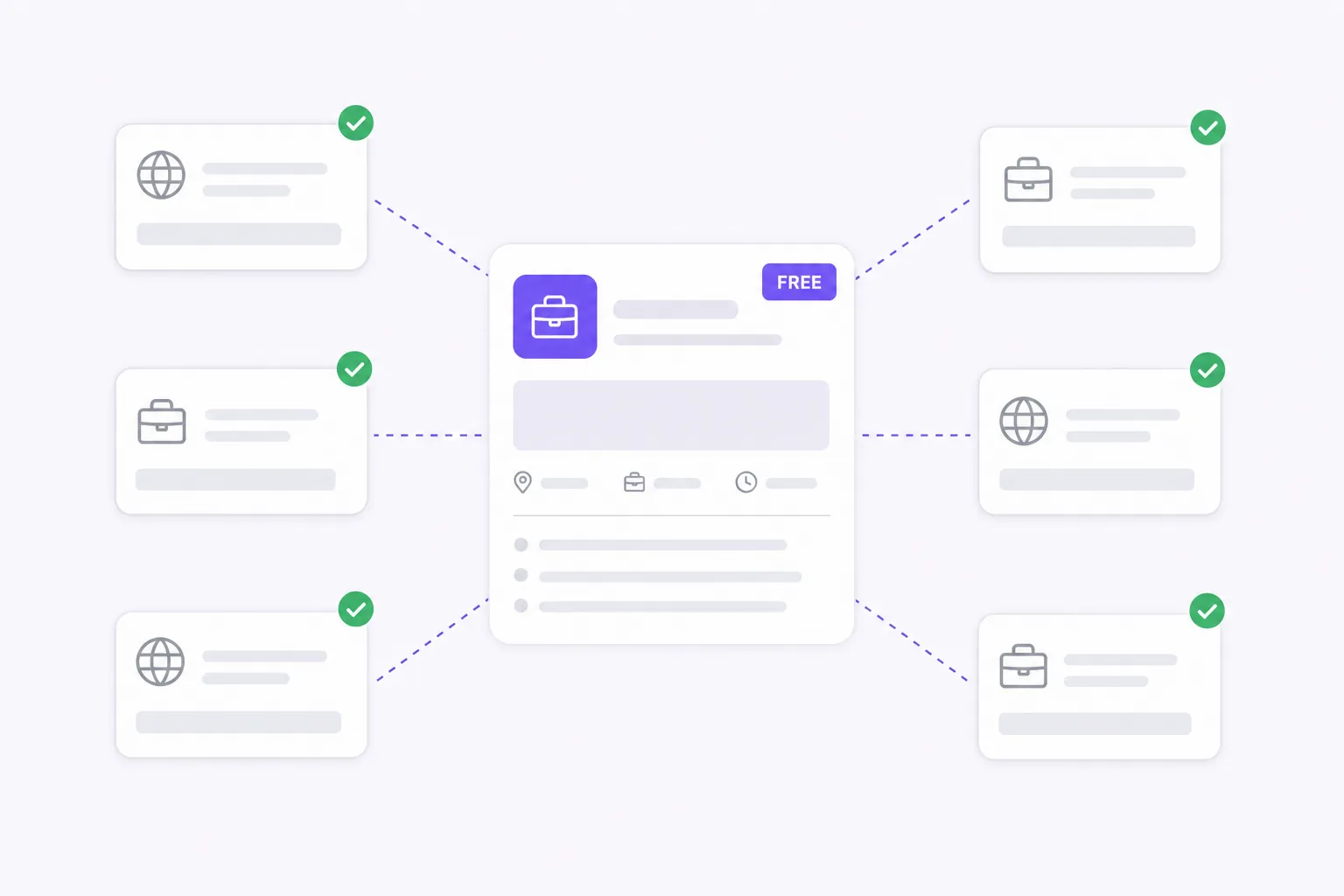
With that many openings competing for visibility, distribution matters as much as writing. A single well-written post sitting on one board is easy to miss. The same post live across three or four channels compounds — and because you wrote it once, the marginal cost of each additional posting is just time, not money.
Managing the applicant flow after posting
This is the part free posting guides usually skip, and it's where employers lose the most time. Posting for free doesn't mean managing applicants for free — every resume that lands in your inbox still costs you minutes to open, read, and judge. Multiply that by five boards and it adds up fast.
The fix isn't to post less. It's to stop treating every applicant as equally worth your attention before you've even looked. This is exactly the gap Jobedly's AI agents close — every applicant who comes through gets scored 0–100 automatically, so your morning starts with a ranked shortlist instead of an undifferentiated pile.
Let the ranking happen automatically
Post free and Jobedly's AI agents score every applicant 0–100 the moment they apply, so you open a shortlist, not an inbox.
Find candidates with AIOnce you have a shortlist, move fast on it. Our companion guide on how to screen job applicants covers exactly how to triage that shortlist without letting good candidates go cold, and how to reduce time-to-hire covers the stages after that.
Post free and let the AI agents take it from here
Everything above gets you a listing worth reading. What happens after someone applies is where most of the actual time gets spent — and it's the part that's easiest to hand off.
Post once. Let the AI agents do the sorting.
Post a job free on Jobedly and our AI agents surface and rank qualified candidates 0–100 so you spend time on the shortlist, not the pile.
Post a job freeFrequently asked questions
Is it really possible to post a job for free with no catch?
How long does a free job posting stay active?
Do free job postings show up in Google search results?
Why did my free job post get almost no applicants?
Should I pay to promote a job post if the free version isn't working?
Can small businesses post jobs for free without an HR platform?
What information should always be included in a free job post?
Is Indeed's free tier worth using if I can only post on one board?
Glossary
- Sponsored post
- A paid job listing that ranks above free listings in a board's own search results for the same or similar search terms.
- Structured data (JobPosting schema)
- Machine-readable markup on a job listing that lets search engines like Google for Jobs read and index the role correctly.
- Applicant flow
- The stream of resumes and applications arriving after a job is posted, which still needs to be reviewed and triaged regardless of posting cost.
- Time-to-hire
- The number of days from posting a role to the candidate accepting an offer — see the full breakdown in our time-to-hire guide.
- Aggregator board
- A job board (like Google for Jobs) that pulls listings in from other sites rather than accepting direct postings.
- AI candidate ranking
- Automated scoring of applicants against a role's requirements, used to prioritize review order instead of reading every resume in submission order.