Employer Branding: Why Candidates Ghost Before They Even Apply
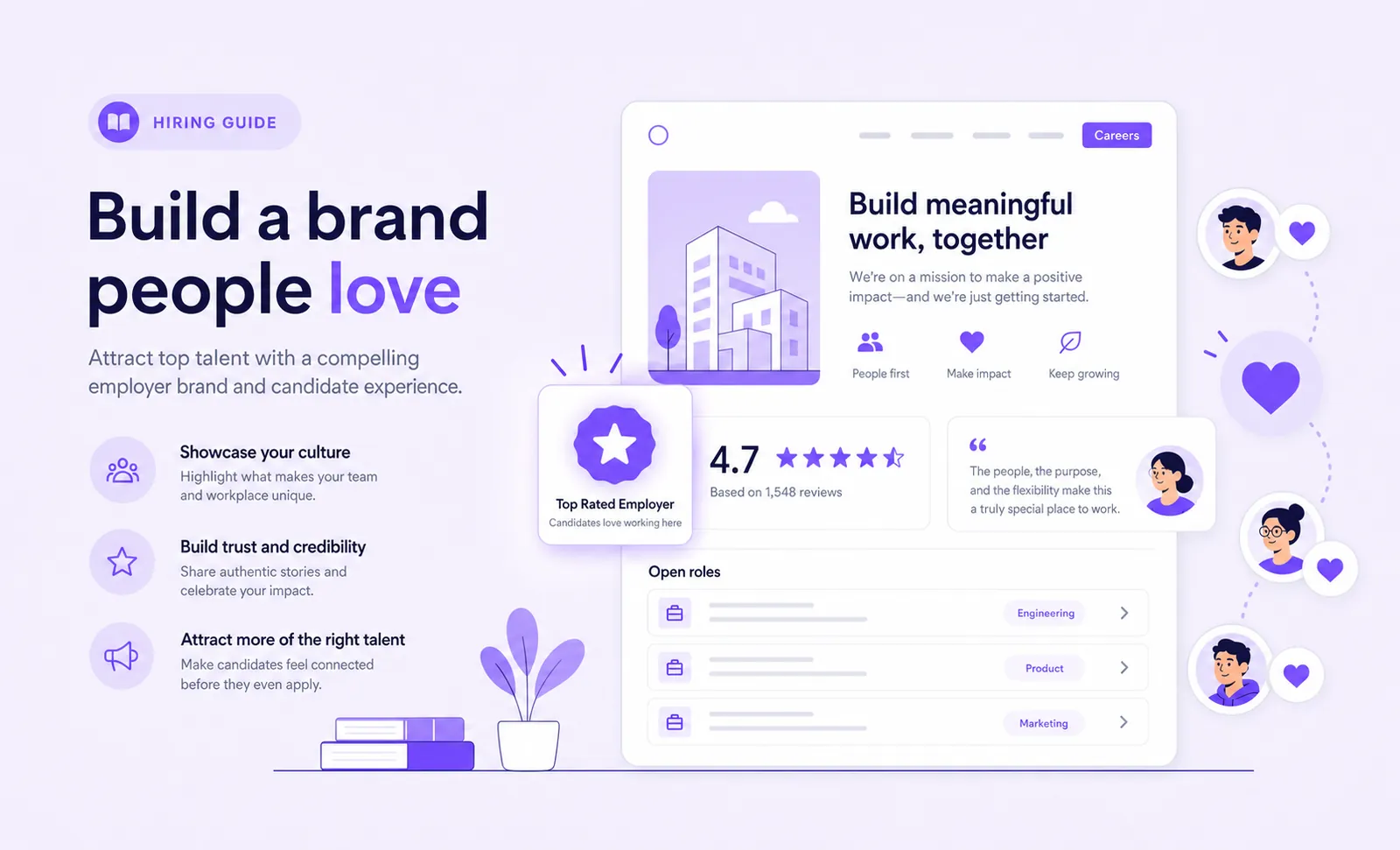
Most candidates who decide not to apply never tell you why. They just don't click "apply," and you never see the drop-off because it happened before your funnel even started counting. Employer branding is what fills that invisible gap — the impression a candidate forms about what it's like to work for you, built from your careers page, your reviews, your job postings, and honestly, from how long you took to reply to their friend six months ago.
We've reviewed careers pages that looked polished and still lost candidates, and we've seen bare-bones pages from small teams that converted well above what their design budget would suggest. The difference was never production value. It was whether the page actually answered what a candidate wants to know before they'll spend twenty minutes on an application.
This guide covers what your careers page needs to say, how to handle public reviews without getting defensive, and how to build a credible employer brand without a marketing team — plus where a fast, transparent hiring process itself becomes part of your brand, because candidates talk about how they were treated whether they got the job or not.
Worth being direct about scope here: this isn't a marketing playbook about crafting a mission statement or a tagline. Candidates rarely reject an offer because your "about us" copy was weak. They reject because the concrete, checkable facts — pay, culture signals, how the process treated them — didn't add up to what the tagline promised. Fix the facts first.
Make the process itself part of your brand
A fast, transparent hiring process is a branding asset. Post free on Jobedly and let AI agents keep your pipeline moving so candidates never sit in silence.
Post a job freeWhy Candidates Ghost Before Applying
"Ghosting" gets blamed on candidates, but a huge share of it happens on the employer side of the funnel, before an application is even submitted. A candidate reads a vague job posting, clicks through to a careers page with no pay information and stock photography that could belong to any company on earth, checks a review site and finds three angry posts about a slow, silent hiring process, and closes the tab. You never see that as a rejection. You see it as a posting that "didn't get much traffic."
This invisible drop-off is exactly why employer branding gets underrated internally. It doesn't show up as an explicit complaint — it shows up as a slowly shrinking applicant pool that everyone assumes is a market condition. Meanwhile, a nearly identical competitor with a clearer careers page and a faster process is quietly pulling from the same pool of candidates and getting a very different result.
What is employer branding?
Employer branding is the reputation you have as a place to work, as distinct from your reputation as a product or service provider. A company can have an excellent consumer brand and a terrible employer brand — customers love the product, but nobody wants to work there because pay is opaque, reviews describe burnout, or the hiring process itself feels chaotic. It's shaped by every touchpoint a candidate has with you before day one: job postings, the careers page, reviews, interview experience, and word of mouth from people who've worked there.
The uncomfortable truth is that most companies find out about their employer-brand problems secondhand, if at all — a recruiter mentions candidates seem hesitant, or a departing employee says something in an exit interview that finally connects the dots. Nobody sends you a report explaining why applications dropped. The signal is usually just quiet: fewer applicants, more no-shows to first interviews, more offers declined without a clear reason given. Any one of those alone might mean nothing. All three together are usually a brand problem, not a market problem.
What a Careers Page Must Answer
A careers page isn't a design project — it's an answer sheet. Every candidate arrives with the same short list of questions, whether they say so or not: what would I actually do here, what does it pay, what's the culture really like beyond a slogan, and is this a place that treats people well. If your page doesn't answer those in plain language, candidates fill the gap with assumptions, and the assumption is rarely generous.
Test this yourself before you take our word for it. Open your own careers page in an incognito window and time how long it takes to find the pay range for a specific open role, a description of what someone actually does day to day, and any real evidence of who currently works there. If it takes more than thirty seconds or several clicks to find any of the three, that's the exact gap costing you applicants right now — not the design, not the copywriting, just missing information.
Careers page examples (what actually works)
| Element | Why it matters | Common mistake |
|---|---|---|
| Pay range or clear range logic | The single biggest filter for serious applicants | Omitted entirely, or buried after five clicks |
| Real team photos and voices | Signals an actual workplace, not stock imagery | Generic corporate photography with no real employees |
| Specific role listings, not a static "careers" blurb | Candidates need to see what's actually open now | One generic "join our team" page with no live openings |
| Honest description of pace/culture | Sets accurate expectations, reduces early attrition | Buzzword-heavy language that says nothing concrete |
| Clear, fast application process | Signals respect for candidate time | Multi-page forms duplicating the resume upload |
Your job postings themselves are part of this — a vague or bloated description does the same damage as a bad careers page, just earlier in the funnel. See how to write a job description for the specific structure that filters well without scaring off good candidates.
Don't underestimate how much load-bearing work the "what would I actually do here" answer carries. Candidates have been burned before by job titles that didn't match the actual day-to-day, and vague postings feel like a repeat of that pattern even when your intentions are perfectly honest. Specificity reads as trustworthiness, even for the parts of the job that aren't glamorous. Naming the less exciting parts of a role, briefly and honestly, tends to build more credibility than pretending they don't exist.
Managing Reviews (Glassdoor/Indeed) Honestly
Every company with enough employees eventually gets a bad review. The instinct to hide it, argue with it, or flood it with fake positive reviews backfires almost every time — candidates can smell an astroturfed rating page, and a company with zero negative reviews often reads as suspicious rather than impressive.
How to respond to bad Glassdoor reviews
- Respond publicly, briefly, and without defensiveness — acknowledge the specific concern rather than issuing a generic corporate non-answer.
- Never argue details in public; if the review contains a factual dispute worth addressing, offer to take it offline and actually follow through.
- Look for patterns across multiple reviews before reacting to one outlier — one angry review might be noise, three similar ones in six months are signal.
- Fix the underlying issue, then let new reviews reflect the fix organically — don't try to bury old ones with a review-request campaign timed suspiciously close to a bad one.
Let the process itself earn better reviews
A slow, silent hiring process is the single most common complaint in employer reviews. Post free on Jobedly and let AI ranking keep candidates moving instead of waiting.
Post a job freeThe response you give matters almost as much for future candidates reading it later as it does for the reviewer who wrote it. Most people leaving a review never come back to see if you responded — but every candidate researching you afterward reads the full thread, response included. Write every reply as if it's aimed at the next hundred readers, not just the one person who posted it.
It also helps to actually read your own reviews on a regular cadence instead of only when someone flags one to you. A monthly ten-minute pass through new reviews catches problems — a recurring complaint about a specific manager, a pattern around a specific stage of the hiring process — while they're still small enough to fix quietly, rather than after they've compounded into a reputation that takes months of good behavior to shift back.
Employer Brand on a Small Budget
Employer branding for small business doesn't require a marketing hire or a photo shoot. It requires honesty and consistency, which are free. Post real photos of your actual space and actual team, even if they're taken on a phone. Write job descriptions in your own voice instead of copying generic template language. Answer candidate questions the same day when you can — responsiveness itself communicates culture more effectively than any tagline.
Small businesses also have an underused branding asset: the owner or manager themselves. A short, genuine note from the person a candidate would actually report to — why this role exists, what's changing about the business right now, what kind of person tends to do well here — carries more weight coming from a small team than an equivalent paragraph would from an anonymous corporate careers page. Use that. It costs nothing but a few minutes of writing.
The hiring process is a branding surface whether you intend it to be or not. A candidate who applies and hears nothing for three weeks forms an opinion about your company that has nothing to do with your product or mission statement — and they'll share that opinion with other candidates in the same field. Small businesses that move fast and communicate clearly during hiring often out-brand much bigger companies purely on process, without spending a dollar on employer marketing.
This is also where a fast, well-run application experience compounds — posting free and screening with AI ranking means candidates aren't left in silence while a pile of resumes waits for someone to have a free afternoon, which is exactly the kind of experience that turns into a bad review even when the eventual hiring decision was fair.
Consistency compounds here in a way a single big effort never does. A small business that sends a genuine, non-templated rejection note to every applicant — even a short one — builds a reputation slowly, one candidate at a time, that eventually shows up as easier hiring six months later. It's unglamorous work. It's also nearly free, and almost nobody does it well, which makes it a real point of differentiation rather than table stakes.
Measuring Whether Your Employer Brand Actually Works
Employer branding is easy to feel good about and hard to actually measure, so pick a small number of concrete signals instead of a vague sense that "things seem better." Track application volume per posting over time, the ratio of qualified to unqualified applicants (a rising qualified ratio suggests your posting and page are attracting the right people, not just more people), offer-acceptance rate, and whether candidates mention your reputation unprompted in interviews.
If your careers page and postings are silent on flexibility while a meaningful share of the workforce actively factors it into where they apply, per BLS telework data (March 2026), you're likely losing candidates to competitors who simply said more. Being explicit about what flexibility you do or don't offer — even if the honest answer is "limited" — outperforms silence, because silence reads as "unknown" and candidates default to assuming the worst when information is missing.
Revisit your careers page and reviews on a fixed schedule, not just when someone complains. A quarterly ten-minute audit — read the page as if you'd never seen it, check for stale photos or outdated openings, skim the last month of reviews for a pattern — catches drift long before it becomes a measurable drop in applications. Employer branding rarely breaks all at once. It erodes quietly, one outdated detail at a time, until you're the company wondering where all the candidates went.
Post once. Let the AI agents do the sorting.
Post a job free on Jobedly and our AI agents surface and rank qualified candidates 0–100 so you spend time on the shortlist, not the pile.
Post a job freeFrequently asked questions
What is employer branding in simple terms?
How do I improve my employer brand quickly?
What should a careers page include?
How should I respond to a bad Glassdoor review?
Does employer branding matter for small businesses?
How do I measure whether employer branding is working?
Should I mention remote or flexible work on my careers page?
Glossary
- Employer brand
- The reputation an organization has as a place to work, distinct from its brand as a product or service provider.
- Candidate experience
- How a job seeker is treated throughout the application and hiring process, from posting through offer or rejection.
- Careers page
- The section of a company's website dedicated to open roles, culture information, and employer-brand content for prospective candidates.
- Qualified applicant ratio
- The share of total applicants who meet a role's core requirements, used as a signal of posting and branding quality beyond raw volume.
- Astroturfing (reviews)
- Artificially inflating positive reviews to mask or offset genuine negative feedback, generally detectable and damaging to credibility when discovered.