How to Interview Candidates So the Decision Isn't a Coin Flip
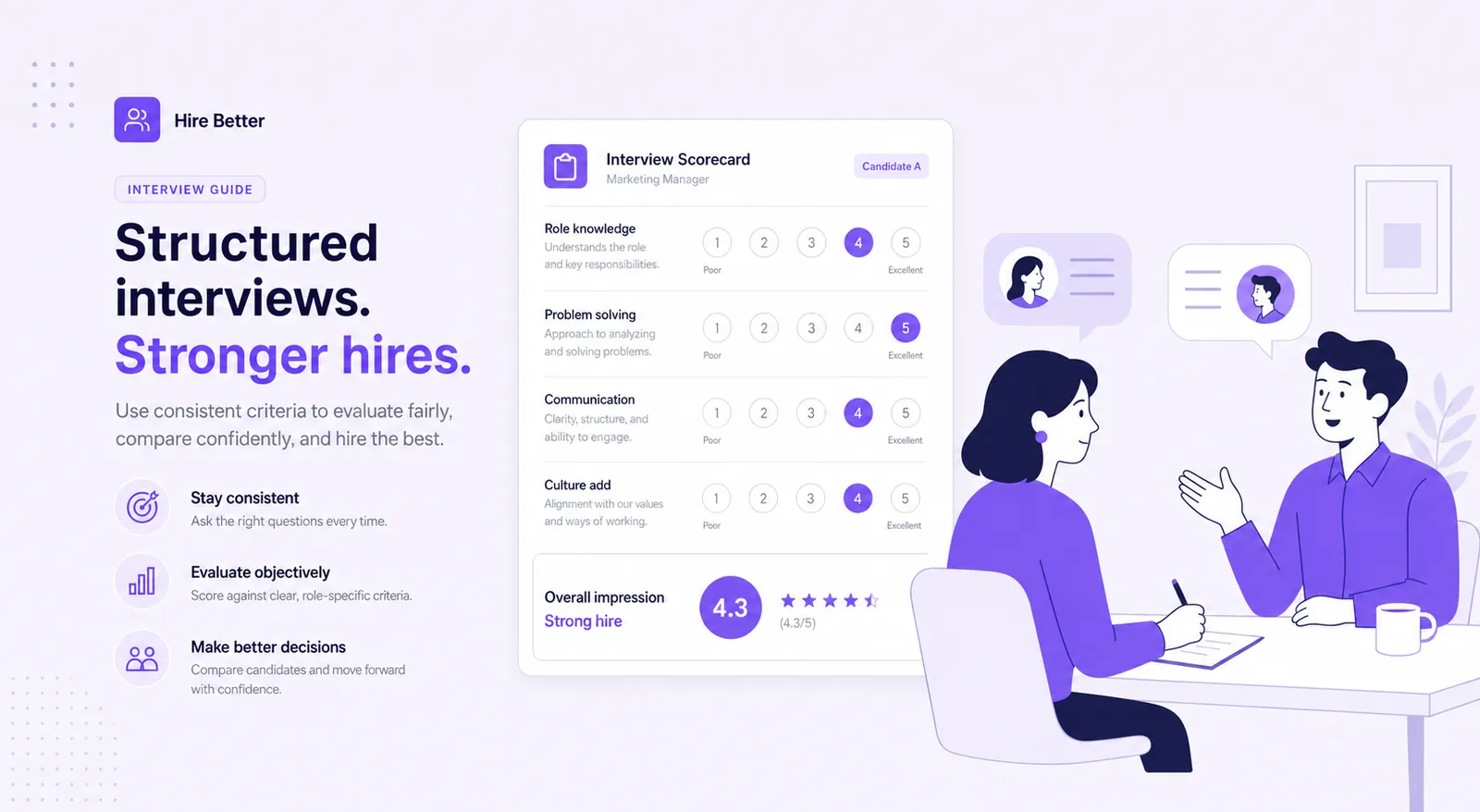
We once sat in on a debrief where two interviewers who'd spoken to the same candidate for the same role came away with opposite recommendations — one said hire immediately, the other said pass. Neither had asked a single overlapping question. That's not a candidate problem. That's what happens when how to interview candidates gets treated as a personality test instead of a measurement process.
Unstructured interviews feel more natural in the room and are, by a wide margin, worse at predicting who'll actually perform well in the role. Structured interviews feel a little more rigid going in and consistently produce better hiring decisions — not because they're colder, but because they're comparable across candidates.
The interview is also, quietly, the most expensive part of the whole hiring process to get wrong. By the time a candidate is sitting across from you, you've already spent real time sourcing, screening, and scheduling. A bad interview process doesn't just risk a bad hire — it risks throwing away all the upstream work that got a genuinely good candidate to that point, because they walked away from a chaotic, inconsistent process before you ever got to an offer.
This guide covers why structure wins over free-flowing conversation, how to build a scorecard you'll actually use, which behavioral questions correlate with real performance, how to catch and reduce your own bias mid-interview, and how to sell the role while you're still evaluating — because the good candidates are evaluating you back the entire time.
Interview a shortlist, not a guessing game
Post free on Jobedly and let AI agents rank applicants 0–100 before your first interview — so the people you're evaluating are worth the hour.
Find candidates with AIStructured vs. unstructured (why structure wins)
An unstructured interview follows the conversation wherever it naturally goes — different questions for different candidates, no fixed scoring, judged mostly on impression. A structured interview asks the same core questions, in roughly the same order, scored against the same standard, for every candidate for that role.
Decades of organizational psychology research, widely summarized in outlets like Harvard Business Review, converge on the same finding: structured interviews predict job performance meaningfully better than unstructured ones, largely because they remove the noise of "which questions happened to come up" and "how comfortable did this person seem in a chair."
How to conduct a job interview
At minimum: same core question set for every candidate for the role, a scorecard filled out immediately after (not the next day, from memory), and a debrief where interviewers share scores before discussing impressions — so no one's opinion anchors everyone else's before the scoring happens independently.
The resistance to structure usually comes from experienced hiring managers who feel, not unreasonably, that they've developed good instincts over years of interviewing. The research doesn't say those instincts are worthless — it says instincts alone, without a comparable structure across candidates, produce noisier decisions than instincts plus structure together. You don't have to abandon your judgment. You have to stop letting your judgment operate on a different data set for every candidate.
Building a scorecard
A scorecard turns "I liked them" into something you can defend and compare. It doesn't need to be elaborate — a handful of the role's real competencies, each scored 1–5 with a note on what evidence supports the score.
Structured interview scorecard
| Competency | Question tied to it | Score (1–5) | Evidence noted |
|---|---|---|---|
| Core technical/functional skill | Scenario question specific to the role | — | What they actually said, not your impression |
| Problem-solving under ambiguity | "Tell me about a time the plan changed mid-project." | — | Specific example, not a general claim |
| Collaboration / communication | "Describe a disagreement with a teammate and how it ended." | — | Whether the resolution was theirs or someone else's |
| Ownership / follow-through | "Walk me through a project from start to finish you're proud of." | — | Depth of detail on the finish, not just the start |
Behavioral questions that predict success
Behavioral questions ask about a specific past situation on the theory that past behavior predicts future behavior better than a hypothetical or a self-rating does. "Tell me about a time..." beats "how would you handle..." for exactly this reason — a hypothetical answer describes an aspiration, a behavioral answer describes what actually happened.
A predictive question only works if you actually let the candidate answer it fully before jumping in. The instinct to fill silence — to add a clarifying example, to nod along and start talking before they've finished thinking — is strong, especially in a slightly awkward pause. Resist it. Some of the most useful signal in an interview shows up in the ten seconds after the initial answer feels complete, when a candidate who's being genuine adds detail unprompted, and a candidate who was reciting a rehearsed story runs out of material.
Best interview questions to ask candidates
- "Tell me about a time you had to deliver bad news to a manager or client." — reveals communication under pressure.
- "Describe a project that failed or fell short. What did you do next?" — reveals accountability, not just competence.
- "Walk me through a decision you made with incomplete information." — relevant for almost every real job.
- "Tell me about a time you disagreed with a decision you had to carry out anyway." — reveals professionalism under friction.
- One role-specific scenario question tied directly to your actual day-to-day work, not a generic template question.
The follow-up matters as much as the question. "What happened next?" and "what would you do differently?" push past a rehearsed opening answer into something harder to fake.
Interviewer bias and how to reduce it
The most common bias in interviewing isn't dramatic — it's the halo effect, where one strong early answer (or a shared alma mater, or a joke that lands) colors how you hear everything that follows. It happens to careful, well-intentioned interviewers constantly, precisely because it doesn't feel like bias in the moment.
- Score each competency immediately after its question, not at the end of the interview from memory.
- Have interviewers submit scores independently before comparing notes as a group.
- Use the same question set for every candidate for the role — variation is where inconsistent standards sneak in.
- Watch for "similar to me" bias specifically — shared background, school, or interests feeling like a stronger signal than it actually is.
Illegal interview questions
Certain questions are legally prohibited or high-risk in interviews regardless of how casually they arise in conversation — age, disability or health status, pregnancy or family planning, national origin, religion, and marital status among them. The EEOC's guidance on prohibited employment practices is the authoritative source, and it's worth reviewing directly rather than relying on secondhand summaries.
| Avoid asking | Ask instead | Why |
|---|---|---|
| "How old are you?" / "When did you graduate?" | Nothing — age isn't a legitimate interview topic | Age discrimination risk under federal and state law |
| "Do you have kids / plan to?" | "Are you able to meet the schedule requirements of this role?" | Family status isn't relevant; schedule capability is |
| "Where are you from, originally?" | "Are you authorized to work in the U.S.?" (if relevant) | National origin questions carry discrimination risk; work authorization is the legitimate concern |
| "Do you have any health conditions?" | "Can you perform the essential functions of this role, with or without accommodation?" | Disability status is protected; functional capability is the legitimate question |
Selling the role while you evaluate
The best candidates are interviewing you at the same time you're interviewing them, and with unemployment holding around 4.2% as of June 2026, strong candidates in many fields genuinely have options. An interview that's all extraction and no information given back reads as a red flag about what working there is actually like.
Selling shouldn't be confined to the end of the process either. A brief, genuine note about why the role or team is interesting, dropped naturally into the transition between questions, keeps the conversation feeling like a two-way exchange rather than an interrogation with a Q&A tacked onto the end. Candidates notice the difference between an interviewer who's only extracting information and one who's also sharing it.
How many interview rounds
Two to three rounds covers the vast majority of roles well: a screen, a core structured interview, and — for roles with a genuine team-fit or technical-depth question — one more focused round. Beyond three or four rounds, you're usually adding time-to-hire without adding real signal, and good candidates start dropping out of long processes to take other offers. Our guide on reducing time-to-hire covers this tradeoff directly.
Leave real time at the end of each round for the candidate's own questions, and answer them honestly, including tradeoffs. Candidates remember interviewers who were straight with them, and it shortens the negotiation phase later because expectations were set accurately from the start.
Selling the role doesn't mean overselling it. Overselling produces a candidate who accepts based on a picture that doesn't match reality, and the mismatch surfaces in the first month, usually as attrition. A more durable approach is specific honesty — naming what's genuinely good about the role and naming, just as plainly, what's hard about it. Candidates who hear the real tradeoffs during the interview and choose to accept anyway tend to be more resilient once they start, because nothing about the job surprises them later.
Fewer, better interviews
When Jobedly's AI agents have already ranked your applicants, you can go into round one confident the person across the table is worth the full process, not a coin flip on volume.
Find candidates with AIIf your interviews are being scheduled against a thin or slow-moving candidate pool, that's usually a sourcing or screening gap upstream — see how to find qualified candidates and how to screen job applicants to fix it before the interview stage.
The last thing worth saying plainly: a great interview process on a role nobody wants doesn't produce a hire. Structure and scorecards fix the evaluation half of the equation. If offers are being declined or candidates are dropping out mid-process at a high rate, look upstream first — at pay, at the job description's honesty, at how many rounds you're actually running — before assuming the interview itself is where the fix belongs.
Fewer rounds, better candidates
A structured interview process is only as good as who walks into it. Start the funnel with AI-ranked applicants so every round counts.
Post once. Let the AI agents do the sorting.
Post a job free on Jobedly and our AI agents surface and rank qualified candidates 0–100 so you spend time on the shortlist, not the pile.
Post a job freeFrequently asked questions
What is a structured interview and why does it work better?
How many behavioral questions should I ask in one interview?
What questions are illegal to ask in a job interview?
How do I reduce bias when multiple people interview the same candidate?
Should every interview round use the same questions?
How long should a job interview last?
What's the ideal number of interview rounds before an offer?
How do I keep candidates engaged during a multi-round interview process?
Glossary
- Structured interview
- An interview format using the same core questions and scoring standard for every candidate for a role, shown to predict performance better than unstructured formats.
- Behavioral question
- An interview question asking for a specific past example ("tell me about a time...") rather than a hypothetical or self-assessment.
- Interview scorecard
- A structured rating sheet scoring a candidate against defined competencies, filled out immediately after the interview and before group discussion.
- Halo effect
- A cognitive bias where one strong impression early in an interview colors the interviewer's perception of everything that follows.
- Time-to-hire
- The number of days between posting a role and a candidate accepting an offer, directly affected by interview round count and speed.
- EEOC
- The U.S. Equal Employment Opportunity Commission, which publishes guidance on prohibited pre-employment and interview questions.