Candidate Sourcing Strategies That Actually Fill Pipelines
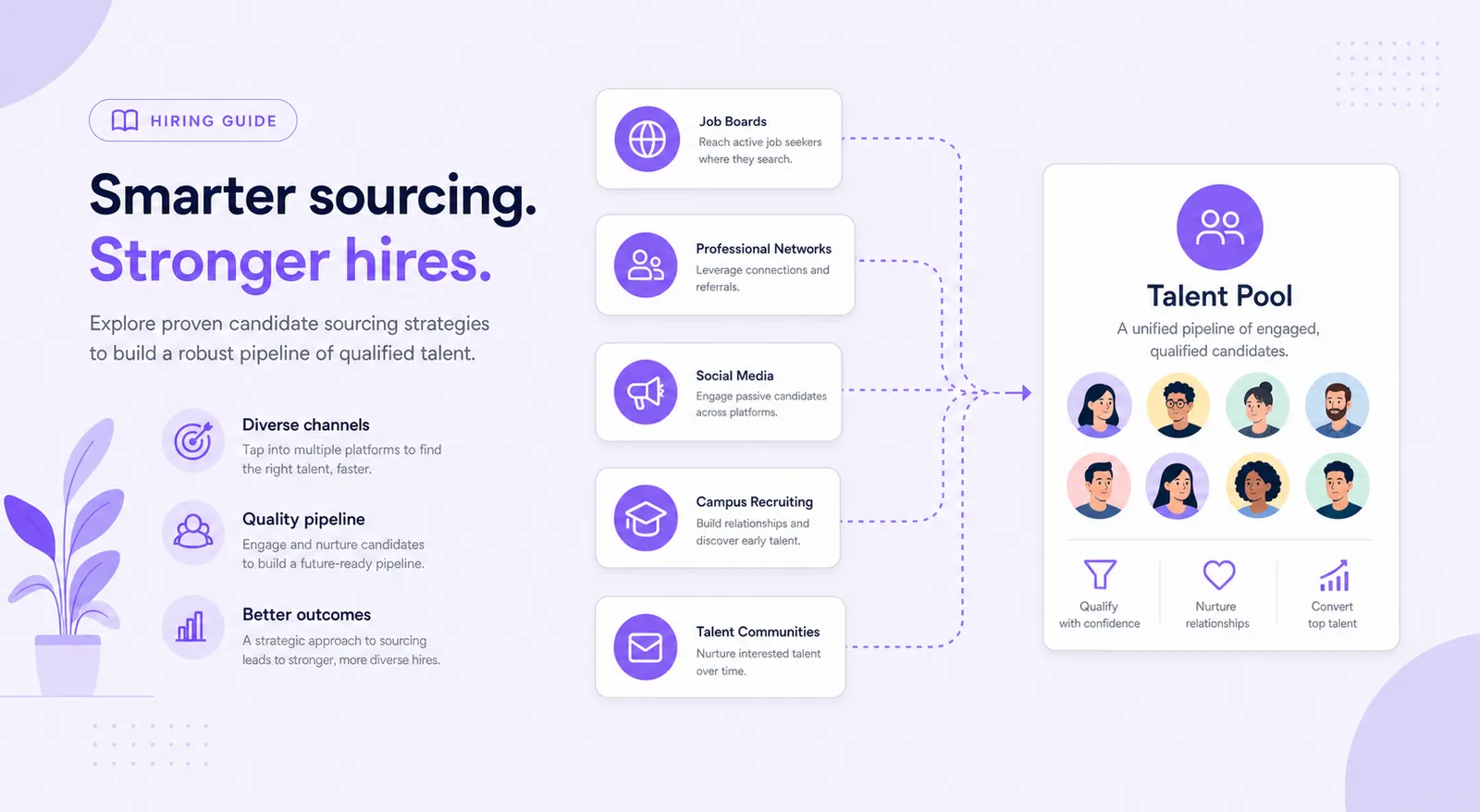
Most job posts fail before they even go live, because "post it and see" isn't a sourcing strategy — it's a hope. Candidate sourcing strategies are the deliberate ways you get qualified people in front of your open role, and the mix matters more than any single channel. We've watched teams pour budget into one sourcing method because it worked once, then wonder why the well ran dry for the next role. Different roles need different sourcing. A senior specialist role and an entry-level hourly role should never be sourced the same way.
The gap between "we have applicants" and "we have qualified applicants" is almost entirely a sourcing problem, not a job-market problem. Getting the right people to even see your opening is half the battle, and it's the half most hiring guides skip past to get to interviewing.
This guide covers the real channel mix — inbound, outbound, referrals, your own talent pool — and where AI-driven matching changes the math entirely, because posting once and letting agents surface and rank who's actually qualified often out-produces manual outbound sourcing for a fraction of the hours spent.
One thing worth setting expectations on early: there's no single sourcing channel that works for every role, every time, forever. What follows is less a ranked list of tactics and more a map of when each one earns its place — so you can build a mix that actually matches the role in front of you instead of defaulting to whatever worked last time.
Source smarter, not just harder
Post free on Jobedly and let AI agents match and rank candidates against your role automatically — sourcing without the manual search grind.
Post a job freeInbound vs. Outbound Sourcing
Inbound sourcing is candidates coming to you — applying to a posting, finding you through search, following up on a referral. Outbound sourcing is you going to them — direct messages, cold outreach, searching profiles for people who match a role but haven't applied anywhere. Both matter, but they solve different problems and most teams over-invest in one and starve the other.
The tell for which one you're under-using is usually in your own reaction to a role. If you're dreading opening a new posting because you already expect a flood of unqualified applications, you have an inbound-filtering problem, not an inbound-volume problem — the fix is better ranking, not less inbound. If you're dreading a new posting because you already suspect nobody right will apply, you have an outbound gap, and passive sourcing needs to start on day one instead of after the posting sits quiet for two weeks.
What is candidate sourcing?
Sourcing is the activity of identifying and attracting potential candidates before they're formally in your pipeline — it's everything that happens upstream of an application landing in your inbox. It includes writing a posting that reaches the right search terms, reaching out to someone who isn't actively looking, mining your own past applicant pool, and asking current employees who they'd vouch for.
Sourcing vs. recruiting
Sourcing is the front end — finding and attracting candidates. Recruiting is the full process, including sourcing plus screening, interviewing, and closing. Some teams have a dedicated sourcer who never touches an interview; smaller teams do both under one hat. The distinction matters because sourcing failures often get misdiagnosed as recruiting failures — if your interview-to-offer ratio looks fine but you're not getting enough qualified applicants in the door, the problem is upstream, not in how you're evaluating people.
We've watched teams try to fix a sourcing problem by tweaking interview questions, which is a bit like adjusting your recipe when the actual issue is that the grocery store never had the right ingredients. If your funnel math shows plenty of interviews converting to offers but too few interviews happening in the first place, no amount of interview-process polish will fix that. Diagnose which layer is actually broken before you start changing things.
| Inbound | Outbound | |
|---|---|---|
| Best for | High-volume, common roles with plenty of active job seekers | Niche, senior, or hard-to-fill roles where good candidates aren't actively looking |
| Time cost | Low per-candidate; scales with good ranking | High per-candidate; manual research and personalized outreach |
| Candidate pool | Active job seekers | Includes passive candidates not currently applying anywhere |
| Where AI helps most | Ranking and filtering high volume automatically | Suggesting matches, not replacing personalized outreach |
Building a Talent Pool You Own
Every hire produces candidates you didn't pick, and most companies throw that data away by not tracking it. A strong runner-up from six months ago for a similar role is often a faster, better source than starting a fresh search from zero. Keep a simple record — even a spreadsheet — of qualified candidates who didn't get the job for reasons unrelated to skill (timing, budget, the role got cut), and revisit it before starting a new outbound search for a similar role.
This matters more for companies that hire the same type of role repeatedly — a growing team hiring its third or fourth account manager doesn't need to relearn the market each time if the first three searches were tracked properly. Even at small scale, this is the single highest-leverage habit in this entire guide, precisely because it's nearly free and almost nobody actually does it consistently.
A talent pool isn't just past applicants. It includes people who engaged with your company in any way — attended an event, followed up after a rejection to ask for feedback, applied to a role that wasn't quite right but clearly liked the company. Treat these as warm leads, not dead ends.
Keeping this pool useful takes almost no ongoing effort if you build the habit early: a short note after every rejected finalist — why they didn't get the offer, whether you'd consider them for something else, how to reach them again. Five minutes per candidate now saves hours of cold re-sourcing later, and it means your second search for a similar role starts with a warm list instead of an empty one.
Boolean/Search Sourcing Basics
For outbound sourcing on any searchable platform — professional networks, resume databases, even general search engines — Boolean search operators let you combine and exclude terms to narrow a huge pool down to a workable list. The basics: quotation marks for exact phrases, AND/OR to combine or broaden terms, a minus sign to exclude irrelevant matches, and parentheses to group logic.
How to source candidates on LinkedIn
The mechanics are similar across most professional network searches: combine job title variations with location and a key skill, exclude terms that pull in the wrong industry, and read past the headline — titles are inconsistent across companies, so someone with the exact skills you need might carry a completely different title than you searched for. The habit that actually improves results over time is refining your search terms based on who you're finding, not sticking rigidly to your first query.
"account executive" AND (SaaS OR software) NOT intern— combines a title, broadens the industry term, excludes a level you don't want.- Search by skill instead of title when titles vary wildly across companies for the same actual job.
- Widen location radius before narrowing skill requirements — skill mismatches are easier to spot than false negatives from an overly tight search.
The real skill in Boolean sourcing isn't memorizing operators — it's iterating fast. Run a search, skim the first page of results, notice what's wrong (too broad, too narrow, wrong industry entirely), adjust one variable, run it again. Treat your first query as a rough draft, not a final answer. People who are good at this typically run five or six variations before they settle on the one that actually returns the right mix of candidates.
Referrals as a Sourcing Engine
Referrals consistently produce some of the strongest hires because the referring employee is vouching with their own credibility, and they've usually already screened for cultural fit informally before mentioning the person at all. The mistake most companies make is treating referrals as passive — waiting for employees to think of someone, rather than actively asking.
Make the ask specific. "Do you know anyone hiring right now?" gets ignored. "We're hiring a [specific role] — do you know anyone who's done that kind of work?" gets an actual answer, because you've made it easy to think of someone instead of asking for a general brainstorm. Pair that with a real incentive if budget allows, but don't assume incentive alone drives referrals — most employees refer people because they're proud of where they work, not for the bonus.
Give referrals somewhere fast to land
Post the role free on Jobedly so a referred candidate can apply in minutes — and get ranked against the role instantly instead of waiting in an inbox.
Post a job freeMake it easy to act on a referral impulse the moment it happens. Someone thinks of a former coworker while making coffee, not during a scheduled "referral time" — if sharing that name takes five clicks and a login, the impulse dies before it turns into an actual introduction. A single forwarded job link they can pass along in a text message beats a formal referral portal almost every time for actual conversion.
Using AI to Match Instead of Manual Search
Manual outbound sourcing works, but it doesn't scale — every hour spent searching profiles and drafting outreach is an hour not spent evaluating the people who already responded. AI matching flips the economics: instead of you searching for candidates, the system surfaces and ranks the people who match your role from everyone who's already in motion looking for work.
Think about the actual arithmetic of manual outbound for a moment. A careful sourcer might personally research and message thirty to fifty qualified-looking profiles in a focused day, and even a strong outreach campaign converts a fraction of those into real conversations. Automated matching against an existing pool of active seekers doesn't have that linear time cost — it evaluates the entire applicant pool against your specific role requirements in the time it takes you to read this paragraph, then hands you a ranked list instead of a research project.
This is the core mechanic behind Jobedly's employer side — post the role once, and AI agents score every applicant 0–100 against it, surfacing the strongest matches instead of making you scroll a raw applicant list in the order people happened to apply. It doesn't replace outbound sourcing for genuinely scarce, senior, or hyper-niche roles — but for the large majority of roles, it replaces hours of manual searching with a ranked list that already accounted for fit.
Once candidates are ranked, the next constraint is usually screening speed, not sourcing volume — see how to screen applicants for what to do with a strong shortlist once you have one, and how to reduce time-to-hire for closing the loop from sourced candidate to accepted offer.
None of this means outbound sourcing becomes obsolete. For a role where the entire addressable pool of qualified people might be a few hundred individuals nationwide — a specific engineering specialty, a senior finance leadership role, a highly regulated compliance position — you still need someone doing deliberate, patient outreach, because those candidates often aren't actively applying anywhere. AI matching is the right default for volume. Manual outbound is the right tool for scarcity.
The right sourcing mix for most teams isn't a single channel — it's inbound with AI ranking as the default engine for volume roles, referrals running continuously in the background, a maintained pool from past searches, and manual outbound reserved for the roles genuinely scarce enough to justify the time. Treat sourcing as a portfolio, not a single bet, and revisit which channel is actually producing your hires every few months. The channel that worked best last year quietly stops working and nobody notices until the pipeline runs dry.
Post once. Let the AI agents do the sorting.
Post a job free on Jobedly and our AI agents surface and rank qualified candidates 0–100 so you spend time on the shortlist, not the pile.
Post a job freeFrequently asked questions
What is candidate sourcing exactly?
What's the difference between sourcing and recruiting?
How do I source passive candidates who aren't job hunting?
What are the best candidate sourcing tools?
How do I build a talent pool for future roles?
Do referral bonuses actually improve sourcing?
How does AI candidate matching compare to manual sourcing?
Glossary
- Sourcing
- The activity of identifying and attracting potential candidates before they enter a formal hiring pipeline.
- Inbound sourcing
- Candidates coming to you directly, typically through job postings, search, or referrals.
- Outbound sourcing
- Proactively reaching out to potential candidates, including passive candidates who aren't actively job hunting.
- Passive candidate
- A person who is qualified for a role but not currently and actively searching for a new job.
- Boolean search
- A search technique using operators like AND, OR, and NOT to combine or exclude terms and narrow results.
- Talent pool
- A maintained group of past applicants and other engaged candidates that can be revisited for future openings.