How to Reduce Time-to-Hire Without Cutting Corners
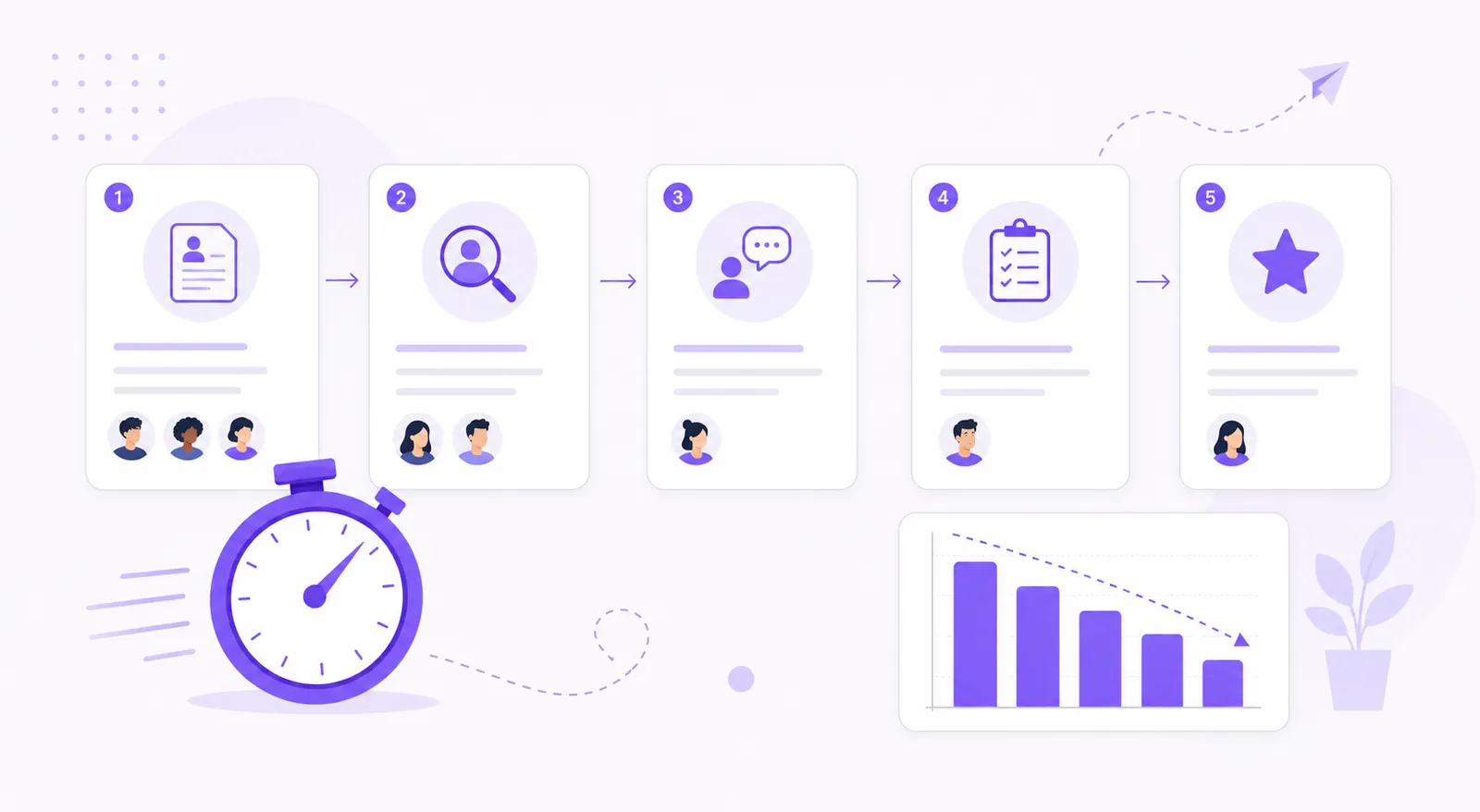
Ask five hiring managers how to reduce time to hire and four of them will say "post faster" or "interview faster." Neither is usually where the time actually goes. We've mapped enough hiring pipelines to see the same thing over and over: the job gets posted quickly, the first applicants show up within days, and then the process stalls — not because candidates vanish, but because nobody's reading the resumes for a week, or the calendar invite for the second interview takes four days to land because three people's schedules have to align.
Time-to-hire isn't one number you improve by wanting it improved. It's a pipeline with distinct stages, and almost always one or two of those stages are eating most of the delay while the rest run fine. Fix the wrong stage and you'll feel busier without actually hiring faster.
This guide breaks the pipeline into its real stages, shows you where time typically leaks, and covers where AI-assisted screening — ranking every applicant 0–100 the moment they apply — removes days from the slowest part of the process without lowering your standards. Slower isn't more careful. It's usually just less organized.
It's also worth being upfront about what this page won't tell you: there's no universal "good" number for time-to-hire, because it depends heavily on role type, seniority, and how competitive your local market is for that specific skill. What we can tell you is how to find your own leaks, fix the ones that are actually fixable, and stop guessing at where the slowness comes from.
Cut the screening bottleneck first
Jobedly's AI agents rank applicants against the role the moment they apply, so you're reviewing a shortlist instead of a pile — the single biggest time-to-hire fix most teams skip.
Find candidates with AIWhere Hiring Time Actually Leaks
When we watched full hiring cycles from posting to offer, the leak was almost never candidate scarcity. It was almost always internal: applications sitting unread, interview scheduling bouncing between calendars for days, or a decision-maker who "will look at it Friday" three Fridays in a row. Candidates don't ghost because they got bored waiting — they take other offers because they got tired of waiting.
There's a specific pattern worth watching for: teams that are fast at the start and slow at the end. Posting goes up quickly, first applications get reviewed within a day or two, momentum feels good — and then everything grinds down at the decision stage, where a hiring manager wants "just one more candidate" before committing, over and over, until the strong candidate from week one has taken another job. Early speed doesn't compensate for late indecision. Candidates remember the last mile, not the first one.
Average time to hire
There's no single "normal" number — it varies hard by role seniority, industry, and how competitive the local labor market is for that skill. What's consistent across roles is the shape of the delay: entry-level and hourly roles that stretch past two weeks usually have a screening bottleneck, while skilled or senior roles that stretch past a month usually have a scheduling or decision-committee bottleneck. Diagnose the shape before you try to fix the number.
| Stage | Typical leak | Root cause |
|---|---|---|
| Posting live → first review | 3–7 days before anyone reads applications | No owner assigned to check daily |
| Review → first screen call | 1–2 weeks | Manual resume reading with no ranking system |
| Screen → hiring-manager interview | 4–10 days | Calendar coordination across multiple people |
| Interview → decision | Days to weeks | No scorecard, decision deferred waiting for "one more candidate" |
| Decision → offer accepted | 1–5 days | Offer details not pre-approved, slow internal sign-off |
There's also a psychological reason this leak is so common and so invisible: the stages you spend the most active effort on — the interview itself, deliberating over an offer amount — feel like the "real" hiring work, so they get remembered and optimized. The stages that are just waiting — an unread inbox, a calendar that hasn't been checked — don't feel like work at all, so nobody thinks to fix them, even though they're often the majority of the elapsed time.
Worth naming directly: a slow process doesn't just cost you time, it costs you candidates you never even find out you lost. Someone doesn't email to say they took another offer while waiting on you — they just stop responding, and it reads on your end as ghosting rather than as a symptom of your own pipeline dragging. If your no-show and non-response rate has crept up, check your stage timing before you conclude candidates have gotten flakier.
Mapping Your Pipeline Stages
You can't fix what you haven't measured. Write down every stage your last five hires actually went through — not the stages in your handbook, the real ones — and timestamp each transition: posted, first application, first review, first screen call, first interview, offer, acceptance, start date. Most teams discover their process has an extra unofficial stage nobody planned, like "waiting for a second opinion from someone who wasn't in the original loop."
Time to hire vs. time to fill
These get used interchangeably and shouldn't be. Time-to-fill counts from when the requisition opens to when someone accepts — it includes however long the role sat open before you even started sourcing. Time-to-hire counts from the candidate's first touch (application or first contact) to acceptance. If your time-to-fill is long but time-to-hire is short, your bottleneck is upstream — you're slow to start the search, not slow once it's running. If time-to-hire itself is long, the pipeline is the problem.
- Time-to-fill: requisition approved → offer accepted.
- Time-to-hire: candidate's first application/contact → offer accepted.
- Track both. A long time-to-fill with a short time-to-hire means the fix is in how fast you decide to start searching, not in the search itself.
Once you have real stage timestamps, the fix is usually obvious and boring — it's rarely "we need a better ATS," it's "nobody owns Tuesday's application review" or "we don't pre-book interview slots." Boring fixes are the ones that actually stick.
It's worth mapping this once even if you're a small team hiring for a single role, not just a company running dozens of pipelines at once. The exercise takes less than an hour — pull up your email and calendar for the last hire, note the date of each transition, and you'll see the pattern immediately. Most people are shocked by how much of the total timeline was just waiting, once they actually write the dates down instead of relying on a general impression of "it took a while."
Cutting Scheduling and Screening Drag With AI
Screening is where manual process costs the most time relative to the value it adds. Reading forty resumes to find the six worth a call is repetitive, easy to deprioritize when you're busy, and exactly the kind of task that benefits from automated ranking rather than a human doing it under time pressure at 6pm.
This is the specific gap AI screening closes. Instead of a pile of applications waiting for someone to have an open afternoon, Jobedly's agents score every applicant 0–100 against the role the moment they apply, so the shortlist exists before you've opened your inbox. That doesn't replace your judgment on the final call — it removes the multi-day wait before you get to use that judgment at all. For a deeper walkthrough of the screening mechanics themselves, see how to screen applicants.
Scheduling drag is the other half of this problem and it's less discussed than screening, probably because it feels more like an annoyance than a process failure. It isn't just an annoyance — the back-and-forth of "does Tuesday work? What about Wednesday afternoon?" strung across three or four interviewers routinely adds three to five calendar days to a pipeline, days that add up fast across even a handful of open roles. A shared availability system or a simple rule (interviewers commit to two fixed weekly slots reserved for hiring) removes almost all of it.
Stop the screening pile from forming
Jobedly ranks every applicant 0–100 against the role automatically, so the multi-day review backlog never has a chance to build up.
Find candidates with AIHow to speed up the interview process
- Pre-book interview slots in a shared calendar before the role even opens, so scheduling isn't a live negotiation for every candidate.
- Cut to one screen call and one structured interview for most roles — three or four rounds rarely improves the decision, it mostly adds calendar days. See how to interview candidates for what actually belongs in that one structured round.
- Use a scorecard so the decision doesn't wait on a debrief meeting that takes a week to schedule.
- Pre-approve offer ranges so an accepted candidate doesn't wait days for internal sign-off.
Parallel vs. Sequential Stages
Sequential pipelines — where nothing starts until the previous step fully finishes — feel orderly but they're slow by design. Reference checks that only start after an offer is verbally accepted. Background checks that only start after references clear. Panel interviews scheduled one at a time instead of grouped into a single day. Every sequential handoff adds calendar days that compound.
Running steps in parallel where legally and practically possible is the single highest-leverage fix most teams haven't tried. Start reference checks the moment you're down to a final candidate, not after the offer. Group panel interviewers into one day instead of spreading them across a week. Have your background-check vendor ready to go the moment a candidate consents, rather than initiating the request days later. None of this requires new headcount — it requires deciding your default is "run in parallel unless there's a real reason not to," instead of the reverse.
The same logic applies to panel interviews. A common pattern is scheduling four interviewers one at a time across a week because "that's how the calendar worked out." Try the opposite default: block a single day, get all four in the same window, and treat a scattered week as the exception that needs a reason, not the norm. Candidates consistently describe a single well-run interview day as a better experience than a spread-out week, even when the total interview time is identical — concentrated effort just feels more respectful of their time.
Measuring Time-to-Hire Honestly
Vanity metrics creep in here easily — teams report "time to hire" from when they finally got budget approval, conveniently excluding the six weeks the requisition sat waiting for sign-off. Measure from the candidate's perspective: the clock starts when they apply, not when your internal process decided to notice them.
In a labor market with millions of open roles at any given time, per the BLS Job Openings and Labor Turnover Survey, a slow process isn't a neutral inconvenience — it's actively losing you candidates to whoever moves faster, including for roles where you're objectively the better opportunity. Speed isn't vanity metrics. It's a real competitive variable, on par with pay and role quality, in how many strong candidates you actually get to choose from.
Track time-to-hire by stage, not just start to finish, and revisit it every quarter. Pipelines drift — a scheduling habit that worked with three interviewers breaks when you add a fourth. Small, regular measurement catches drift before it becomes a six-week average nobody noticed creeping up.
One caution worth stating plainly: don't let a time-to-hire target quietly become a pressure to skip steps that protect hiring quality. The goal isn't the fastest possible hire — it's removing the delay that adds no value. A reference check that takes two days to schedule but genuinely surfaces useful information is worth those two days. An approval meeting that exists purely out of habit and adds nothing to the decision is not. Cut the second kind, keep the first, and your time-to-hire number will improve for the right reasons.
If your bottleneck traces back to sourcing volume rather than pipeline speed — meaning you're moving fast once candidates apply, but too few strong candidates are applying in the first place — that's a different problem with a different fix. See candidate sourcing strategies for how to widen the top of the funnel before you worry further about the speed of what's already flowing through it.
Post once. Let the AI agents do the sorting.
Post a job free on Jobedly and our AI agents surface and rank qualified candidates 0–100 so you spend time on the shortlist, not the pile.
Post a job freeFrequently asked questions
What is a good average time to hire?
What's the difference between time to hire and time to fill?
Why is our hiring process so slow if candidates keep applying?
How can AI screening reduce time to hire?
How many interview rounds should we run to keep things fast?
Should reference and background checks happen before or after an offer?
Does a faster hiring process mean lower hiring quality?
Glossary
- Time-to-hire
- The elapsed time from a candidate's first application or contact to offer acceptance.
- Time-to-fill
- The elapsed time from a requisition being approved to an offer being accepted, including any delay before sourcing begins.
- Pipeline stage
- A distinct step in the hiring process (e.g., screen, interview, offer) that can be individually timed and measured.
- Sequential vs. parallel process
- Sequential steps only begin after the prior step fully completes; parallel steps run concurrently where legally and practically possible, reducing total elapsed time.
- Scorecard
- A structured rubric used to rate candidates consistently across interviewers, reducing time spent debating subjective impressions.
- Requisition
- The internal approval to open and fill a role, which starts the time-to-fill clock.