Resume Screening: How to Sort a Big Pile Fast (and Fairly)
We once watched a hiring manager reject a genuinely strong candidate in under four seconds — one glance at an eight-month employment gap, no further reading, next resume. Two weeks later, same pile, we asked her to look again. Same candidate. The gap was a parental leave, and the rest of the resume was the best fit in the stack. Resume screening done on instinct is fast and cheap right up until it quietly costs you your best hire, and you never even find out it happened.
The fix isn't slowing down. It's screening against written criteria instead of gut reaction, which is exactly the discipline our guide on how to screen applicants lays out at a high level. This page goes deeper into the resume stage specifically: what to actually check first, which "red flags" are myths, and how a scoring system holds up when you're not screening four resumes but four hundred.
None of this requires reading every resume top to bottom in order. It requires knowing, before you open the first one, exactly what you're checking for and in what order — and having a defensible reason for every candidate you pass on.
Skip the raw inbox, start with a ranked list
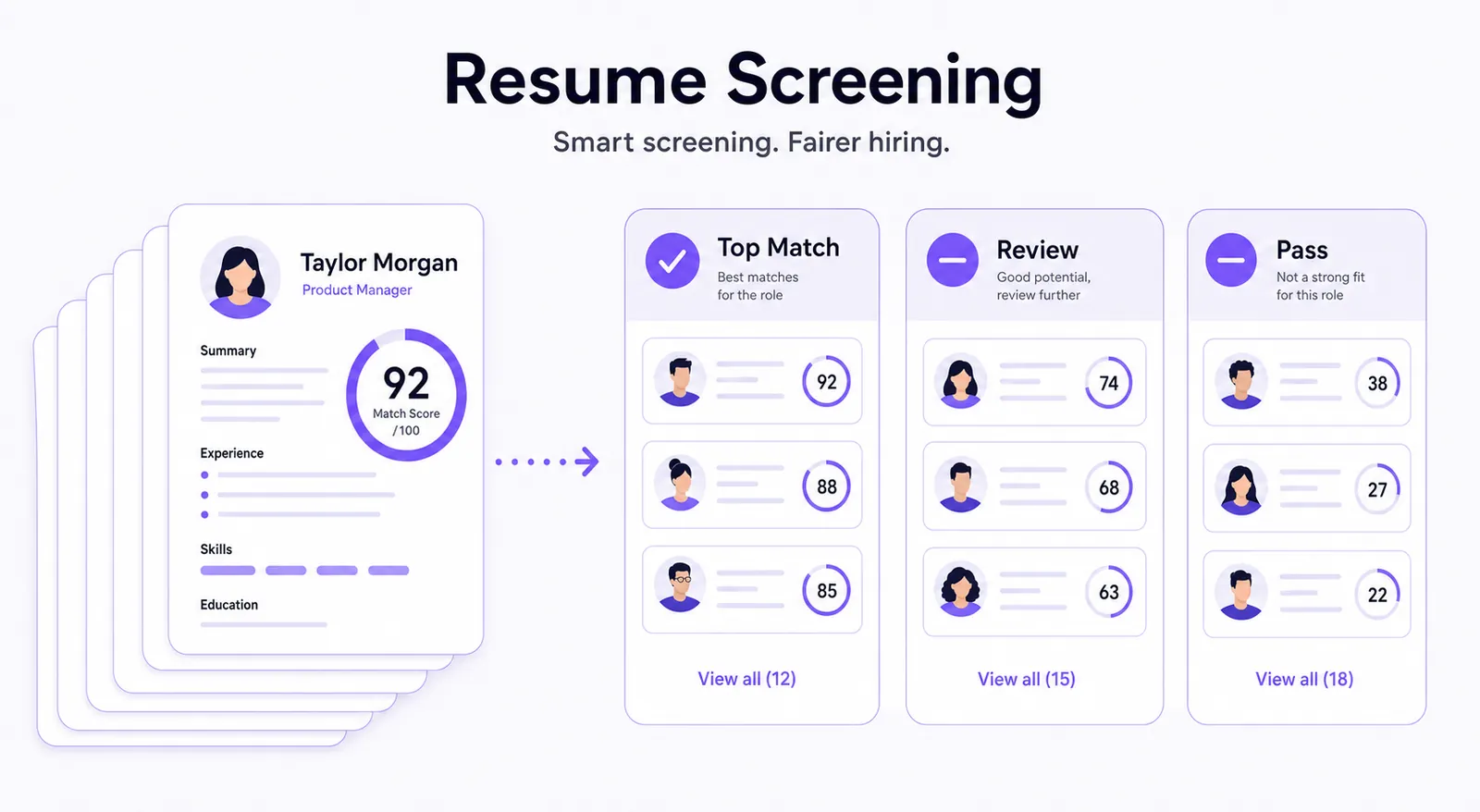
Jobedly's AI agents score every applicant 0–100 against your role's real requirements the moment they apply, so your manual screen is a confirmation pass, not a cold start.
Find candidates with AIMust-haves vs. nice-to-haves
Every resume screening process lives or dies on one distinction: what's actually non-negotiable versus what would just be nice. Most job descriptions blur the two into a single wall of bullet points, and that ambiguity gets inherited straight into the screening stage, where it turns into inconsistent judgment calls.
- Write down 3–5 true must-haves — a license, a specific years-of-experience floor, a tool you cannot train on the job.
- Everything else is a nice-to-have, full stop, even if a stakeholder really wants it.
- A candidate missing a must-have is out, no exceptions, before you weigh anything else about them.
- A candidate missing several nice-to-haves but hitting every must-have still deserves a real look.
The discipline here isn't about being strict. It's about being consistent — the same bar applied to resume three and resume thirty, instead of a bar that quietly shifts once you're tired or once you've already liked one candidate more than you meant to.
The knockout-question approach
One trick that speeds up resume screening without sacrificing fairness: turn each must-have into a single yes/no knockout question you can answer just by scanning the resume. "Do they have an active RN license?" is answerable in two seconds. "Are they a good communicator?" is not — that's an interview question wearing a resume-screening costume.
- Convert every must-have into a literal yes/no question.
- Scan each resume against the knockout questions first, before reading anything else.
- Anyone who fails a knockout question is out — log the specific reason in one line.
- Only candidates who pass all knockouts move to a full read for evidence and fit.
This is the same logic our screening guide uses for phone screens, applied one stage earlier. Knockout questions keep the fast, mechanical part of screening mechanical, so your judgment gets spent where it actually matters — comparing the candidates who cleared the bar.
Structured criteria that avoid bias
Unstructured resume review is where a lot of unintentional bias creeps in, not through any deliberate decision but through the brain filling gaps with pattern-matching. A name, a school, a neighborhood, a graduation year — none of it should matter for the role, and all of it quietly influences an unstructured skim.
The U.S. EEOC — prohibited employment policies is explicit that screening criteria need to be applied consistently and tied to actual job requirements — not vibes, and not anything that functions as a proxy for a protected characteristic. Written, must-have-based criteria applied the same way to every resume is the most direct way to satisfy that in practice, not just on paper. None of this is legal advice for your specific situation — employment law varies by state and locality, especially around background checks and salary-history questions, so confirm current requirements with counsel or your local labor agency before finalizing a screening process.
SHRM research on structured hiring has repeatedly found the same pattern we see in practice: a documented scorecard, applied identically to every candidate, produces both faster decisions and a more defensible record than an unstructured read — the two goals people usually assume trade off against each other actually move together once the process is structured.
Red flags that actually matter (and the ones that don't)
Plenty of things treated as automatic resume red flags are actually noise, and treating them as disqualifying costs you candidates for no real reason. Other things that get waved off as minor are worth a genuine second look. Here's the split we'd defend.
| Signal | What it tells you | Weight |
|---|---|---|
| Missing a stated must-have | Direct disqualifier if the must-have is real and job-critical | High — knockout |
| Employment gap | Almost nothing on its own — leave, caregiving, layoff, sabbatical, further study | Low — ask, don't assume |
| Job-hopping without context | Could signal instability, or could signal a volatile industry/contract work — context matters more than count | Medium — ask about pattern |
| Vague, adjective-heavy bullets ("team player," "hard worker") | Weak signal of actual specificity or self-awareness, not disqualifying alone | Low — note, verify later |
| Specific, quantified accomplishments | Reasonably strong positive signal of real ownership over outcomes | Medium-high — weigh in favor |
| Typos or formatting inconsistency | Weak signal, more about role fit — matters more for writing-heavy roles than others | Low to medium, role-dependent |
| Career pivot into a new field | Not inherently negative — often brings adjacent skills competitors overlook | Low — evaluate the transferable evidence |
How AI ranking triages the pile
Manual knockout questions work fine at forty resumes. At four hundred, even a fast structured pass takes real hours, and fatigue starts eroding consistency exactly where you need it most — late in the stack, when the bar has to be identical to resume five.
This is where automated 0–100 ranking against your stated requirements earns its place. It doesn't replace judgment on the finalists — it applies the mechanical knockout-question pass at scale, instantly, with no fatigue-driven drift, so the humans on your team spend review time on the top slice of the pile instead of the whole inbox.
That volume is real and growing: the BLS Job Openings and Labor Turnover Survey put U.S. job openings at 7.594M as of May 2026 — at that scale across the market, employers screening manually for every requisition are working against the clock in a way structured, automated triage simply isn't.
One caution worth naming: automated ranking is only as fair as the criteria it's ranking against. Garbage-in, garbage-out applies here exactly as it does to manual screening — vague or non-job-related criteria produce a vague or biased ranking no matter how sophisticated the scoring math is. The discipline of writing real must-haves down before you screen matters just as much, arguably more, once ranking is doing the first pass.
Once your resume-screened shortlist is in hand, the next stage is a short, structured call — our phone screening guide covers the script and the questions that actually predict something, and our pre-employment screening guide covers what comes after that, closer to an offer.
Post once. Let the AI agents do the sorting.
Post a job free on Jobedly and our AI agents surface and rank qualified candidates 0–100 so you spend time on the shortlist, not the pile.
Post a job freeFrequently asked questions
What is resume screening in the hiring process?
How long should resume screening take per candidate?
Is an employment gap a legitimate reason to reject a resume?
What should I look for when screening resumes?
Can AI resume screening be biased?
How many resumes should make it to a phone screen?
Glossary
- Resume screening
- The initial triage pass over incoming resumes against a role's stated requirements, done before any phone or interview stage.
- Must-have criteria
- The small, non-negotiable set of qualifications a candidate needs to proceed — decided before screening starts.
- Knockout question
- A yes/no version of a must-have, used to quickly disqualify candidates who don't meet a non-negotiable requirement.
- Criteria drift
- The gradual, usually unconscious shift in screening standards over the course of a hiring round, typically caused by fatigue or early favorable impressions.
- Screening scorecard
- A structured rating sheet applied identically to every candidate at the screening stage, used for consistency and a defensible record.