Pre-Employment Screening and Assessments (Done Right)
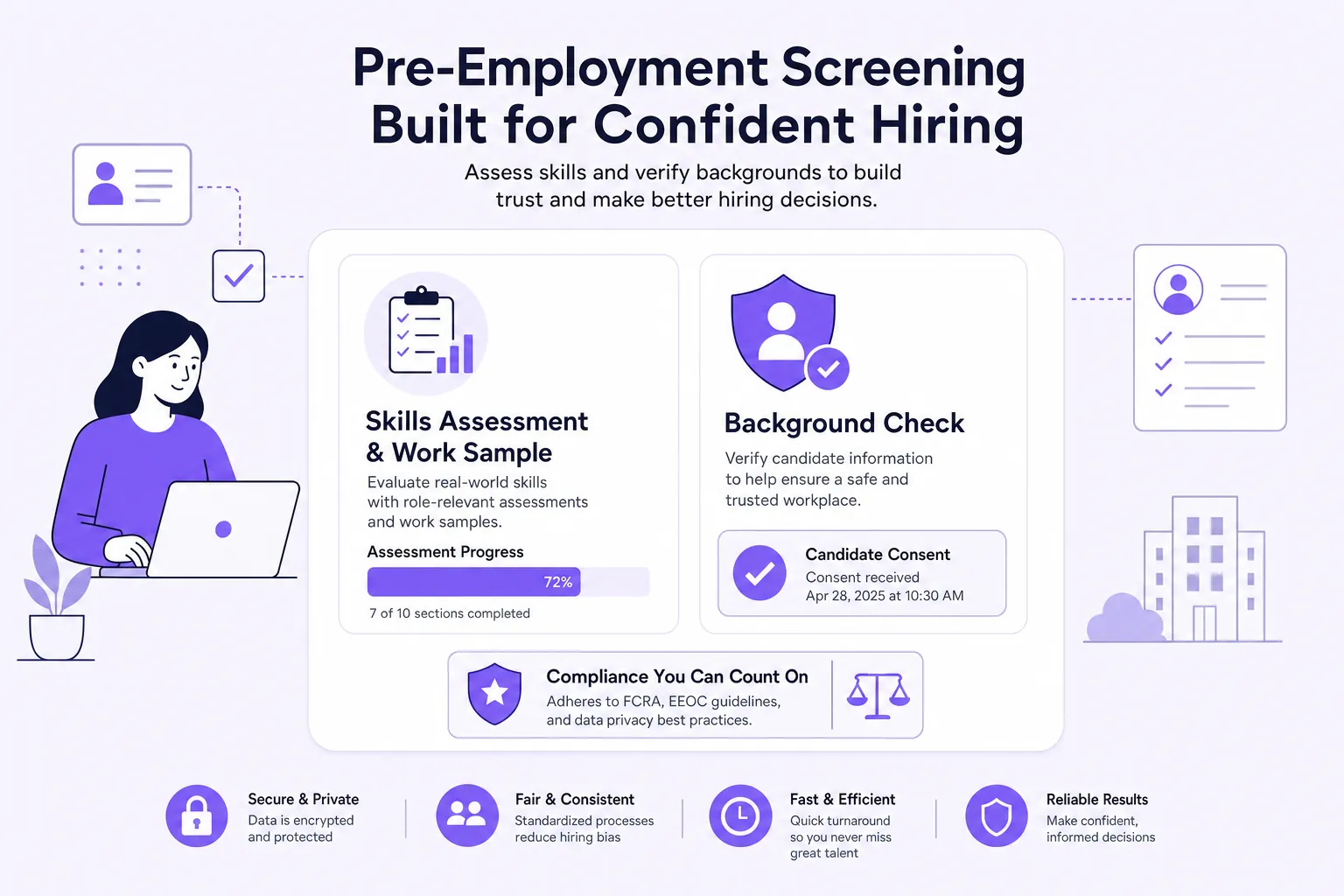
A client once ran every finalist through a 90-minute personality assessment before making an offer — expensive, time-consuming, and by the vendor's own validity data, barely more predictive of job performance than a coin flip for the role in question. Meanwhile a 20-minute, role-specific work sample they'd been skipping as "extra work" would have told them more in a fifth of the time. Pre-employment screening only pays off when the method actually predicts something — plenty of popular ones don't.
This page picks up after the phone screen described in our broader guide on how to screen applicants, and covers the stage closest to an offer: skills tests, work samples, assessments, and background and reference checks. We'll separate what genuinely predicts performance from what's a well-marketed guess, and walk through the legal guardrails — consent, disclosure, adverse action — that apply once you're checking someone's history.
None of this is legal advice for your specific situation; we'll flag where to check current rules for your jurisdiction. But the practical framework — what to test, what to verify, and how to stay consistent doing it — holds regardless of where you're hiring.
What actually predicts performance
Not all pre-employment assessments are created equal, and the popularity of a method has almost no relationship to how well it predicts on-the-job performance. Structured work samples and job-specific skills tests consistently outperform personality inventories and unstructured interviews in predictive validity research, yet personality tests remain far more common — largely because they're easier to administer at scale, not because they work better.
| Assessment type | Predicts | Effort | Risk |
|---|---|---|---|
| Work sample / job simulation | Strong — directly measures the actual task | Medium — needs role-specific design | Low, if scored consistently |
| Structured skills test | Strong for technical/measurable skills | Low to medium — often off-the-shelf | Low |
| Structured reference check (same questions, every reference) | Moderate — validates claims and past performance patterns | Low | Low, if consistent |
| Background check (criminal, employment, education verification) | Doesn't predict performance directly — verifies facts and manages risk | Low — usually outsourced | Medium — legal exposure if consent/process is wrong |
| Generic personality inventory | Weak to moderate at best, highly role-dependent | Low | Low practically, but often low ROI |
| Unstructured "gut feel" panel interview | Weak — most inconsistent method available | Low effort, high hidden cost | Medium — inconsistency itself is a legal and quality risk |
The pattern worth internalizing: the closer an assessment gets to simulating the actual work, the better it predicts. The further it drifts into abstract personality or general aptitude territory, the weaker and more role-dependent the signal gets.
When a work sample beats an interview
A work sample wins whenever the role has a concrete, observable output — writing, code, a spreadsheet model, a sales call role-play. Interviews are good at surfacing how someone talks about their work; work samples show you the work itself, which is a meaningfully different and generally more reliable signal.
- Keep it short and realistic — a scaled-down version of an actual task, not an artificial puzzle.
- Score it against a rubric decided before you see any submissions, the same discipline as a screening scorecard.
- Pay candidates for work samples that take real time, or keep the sample short enough that it's a reasonable ask unpaid — both norms exist depending on the field and length.
- Use it to complement, not replace, the interview — it answers "can they do this specific thing," not "will they be a good long-term fit."
The tradeoff is design effort. A generic personality test is a click-to-deploy product. A good work sample takes real thought to build and calibrate for your specific role — but that upfront cost is exactly why it predicts better; it's measuring the actual thing you care about instead of a proxy for it.
Validity vs. gimmicks
A lot of pre-employment assessment products are sold on polish rather than predictive validity — slick reports, confident-sounding categories, and no published data tying the score to actual job outcomes. If a vendor can't point you to real validity research for a role like yours, treat the tool as entertainment, not evidence.
Background checks: consent, disclosure, and adverse action
Background checks are fundamentally different from skills assessments — they don't measure ability, they verify facts and manage risk, and they come with binding legal obligations most other screening steps don't carry. The FTC — background checks (employer guidance) lays out the core requirements under the Fair Credit Reporting Act whenever you use a third party to run a background check: written disclosure, the candidate's written authorization, and specific notice requirements before and after you take any adverse action based on the results.
- Disclose in writing, in a standalone document, that you may run a background check — not buried in an application form.
- Get written authorization before ordering the report.
- If results might lead to an adverse decision, send a pre-adverse-action notice with a copy of the report and time to respond before finalizing anything.
- If you proceed with the adverse decision, send the required adverse-action notice afterward.
Consistency matters here just as much as it does earlier in screening. The U.S. EEOC — prohibited employment policies guidance is clear that background-check criteria — what disqualifies someone, and why — need to be applied the same way to every candidate for the same role, and ideally tied to specific job relevance rather than a blanket policy that disqualifies broad categories of past issues regardless of relevance to the role. This is general orientation on widely applicable FCRA and EEOC guidance, not legal advice for your business — background-check rules, including “ban the box” restrictions on when you can ask about criminal history, vary significantly by state and city and change over time, so confirm current requirements for your specific jurisdiction with counsel before building or changing your process.
Putting the checks together without slowing down the offer
The failure mode we see most with pre-employment screening isn't skipping it — it's stacking too many low-value checks in sequence, each adding days, right at the point where a strong candidate is most likely to accept a competing offer. Pick the two or three checks that actually predict something for your role, run them in parallel where you can, and skip the rest.
A reasonable default: one role-relevant skills test or work sample, a structured reference check with the same three or four questions for every reference, and a background check sized to actual role risk (a cash-handling role and a fully remote content role don't need the same depth of check). That combination covers ability, verified history, and risk management without turning your offer stage into a multi-week gauntlet.
Get to a strong shortlist faster
Post a job free on Jobedly and let AI agents rank applicants 0–100 before screening even starts, so the finalists you're running through assessments and checks are already your strongest pool.
Post a job freeIf you're still working out the earlier stages that feed into this one, our resume screening guide covers the must-have filter that builds your initial shortlist, and our phone screening guide covers the script that gets candidates to this stage in the first place.
Post once. Let the AI agents do the sorting.
Post a job free on Jobedly and our AI agents surface and rank qualified candidates 0–100 so you spend time on the shortlist, not the pile.
Post a job freeFrequently asked questions
What is included in pre-employment screening?
Do personality tests predict job performance?
What's required before running a background check on a candidate?
Should candidates be paid for work-sample assessments?
How far back do employment background checks typically go?
What's the difference between a skills test and a work sample?
Glossary
- Pre-employment screening
- The set of checks — skills assessments, work samples, reference checks, background checks — used to verify a candidate before an offer becomes final.
- Work sample
- A short, realistic simulation of actual job tasks used to evaluate a candidate's ability directly, rather than through self-report or general aptitude testing.
- Predictive validity
- The degree to which an assessment score actually correlates with real, later job performance — the key measure of whether a screening tool is worth using.
- Adverse action
- A negative hiring decision based partly or fully on background-check results, which triggers specific FCRA notice requirements to the candidate.
- Ban the box
- State or local laws restricting when in the hiring process an employer can ask about a candidate's criminal history.