Phone Screening Questions and Script That Save Hours
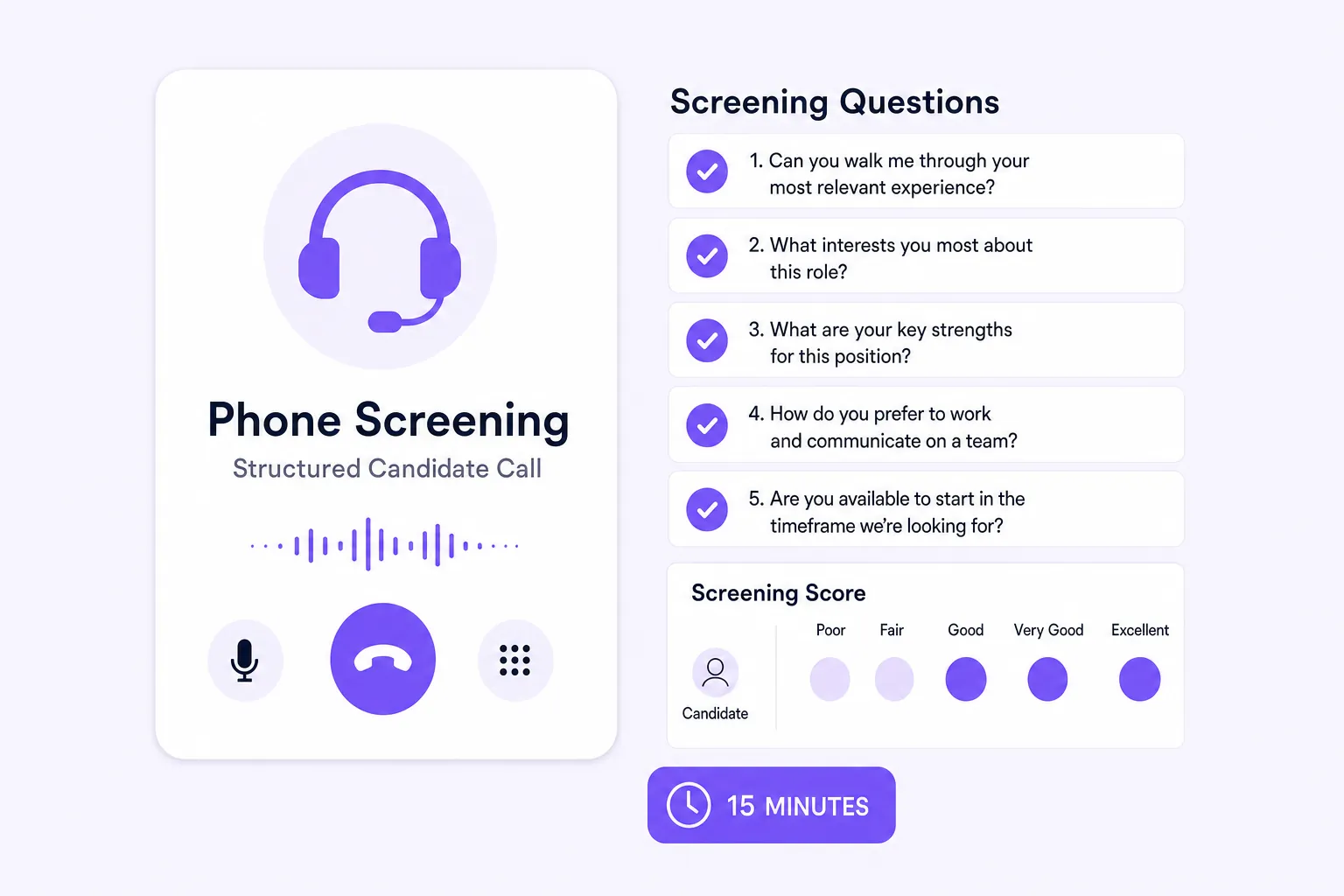
We've sat in on phone screens that ran 45 minutes and ended with the interviewer still unsure whether the candidate should move forward. That's not a candidate problem. That's a script problem. Phone screening works when it has one narrow job — confirm the resume, rule out deal-breakers, check alignment — and it falls apart the moment it quietly turns into a mini-interview.
Our broader guide on how to screen applicants covers where the phone screen fits in the overall process. This page is the script itself: what to actually ask in 15–20 minutes, what you should never ask no matter how casually it comes up, and how to score the call so five candidates screened on five different days are still being judged against the same bar.
None of this requires charisma or improvisation. It requires a script you actually follow, every time, whether the candidate is your top pick on paper or a long shot you're screening out of thoroughness.
What a phone screen is actually for
A phone screen has exactly four jobs: verify the resume basics are real, rule out true deal-breakers, confirm compensation and logistics are aligned, and get a first read on communication. That's it. It is deliberately not the place to evaluate depth of expertise, judgment under pressure, or cultural fit — those belong to the structured interview stage that comes after.
- Verify: does the resume match what the candidate says in their own words?
- Deal-breakers: does anything rule this out immediately — a true must-have, availability, work authorization?
- Comp alignment: is there a realistic overlap between expectations and your range?
- Communication: a first, light read — not a scored evaluation, just a sanity check.
Treating the phone screen as narrower than an interview is what keeps it fast. The moment you start asking behavioral deep-dives or scenario questions on this call, you've effectively promoted it to an interview without giving it the structure or scorecard an interview deserves.
A reusable phone screen script
A script isn't a rigid word-for-word read — it's a fixed sequence you follow every time, so the call stays consistent whether you're on candidate one or candidate twenty.
- Open (1–2 min): brief intro to the role and the call's purpose — set expectations for length.
- Resume walkthrough (3–5 min): "Walk me through your current role and why you're looking."
- Must-have check (5–7 min): one question tied directly to each true must-have from your criteria list.
- Logistics (3–4 min): availability, pay expectations, start-date timing, work authorization if relevant.
- Candidate questions (2–3 min): "What questions do you have for me?" — note the quality of the question, not just the answer.
- Close (1 min): tell them the real next step and real timeline — vague endings are the most common candidate complaint about phone screens.
Fifteen to twenty minutes total is the right target. If a call is consistently running past 25 minutes, something in the script has drifted into interview territory, and it's worth reviewing what's actually being asked.
Start the call with a real shortlist
Jobedly's AI agents rank applicants 0–100 against your requirements before your first phone screen, so you're calling the strongest candidates first, not working the pile in application order.
Find candidates with AIThe best phone screening questions
The questions that work best on a phone screen are narrow and quickly checkable — you're listening for a specific signal, not evaluating a full answer the way you would in an interview.
| Question | What you're listening for |
|---|---|
| "Walk me through your current role and why you're looking." | Resume accuracy and motivation — vague or evasive answers here are the biggest early signal. |
| One must-have-specific question (e.g. "Have you used [required tool] day-to-day?") | A direct yes/no on the actual requirement, not a general impression of competence. |
| "What's your availability and target start date?" | Logistics fit — a mismatch here can rule someone out regardless of how strong they are. |
| "What are you targeting for compensation in this move?" | Realistic overlap with your range — big gaps are worth surfacing now, not at offer stage. |
| "What questions do you have for me?" | Preparation and genuine interest — a rushed or absent answer is itself a data point. |
Notice none of these are the classic "tell me your greatest weakness" style questions. Those measure comfort performing self-assessment on the spot, which correlates with almost nothing about actual job performance — save real behavioral and scenario questions for the structured interview.
What not to ask (and why it matters legally)
Phone screens happen fast, informally, and usually with no second person listening in — which is exactly why they're where a disproportionate amount of legal exposure in hiring actually originates. The U.S. EEOC — prohibited employment policies and its more specific companion on EEOC — pre-employment inquiries both make clear that certain topics are off-limits regardless of how casually they come up in conversation.
- Age, date of birth, or graduation year used to infer age.
- Disability status, health conditions, or medical history.
- Pregnancy, family plans, marital status, or childcare arrangements.
- National origin, immigration status beyond basic work-authorization confirmation, or religion.
- Salary history, in jurisdictions that restrict it — asking expectations going forward is generally safer than asking what someone currently earns.
This is general orientation, not legal advice for your business — rules on salary-history questions and other screening topics vary by state and city and change over time, so confirm current requirements for your jurisdiction with counsel or your local labor agency before finalizing your script. The practical fix in the meantime is the same one that helps with fairness generally: stick to the script. A written phone screen script that never touches these topics protects you far better than good intentions in the moment, because good intentions don't survive a rushed Tuesday afternoon of back-to-back calls.
Scoring the call the same way every time
Memory is a bad record-keeping system. The call you remember most favorably an hour later is often the one where the candidate was warmest in tone, not the one where they actually answered the must-have questions best. A live scorecard — a simple pass/fail on each must-have, plus a short note — beats a paragraph reconstructed from memory every time.
Once a candidate clears the phone screen, the next stage usually involves a skills check or background verification before an offer — our pre-employment screening guide covers what's worth testing and the legal guardrails on background checks. And if you're still refining the resume-triage stage that feeds into this call, our resume screening guide covers the must-have filter in detail.
Post once. Let the AI agents do the sorting.
Post a job free on Jobedly and our AI agents surface and rank qualified candidates 0–100 so you spend time on the shortlist, not the pile.
Post a job freeFrequently asked questions
How long should a phone screen last?
What questions should you ask in a phone screening?
What questions are illegal to ask during a phone screen?
Should the same person do the phone screen and the full interview?
Is it OK to ask about salary expectations on a phone screen?
How do you score a phone screen consistently across candidates?
Glossary
- Phone screen
- A brief early call used to confirm resume accuracy, check must-haves, and align on logistics — not a substitute for a full interview.
- Deal-breaker
- A must-have or logistics fact (availability, comp, authorization) that would rule a candidate out regardless of other strengths.
- Screening script
- A fixed sequence of questions and topics followed identically on every phone screen for a given role.
- Comp alignment
- The degree of overlap between a candidate's compensation expectations and the employer's actual budgeted range for the role.
- Live scorecard
- Notes and pass/fail ratings recorded during the call itself, rather than reconstructed from memory afterward.