How to Find Employees for a Small Business (Without a Big Budget)
We watched a five-person shop post one opening on a big national board and get two hundred resumes back — almost none of them for the actual job. That's the small-business hiring trap in one sentence: the channels built for big companies either ignore you or bury you. How to find employees for a small business is a different question than how a staffed recruiting team finds candidates, and it needs a different answer.
You don't have a recruiter on retainer, a brand candidates already recognize, or a week to spend sorting applicants. What you do have is a network, a community, and — if you use it right — the same AI matching that used to be an enterprise-only advantage. This page is the small-business-specific version of our broader guide on how to find qualified candidates; that one covers sourcing in general, this one covers what actually works when the budget is thin and the team is you.
We'll walk through where small employers actually find good hires, how to compete on things that aren't salary, why the "post and pray" approach backfires specifically at small scale, and the one myth that keeps owners from trying anything else.
The "I posted and got 200 unqualified resumes" problem
This is the single most common complaint we hear from small-business owners, and it's rarely a talent-supply problem. A generic post on a high-traffic board pulls in every job seeker doing a keyword search that week, qualified or not, because nothing in the post filtered anyone out. The bigger the board, the bigger the pile — and a five-person company doesn't have a recruiting coordinator to sort it.
A national chain hiring two hundred people a quarter can absorb a bad applicant-to-hire ratio; volume covers for inefficiency. A small business hiring one person can't. Every unqualified resume you have to read is a much bigger share of your total available hiring time than it would be for a bigger team. That asymmetry is why sourcing pain lands harder on small employers, and why fixing it — not tolerating it — actually matters here.
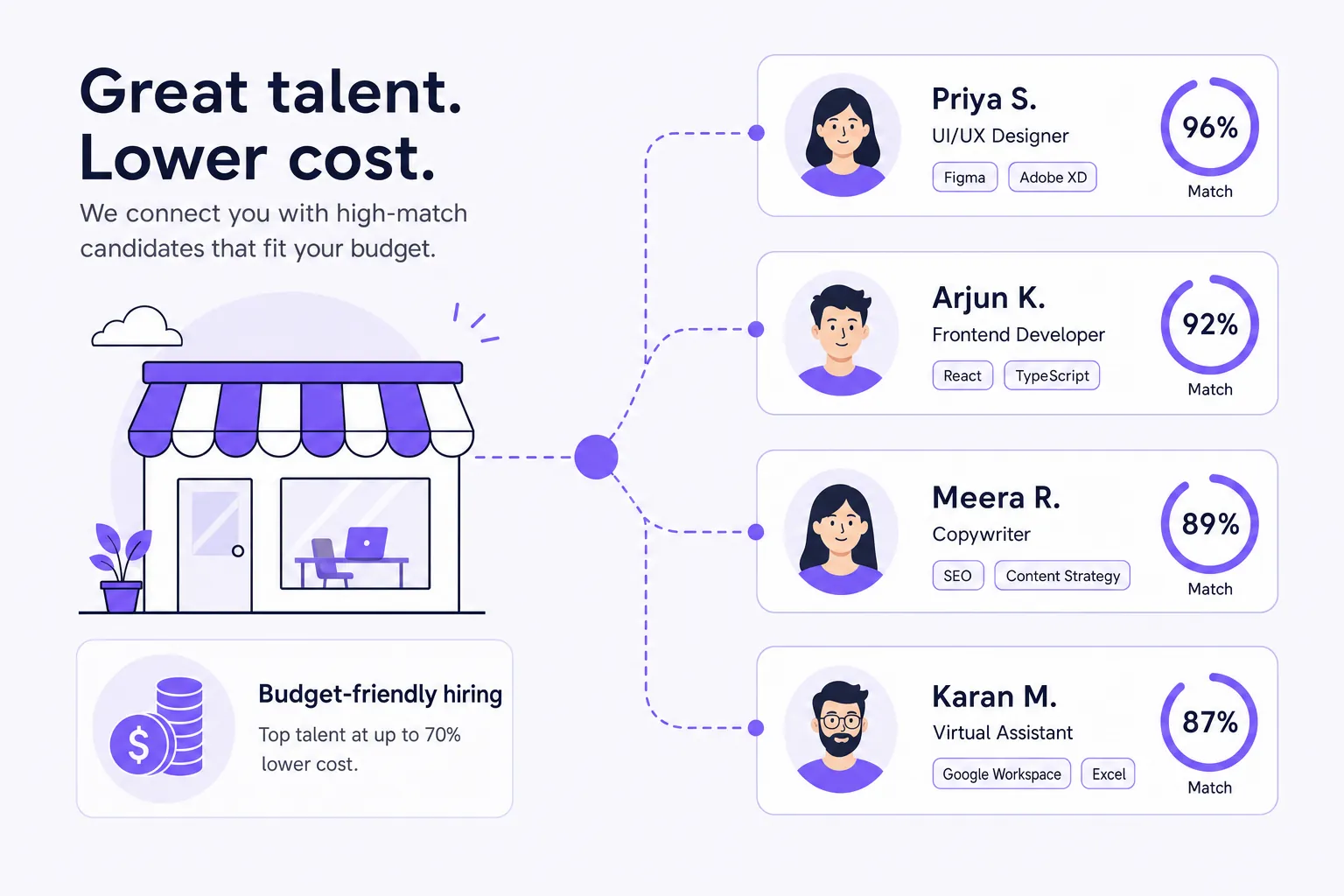
The fix isn't posting to more boards. It's posting somewhere the applicant pool is smaller but more relevant, and letting a ranking system do the sorting a human otherwise would. That's the exact gap AI matching (Jobedly's approach) is built to close — free to post, and it ranks whoever applies by fit instead of forcing you to read all two hundred in the order they arrived.
Where small employers actually find good hires
Referrals are still the most underused resource a small business already owns. Your current employees, your regular customers, your suppliers — all of them know people, and almost none of them think to mention an opening unless you ask directly and repeatedly. A short, specific ask ("we're hiring a part-time driver, know anyone?") posted on your own channels costs nothing and consistently outperforms a cold post on a general board.
Local and community channels are the second most skipped lever. A community Facebook group, a local trade association listserv, a bulletin board at a community college, a mention at a chamber of commerce meeting — these reach people already anchored to your area, which matters more for a role that can't be remote than any national board will.
Trade schools and community college career centers are worth a direct relationship if your role has any skilled-trade or technical component. They exist specifically to place students with local employers, and most have far fewer businesses reaching out than you'd expect — which means less competition for the same graduating class.
Free boards plus AI ranking
Free job boards paired with AI candidate ranking give a small employer access to the same surfacing logic a much bigger recruiting team would use, without hiring anyone to run it. You post once, applicants come in, and instead of reading them in the order they arrived, they're already ranked by fit. That turns the "200 resumes" problem from a chore into a shortlist.
Rehiring boomerangs — former employees who left on good terms — are the fastest hire a small business can make when the timing lines up. They already know the job, the systems, and the customers, and the reference check is your own memory of how they performed. A short list of "good people who left for good reasons" is worth keeping specifically for this.
Small-business hiring channels compared
There's no single best channel — it depends on how much time you have this week versus how much you can spend. Here's how the realistic options stack up for a business without a dedicated recruiting budget.
| Channel | Cost | Effort | Fit for small business |
|---|---|---|---|
| Employee/customer referrals | Free | Low — just ask | Excellent — highest quality-to-effort ratio |
| Free job board + AI ranking (Jobedly) | Free | Low — post once, ranking does the sorting | Excellent — scales without added headcount |
| Local/community boards & groups | Free | Low–medium | Strong for local, in-person roles |
| Trade school / career center partnerships | Free | Medium — relationship takes time to build | Strong for skilled-trade or technical roles |
| Rehiring past employees (boomerangs) | Free | Low — check your own list first | Excellent when timing lines up |
| Paid national job board | Low–medium | High — heavy manual sorting | Weak — pool too broad, too much noise |
| Hiring a recruiter | High (fee or % of salary) | Low for you, high cost | Rarely worth it below a certain hire volume |
How to compete when you can't win on salary
Most small businesses can't out-pay a larger competitor for the same role, and trying to compete purely on salary is usually a losing game. What actually moves a candidate's decision at this size is often something else entirely: schedule flexibility, a faster path to more responsibility, a shorter commute, or simply working for someone who'll actually know their name.
- Be explicit about flexibility if you have it — a fixed schedule at a big employer is a real pain point you can solve.
- Name the growth path honestly. "You'd be our third hire and would help shape how this role works" is a real pitch, not filler.
- Move fast. Small businesses can extend an offer in days where a larger company takes weeks — speed itself is a competitive advantage worth naming to the candidate.
- List pay anyway, even if it's not top of market. An unlisted range reads as evasive; a listed, honest range reads as a business that respects a candidate's time.
The U.S. Small Business Administration's guidance on hiring and managing employees is a solid baseline for the compliance side of this — worker classification, required postings, and recordkeeping — so the pitch you make doesn't outrun the paperwork behind it.
Unemployment has sat at a historically moderate 4.2% as of June 2026, which means a meaningful share of the people you'd want to hire are currently working somewhere else and not browsing boards. A referral ask or a warm local connection reaches that group; a generic posting mostly doesn't.
Post free — let AI ranking do the sorting for you
Jobedly's AI agents score every applicant against your role 0–100, so a small team can post once and review a shortlist instead of a pile.
Post a job freeBuilding a pipeline without a system to manage it
You don't need an applicant tracking system to keep a pipeline — you need a habit. A simple running list of "good candidates we didn't hire this time" and "good former employees" covers most of what a small business actually needs, and it turns your next opening into a five-minute phone call instead of a fresh search from zero.
The habit that makes this work is small and boring: after every hiring round, spend ten minutes writing down who was strong but not quite right, and why. That list is worth more six months from now than it feels like today, and it's the fastest re-hire you'll ever make if the next opening matches what they were good at.
Once applicants start coming in through whichever channel you've chosen, the next bottleneck is usually reading through them fast without missing the good ones — our guide on how to attract qualified applicants covers how to write the post itself so the people who do apply are worth your time, and active vs. passive candidate sourcing breaks down when it's worth reaching beyond people already looking.
Post once. Let the AI agents do the sorting.
Post a job free on Jobedly and our AI agents surface and rank qualified candidates 0–100 so you spend time on the shortlist, not the pile.
Post a job freeFrequently asked questions
How do small businesses find employees without a recruiter?
What's the fastest way to find employees for a small business?
Why did my job posting get so many unqualified applicants?
Is it worth paying for a job posting as a small business?
How can a small business compete with bigger employers for talent?
Should a small business rehire former employees?
Glossary
- Boomerang employee
- A former employee who left on good terms and returns to work for the same employer again later.
- Referral ask
- A direct, specific request to current employees, customers, or contacts to recommend someone for an open role, rather than waiting for it to happen unprompted.
- AI candidate ranking
- Automated scoring that orders applicants by fit to a role's requirements rather than by application timestamp.
- Non-salary lever
- A benefit a small employer can offer besides pay — flexibility, growth path, speed of hiring — used to compete for talent without matching a bigger company's salary.
- Post-and-pray hiring
- Posting a job with no targeting or filtering and hoping the right applicant surfaces on their own, typically producing high volume and low relevance.