Active vs Passive Candidate Sourcing: When to Use Each
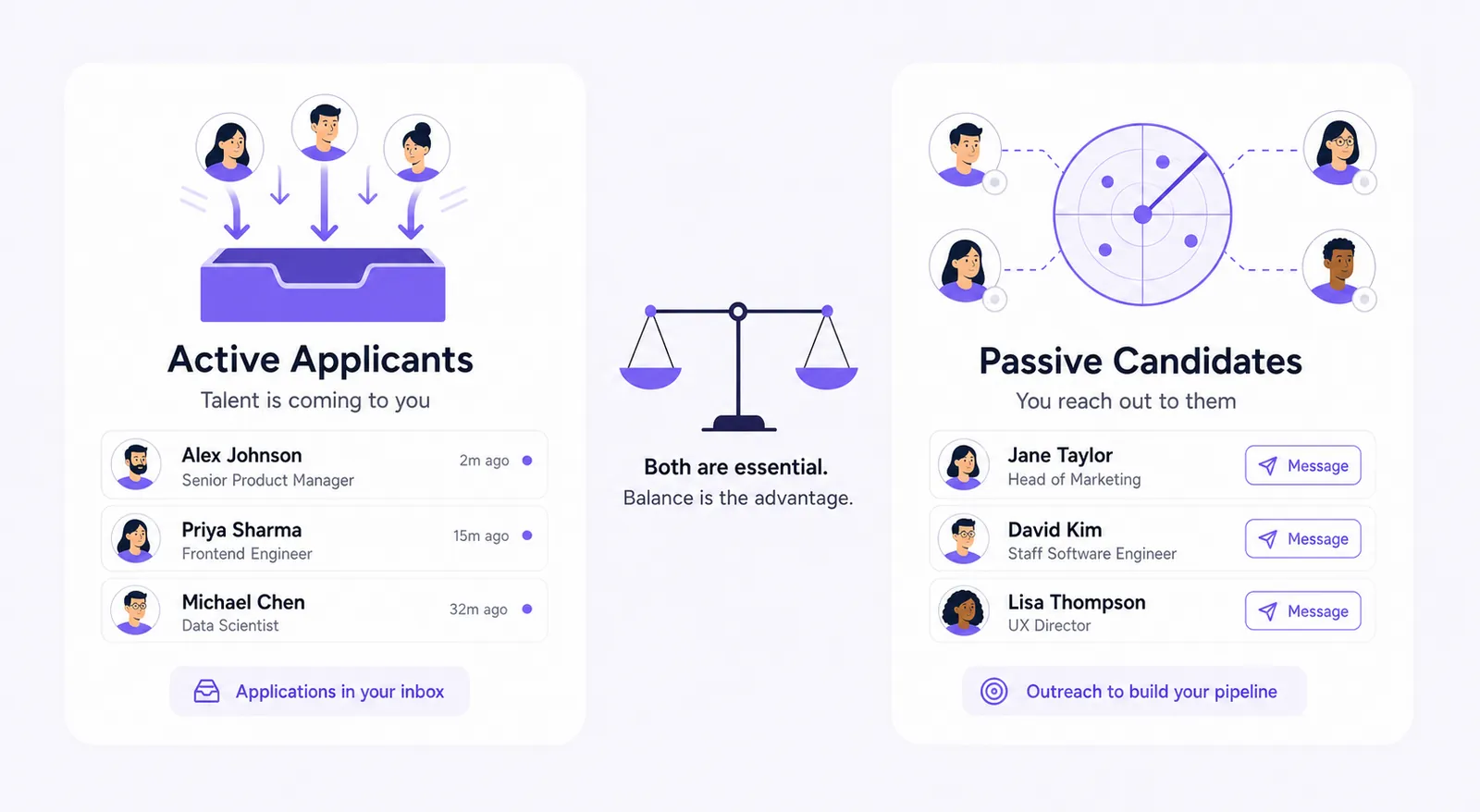
We once had two candidates for the same role, sourced two completely different ways. One found the posting on a Tuesday afternoon and applied within the hour. The other wasn't looking at all — a colleague mentioned the opening at a conference, and it took three follow-up messages before they'd even take a call. Both turned into strong hires. That's the whole tension in active vs passive candidate sourcing: the labels describe where someone is in their search, not how good they'll be at the job.
Getting this distinction right matters because active and passive sourcing cost different amounts of time and money, and using the wrong one for the situation wastes both. This page breaks the two apart cleanly, compares them across the dimensions that actually matter, and covers where our broader guide on how to find qualified candidates only touched the surface.
We'll cover what separates active from passive sourcing, the real cost and time tradeoffs, how AI ranking changes the math on a big active pool, and when passive outreach is genuinely worth the effort versus a waste of a Tuesday afternoon.
The actual distinction between active and passive sourcing
Active candidates are applying right now, browsing boards this week, or otherwise visibly in the market for a new role. Active sourcing means reaching them where they're already looking — a job posting, a board, a career page — and making sure your listing is easy to find and worth clicking.
Passive candidates are employed and not actively searching, but not unreachable either. Passive sourcing means going to find them — direct outreach, referrals, talent pools from past rounds, or matching technology that surfaces fit from background rather than search behavior. Nobody applies to a passive-sourced opening on their own; someone has to bring it to them.
Neither label says anything about quality. It says something about reachability and effort. A brilliant candidate who happens to be job-hunting this month is still an active candidate; a mediocre one who isn't looking is still passive. Confusing "passive" with "better" is where most of the bad advice on this topic comes from.
Active vs. passive sourcing compared
Here's how the two actually compare across the dimensions that decide which one is worth your time for a given role.
| Dimension | Active sourcing | Passive sourcing |
|---|---|---|
| Speed | Fast — candidates come to you | Slow — outreach, waiting, follow-up cycles |
| Cost | Low (free/paid posting) | Higher — time-intensive or paid tools/recruiter fees |
| Conversion rate | Higher — they're already motivated to move | Lower — most aren't looking and many won't engage |
| Effort per hire | Low, especially with AI ranking | High — manual research and personalized outreach |
| Candidate quality range | Wide — includes both strong and weak fits | Can be very strong per contact, but small sample |
| Best for | Most roles, most of the time | Hard-to-fill, senior, or highly specific roles |
The pattern worth noticing: active sourcing wins on speed, cost, and conversion almost every time. Passive sourcing wins on ceiling — the specific person you reach might be exactly right — but only if you can actually find and convince them, which is the expensive part.
When passive outreach is worth it — and when it's a waste
Passive outreach earns its cost when the role is genuinely hard to fill through normal channels — a narrow specialty, a senior position with a small qualified population, or a role where the ideal background is rare enough that waiting for an application is unrealistic. In those cases, the extra effort of direct, targeted outreach is buying you access to people who'd never see a posting otherwise.
It's a poor use of time for high-volume, more common roles. Cold-messaging people who aren't looking has a low response rate no matter how well the message is written — that's just the nature of interrupting someone who wasn't thinking about a job change. For a role that a solid active posting fills in a week or two, the math on spending days sourcing passively rarely works out.
Research from LinkedIn Talent Solutions has repeatedly found that a large majority of the workforce identifies as at least somewhat open to a new opportunity while not actively searching — which is the population passive sourcing exists to reach, and exactly the group a post-and-wait strategy never touches.
How AI ranking changes the active-sourcing math
The traditional objection to active sourcing at scale is volume: a popular posting can produce more applicants than a small team can realistically read, so quality gets buried under quantity and someone starts skimming. AI ranking removes that ceiling by scoring every applicant against the role the moment they apply, so a bigger active pool becomes an asset instead of a liability.
That shifts the calculation meaningfully: instead of narrowing your posting's reach to keep the applicant count manageable, you can widen it and let ranking do the sorting. A wider active pool, reviewed through a ranked shortlist, often out-performs a narrow, cautiously-targeted passive search — for a fraction of the time cost.
U.S. job openings sat at 7.594 million as of May 2026, per the Bureau of Labor Statistics — a labor market with that much active movement means the active pool for most roles is larger than employers assume, and increasingly usable once ranking handles the volume.
Widen your active pool without widening your workload
Jobedly's AI agents rank every applicant 0–100 the moment they apply, so a bigger active pool means a better shortlist, not more reading.
Find candidates with AIChoosing the right mix for your role
Most hiring rounds do best with active sourcing as the default and passive outreach as a deliberate, occasional supplement — not the reverse. Start with a well-written, ranked active posting. Reserve passive effort — referrals, direct outreach, talent pools — for roles where active sourcing alone has genuinely stalled, not as a first move out of habit.
- Common role, healthy applicant volume expected → active sourcing, AI-ranked.
- Rare skill set, small qualified population → active posting plus targeted passive outreach in parallel.
- Active posting has run for weeks with no fit → escalate to passive outreach and referrals.
- Senior or highly specific role → passive sourcing earns its cost from the start.
If you're a small team without dedicated sourcing headcount, our guide on how to find employees for a small business covers which of these channels are realistic without a recruiter. And once applicants start arriving through whichever mix you choose, how to attract qualified applicants covers making sure the posting itself is pulling in the right people, not just more of them.
Post once. Let the AI agents do the sorting.
Post a job free on Jobedly and our AI agents surface and rank qualified candidates 0–100 so you spend time on the shortlist, not the pile.
Post a job freeFrequently asked questions
What is the difference between active and passive candidate sourcing?
Is passive sourcing more effective than active sourcing?
How do you passively source candidates?
Do passive candidates take longer to hire than active ones?
Should small businesses bother with passive candidate sourcing?
Can AI matching find passive candidates too?
Glossary
- Active candidate
- A job seeker currently and visibly searching for a new role — applying to postings, browsing boards, updating profiles.
- Passive candidate
- A person not actively job-hunting who could still be a strong fit if reached directly with the right opportunity.
- Candidate sourcing
- The process of identifying and reaching potential candidates, active or passive, as distinct from screening or interviewing them once found.
- Talent pool
- A maintained list of past applicants or contacts who were strong but not selected, kept warm for future openings.
- AI candidate ranking
- Automated scoring that orders applicants by fit to a role's requirements rather than by application timestamp.