How to Attract Qualified Applicants (Not Just More)
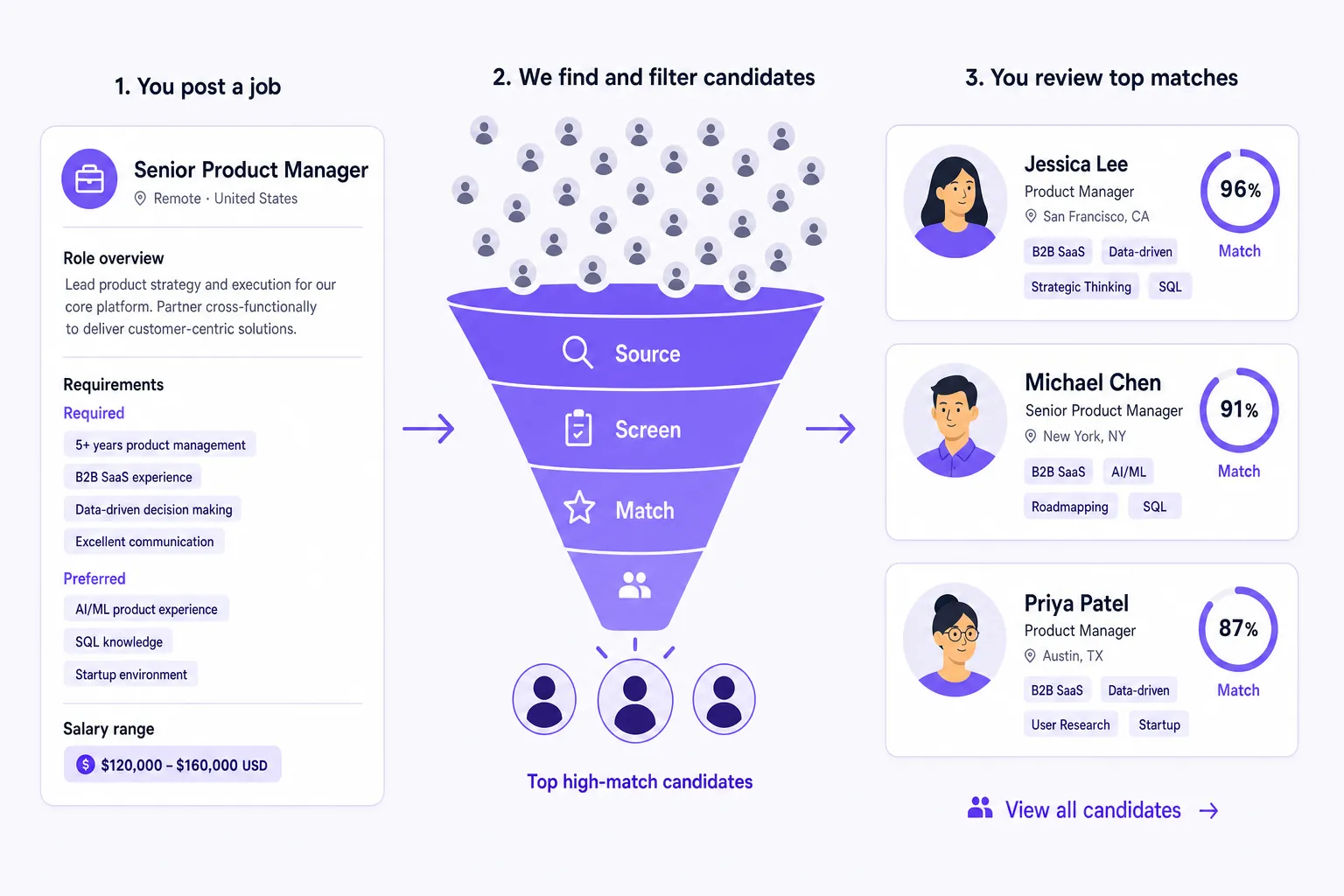
A hiring manager once told us their posting was "working great" because they had ninety applicants in three days. Ninety applicants and zero people worth interviewing, as it turned out. That's the trap in chasing volume: it feels like success right up until you actually open the pile. How to attract qualified applicants is fundamentally a different goal than attracting more applicants, and optimizing for the wrong one is how postings like that happen.
Quality and quantity aren't the same lever, and they sometimes pull in opposite directions — a tighter, more specific post will often produce fewer total applicants and a dramatically higher share of good ones. This page is the deep dive our broader guide on how to find qualified candidates only summarized: exactly which changes to a posting move the needle on who applies, not just how many.
We'll cover why vague, kitchen-sink postings attract noise, the specific effect of salary transparency on applicant quality, the signals that filter for real fit, and why response speed matters more than most employers assume.
Why vague, kitchen-sink postings attract noise
A posting stitched together by five stakeholders who each added their own must-have reads like a wish list, not a real bar. Qualified candidates who don't meet every line — even ones that were never actually essential — self-select out. Meanwhile, unqualified applicants who ignore requirements entirely apply anyway, because they had nothing to lose by trying. The kitchen-sink posting filters out exactly the wrong group.
Vague titles compound the problem. "Growth Ninja" or "Rockstar Associate" doesn't tell a search algorithm or a human what the job is, so it either gets buried in search results or attracts people responding to the vibe of the title rather than the actual work. A plain, accurate title consistently outperforms a clever one for attracting the right applicants.
The fix isn't writing a longer post to cover every base — it's writing a shorter, more accurate one. Cut the requirements list to what's genuinely non-negotiable, name the role plainly, and describe the actual day-to-day work instead of the department's five-year vision. Every extra line in a requirements section is a chance to filter out someone who could have done the job well.
What salary transparency actually does to applicant quality
Listing pay does two things at once, and both improve quality. First, it screens out candidates whose expectations are far outside your range before they spend time applying — saving both sides a mismatched conversation. Second, it signals to strong candidates — who typically have options and won't gamble their time on an unknown — that the posting is worth the effort. An unlisted range reads as evasive to exactly the people you most want to apply.
This is one of the more consistent findings in hiring research: transparency doesn't just change how many people apply, it changes who bothers to. Candidates weighing several open postings tend to deprioritize the ones without a listed range, all else equal, because the range-less posting carries more risk for the same time investment.
SHRM has tracked the broader shift toward pay transparency across states and employers, driven partly by law and partly by candidate expectation — and the practical effect for hiring quality holds regardless of which pushed it: transparent postings draw a better-matched pool.
Post changes and their effect on applicant quality
Here's the honest version of what changes actually move the needle, based on what we've watched happen when employers rewrite a struggling posting.
| Change made | Effect on applicant quality |
|---|---|
| Add a real, honest pay range | Fewer mismatched applicants; more strong candidates willing to apply |
| Split requirements into required vs. preferred | Qualified people who lack a "nice to have" stop self-eliminating |
| Replace a vague/clever title with a plain, accurate one | Better search visibility; fewer vibe-based applicants |
| Cut the requirements list from 15 lines to 5 | Fewer unqualified applicants deterred by nothing left to guess at; fewer qualified people scared off |
| Describe actual daily work, not department mission | Applicants self-select based on real fit, not marketing language |
| Respond within 48 hours instead of weeks | Higher offer-acceptance rate among the strongest candidates |
Employer signals that filter for fit
Beyond the posting text itself, a handful of signals tell a candidate whether this employer is worth the effort of applying — and the absence of those signals filters out exactly the candidates with better options.
Required vs. preferred qualifications
- Clearly separate what's truly required from what's merely preferred — don't bury "nice to have" inside a single undifferentiated list.
- State the required list first, and keep it to three to five items, maximum.
- Frame preferred qualifications as a plus, not a filter — language like "bonus if you have" invites people who are missing it to still apply.
Response speed is an underrated signal. A candidate who hears back within a day or two reads that as a well-run process; one who hears nothing for three weeks reasonably assumes the opposite, and the strongest candidates — who usually have other conversations going — are the most likely to simply move on. Speed doesn't just help conversion; it's itself a quality filter, because the candidates worth chasing are the ones with somewhere else to be.
Post a clear, honest job free
Jobedly lets you post free and our AI agents rank whoever applies 0–100 against the role — so a tighter, more honest posting gets even easier to act on.
Post a job freePutting quality-first posting into practice
None of this requires more time than writing a vague post — it requires different choices inside the same amount of time. Trim before you publish, not after you're drowning in applicants. Decide your true must-haves before the first resume arrives, not while reading the fortieth one.
If you're a small team without a dedicated recruiting function, our guide on how to find employees for a small business covers the channel side of this same problem — where to post, not just what to write. And if your posting is solid but volume is still thin, active vs. passive candidate sourcing covers when it's worth reaching beyond people actively browsing boards.
Once a tighter posting is pulling in the right people, the next problem is usually reading them efficiently rather than exhaustively — worth revisiting once you've made these changes and are seeing a smaller, sharper pile land in your inbox.
Post once. Let the AI agents do the sorting.
Post a job free on Jobedly and our AI agents surface and rank qualified candidates 0–100 so you spend time on the shortlist, not the pile.
Post a job freeFrequently asked questions
How do I attract more qualified applicants without getting flooded with unqualified ones?
Does listing salary attract better applicants?
Should I separate required and preferred qualifications in a job post?
Why do vague job titles attract the wrong applicants?
Does response speed affect the quality of who accepts an offer?
Is it bad to get fewer applicants after rewriting a job posting?
Glossary
- Required qualification
- A truly non-negotiable skill or credential a candidate must have to be considered, as distinct from a preferred qualification.
- Preferred qualification
- A qualification that's a plus but not disqualifying if absent — should be labeled separately from required qualifications, not bundled together.
- Salary transparency
- The practice of listing a real pay range in a job posting, shown to affect both the number and quality of applicants.
- Kitchen-sink job posting
- A posting with an overloaded requirements list assembled from multiple stakeholders' individual must-haves, which tends to filter out qualified candidates while failing to filter out unqualified ones.
- Applicant quality
- The share of applicants to a posting who are genuinely qualified and worth evaluating, as distinct from raw applicant volume.