Best Free Job Posting Sites (and What Each Is Good For)
We once had a client ask why their job wasn't showing up anywhere, only to find it live on three separate boards — just not where they were looking for it. That's the thing about free job posting sites: there isn't one "free," there are half a dozen different versions of it, and each comes with its own rules about who actually sees your listing. Our guide to posting a job for free covers the general strategy; this page is the channel-by-channel breakdown that guide only had room to summarize.
Some of these sites are free because a bigger company subsidizes them by selling upgrades to your competitors. Some are free because they're aggregators pulling your listing in from somewhere else entirely. A couple are free in name but functionally throttled until you pay. None of that makes them useless — it just means you need to know which game you're playing before you pick a channel and walk away.
Below is what we've actually seen happen on each major free channel: Jobedly, Indeed's free tier, Google for Jobs, LinkedIn, Facebook/Marketplace, ZipRecruiter's trial, state workforce boards, niche boards, and plain old referrals. Same job, different outcome depending on where you sent it.
The free channels, compared side by side
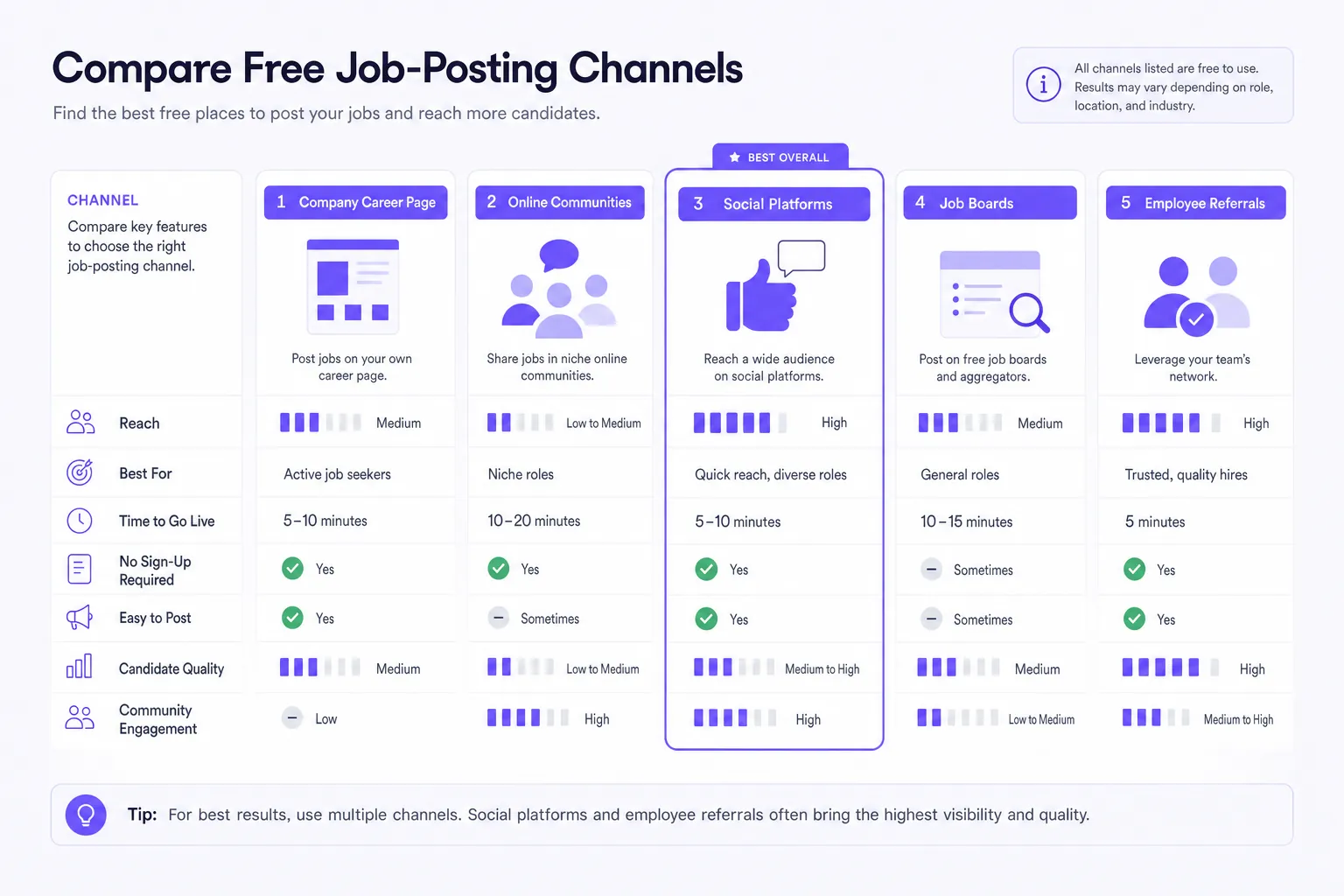
Before picking a channel, it helps to see them next to each other rather than one at a time in isolation — because the tradeoffs only make sense in contrast.
| Channel | Best for | Real cost / limits | Applicant quality |
|---|---|---|---|
| Jobedly | Any role, especially when you want ranked applicants | Free, unlimited postings | AI-ranked from the first applicant, not just raw volume |
| Indeed (free tier) | High-volume, common titles | Free, but sponsored posts outrank you and visibility fades over days | High volume, mixed quality — you do the filtering |
| Google for Jobs | Careers pages / boards with valid structured data | Free — it's aggregation, not a direct post | Depends entirely on the source listing's quality |
| LinkedIn (free share) | Roles where your network is relevant | Free, but it's a feed post, not a real job slot | Small pool, often warmer/referral-adjacent |
| Facebook / Marketplace Jobs | Local, hourly, retail, food service roles | Free, limited targeting without ad spend | Local and fast, uneven qualification |
| ZipRecruiter (free trial) | Short-term test of reach before paying | "Free" is a time-boxed trial, not an ongoing free tier | Reasonable during trial, then paywalled |
| State workforce boards | Roles eligible for local workforce programs | Free, sometimes tied to unemployment-benefit requirements | Steady but narrower, often overlooked by other employers |
| Niche / industry boards | Licensed, specialized, or trade-specific roles | Often free for a basic listing | Small pool, but pre-qualified by nature |
| Referrals | Any role, especially hard-to-fill ones | Free, costs relationship capital and follow-up time | Consistently the highest quality per applicant |
Where "free" quietly has strings attached
"Free" almost always means free to publish. It rarely means free to be seen equally alongside paid competitors. Knowing the specific string attached to each channel saves you from blaming the wrong thing when applicants don't show up.
- Indeed: your free post is real and searchable, but sponsored listings from competitors for the same title sit above you, and organic visibility tends to fade the longer the post sits unrefreshed.
- ZipRecruiter: the free period is a trial window, not a standing free tier — plan around it ending, not around it staying free.
- LinkedIn: a free "post" is a feed update, not entry into LinkedIn's actual job-matching system. Don't confuse reach with placement.
- Facebook/Marketplace: free organic reach exists but is unevenly distributed by Facebook's own algorithm — some posts get real traction, others sit almost invisible with no clear reason why.
- State workforce boards: genuinely free, but some job seekers are directed there as part of unemployment-benefit requirements rather than by active interest in your specific role — applicant intent varies more than on general boards.
The one channel on this list where free doesn't quietly mean "deprioritized" is Jobedly, since there's no paid tier competing against you for placement — every post gets AI-ranked applicant flow without a pay-to-win layer sitting on top of it.
It's worth sizing the actual market you're competing in before picking channels. U.S. job openings sat at 7.594M in May 2026 according to the Bureau of Labor Statistics' JOLTS report, and unemployment held at 4.2% the following month per the BLS Employment Situation report. Read together, that's a labor market with a lot of open roles but relatively few idle job seekers — which is exactly the environment where free channels that reach passive or semi-active candidates (referrals, niche boards, AI matching) start to outperform channels that only reach people actively browsing that day.
Post free without the pay-to-win layer
Jobedly's free post doesn't compete against a sponsored version of itself. Post once and let the AI agents rank who applies.
Post a job freeThe quality myth
Where paying genuinely helps is narrower than most employers assume: extremely saturated titles in competitive metro markets, or a hard deadline where you can't afford to wait out organic reach. Outside those two situations, the free channels above cover most small and mid-size hiring needs without a placement fee attached.
Combining channels without wasting your afternoon
You don't need all nine channels. You need two or three that match the role, run at the same time, with the listing written once and adapted, not rewritten from scratch for each one.
- Write the full listing once — title, pay range, responsibilities, requirements, apply method — before touching any platform.
- Post free on Jobedly first so applicant ranking starts on day one instead of after you've manually sorted a pile elsewhere.
- Add your highest-reach general board (typically Indeed) with fields filled in structured, not pasted as a blob.
- Layer in one local or niche channel that matches the role — Facebook for local/hourly, an industry board for licensed or specialized work.
- Ask for referrals explicitly the same day you post. Don't treat it as a backup; treat it as a parallel channel.
Job openings remain historically elevated — BLS Job Openings and Labor Turnover Survey put U.S. job openings at 7.594M in May 2026 — so a single-channel strategy is competing against a lot of noise. Running two or three free channels in parallel, written once and posted everywhere, is the most efficient way we've found to cut through that without spending on placement.
When paying actually pays off
There's a point where free stops being the efficient choice, and it's worth naming honestly rather than pretending free always wins. If a role has sat for two or three weeks across multiple free channels with genuinely low response — not just slow, but flat — sponsoring one post on your highest-traffic board for a short, defined window is a reasonable next move, not a failure.
The mistake is reaching for paid promotion first, before checking whether the listing itself is the actual problem. A vague title, a missing pay range, or an inflated requirements list will underperform on a paid post exactly the way it does on a free one — paying just makes the underperformance more expensive to watch.
Our step-by-step breakdown of posting a job on Indeed for free covers exactly when sponsoring on that specific board is worth the spend, and what to fix before you ever get there.
Getting your free listing to show up on Google
A detail that trips up a lot of employers: several of the boards above feed into Google for Jobs automatically, which multiplies your free reach without any extra posting work — but only if the board emits valid structured job data. Boards that don't handle this well leave your listing invisible outside their own on-site search, even though it's technically live.
We cover the mechanics of that — the specific schema fields, common validation mistakes, and how to check whether your listing is actually indexed — in how to get your job on Google for Jobs, since it's the single biggest source of free, passive reach most employers never verify.
Picking your combination by role type
The right combination genuinely depends on the role, and treating every opening the same way is where a lot of the wasted afternoon comes from. A few patterns hold up consistently across the employers we've watched go through this.
- Common local roles (retail, food service, warehouse): Jobedly plus Indeed plus Facebook covers most of the reachable pool without spending anything.
- Skilled trades or licensed roles: a niche/industry board plus referrals usually outperforms general boards, even at lower total volume.
- Office and administrative roles: Indeed plus Jobedly plus a LinkedIn share tends to cover both active searchers and your own warm network.
- Roles eligible for workforce programs: add your state workforce board to the mix — it's an overlooked free channel that rarely competes with your other postings for the same applicants.
- Anything hard to fill regardless of category: referrals deserve more deliberate effort than a single ask — follow up, and make it easy for people to actually refer someone.
None of this requires software to plan. It requires deciding, before you post anywhere, which two or three channels actually fit the role — then running them in parallel instead of trying one, waiting a week, and starting over on the next.
Post once. Let the AI agents do the sorting.
Post a job free on Jobedly and our AI agents surface and rank qualified candidates 0–100 so you spend time on the shortlist, not the pile.
Post a job freeFrequently asked questions
What is the best free job posting site for a small business?
Are free job posting sites actually free, or is there a catch?
How many free job boards should I post to at once?
Does posting for free hurt my visibility compared to paying?
Can I post the same job on multiple free sites at the same time?
Do free job posting sites work for hard-to-fill or specialized roles?
Glossary
- Free tier
- The no-cost version of a job board's posting product, typically ranked below sponsored or paid listings in that board's own search results.
- Aggregator
- A platform, like Google for Jobs, that pulls job listings in from other sites rather than accepting direct postings.
- Sponsored post
- A paid listing that ranks above free listings for the same or similar search terms on a given board.
- Applicant flow
- The stream of applications a posting generates over time, which still requires review regardless of whether the posting was free.
- AI candidate ranking
- Automated scoring of applicants against a role's requirements, used to prioritize review order instead of reading every resume as it arrives.